
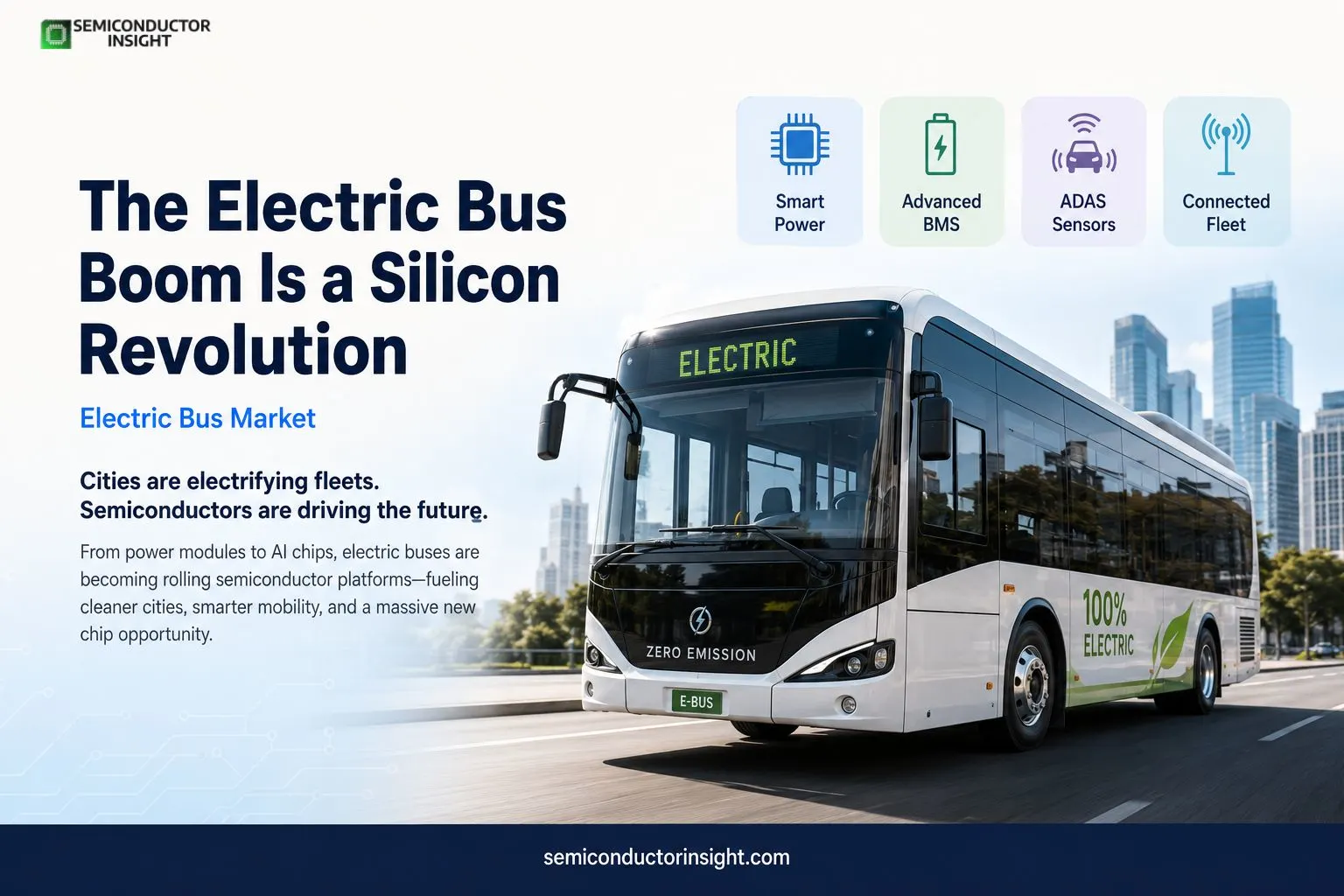
Electric Buses in 2026: The Semiconductor Surge Behind 30,000 New EVs on City Streets
An electric bus gliding silently through a city intersection doesn’t draw much attention anymore. It’s just another part of the urban hum, a long box on wheels that happens to be quieter than its diesel predecessor. But inside that bus, hidden beneath passenger seats and behind driver consoles, is a semiconductor ecosystem that didn’t exist at scale five years ago. Power modules switching at kilohertz frequencies, battery management ICs sampling cell voltages a hundred times a second, radar and camera processors building a real-time map of pedestrians and cyclists, telematics chips uploading performance data to fleet management clouds-this is not a bus with an electric motor bolted on. It is a rolling semiconductor platform, and in 2026 it is being ordered in the tens of thousands by cities from Delhi to Munich to Dubai.
The numbers coming out of municipal transport agencies this year tell a story of acceleration. Delhi, already operating one of the largest electric bus fleets outside China, flagged off another 500 buses in February 2026, pushing its total to 4,286 with a target of 7,500 by year-end. In April it added another 200 and launched an interstate Delhi–Rohtak service, extending electric bus range beyond the urban core. That single city’s procurement program represents millions of dollars in semiconductor content: insulated-gate bipolar transistor modules for traction inverters, microcontroller units for vehicle control, power management ICs for dozens of auxiliary systems, and the sensor suites that enable driver assistance. Multiply Delhi by the dozens of other cities now buying electric buses-Mumbai, Bangalore, Hyderabad, and the smaller state capitals covered under India’s FAME subsidy scheme-and the semiconductor demand becomes a meaningful line item on the global automotive chip ledger.
India is not an isolated case. In Dubai, the Roads and Transport Authority unveiled new Zhongtong electric buses in 2026, signaling the Gulf region’s growing appetite for zero-emission public transport. These buses are air-conditioned fortresses designed to operate in fifty-degree ambient heat, which places extraordinary demands on the thermal management system. The compressors, coolant pumps, and fan arrays are all driven by power semiconductors that must operate reliably at elevated temperatures, a specification that favors silicon carbide devices over traditional silicon IGBTs. SiC MOSFETs, with their wider bandgap and higher thermal conductivity, are increasingly being designed into bus traction inverters and HVAC power stages. The Dubai deployment, while modest in unit count, points toward a regional market-Saudi Arabia, Qatar, Kuwait-that will need high-temperature-capable electric buses for decades.
In Europe, the electric bus story is becoming intertwined with autonomy. Munich’s MAN and Münchner Verkehrsgesellschaft (MVG) have advanced an autonomous electric bus pilot, with real-world trial operations expected from autumn 2026. An autonomous electric bus amplifies the semiconductor content exponentially. Beyond the standard electric drivetrain chips, it requires lidar and radar sensor processors, high-definition camera pipelines, a central compute platform running perception and path-planning algorithms, and a redundant safety controller that can bring the bus to a stop if any primary system fails. Each of these subsystems is built around advanced system-on-chip devices-likely from Mobileye, NVIDIA, or Qualcomm-fabricated on leading-edge or near-leading-edge process nodes. The semiconductor value in an autonomous electric bus could be three to five times that of a conventional electric bus, and while volumes will be low for the rest of this decade, the learning and validation from pilots like Munich’s will shape the architectures of the 2030s.
Not all electric bus development is battery-electric. Hyundai launched the 2026 Universe hydrogen-electric bus, a long-distance intercity vehicle with a claimed range of up to 960.4 kilometers per fueling. Hydrogen fuel cell buses introduce a different semiconductor profile: fuel cell stack controllers that monitor hundreds of individual cell voltages, hydrogen sensors, high-voltage DC-DC converters, and a battery buffer that still requires a full battery management system. The Universe is aimed at intercity routes where battery-electric buses struggle with range, and it demonstrates that the semiconductor industry’s addressable market in heavy transport extends across multiple zero-emission powertrain architectures.
On the manufacturing side, Switch Mobility-the electric vehicle arm of Ashok Leyland-launched the EiV9 electric bus at the Prawaas 5.0 expo in July 2026. The EiV9 is designed for city transit, employee transport, and school mobility, three segments that together account for a large share of India’s commercial bus fleet. Each new model introduction like the EiV9 is a signal to semiconductor suppliers: tool up for another vehicle platform, qualify another set of chips, prepare for another production ramp. The fragmentation of the electric bus market-with different OEMs in India, China, Europe, and North America each developing their own platforms-means that semiconductor demand is broad-based, not concentrated in a few global platforms as with passenger cars. For chipmakers, this fragmentation is a double-edged sword: more design-in opportunities, but also more qualification overhead.
The fleet operators themselves are also becoming more visible. Zingbus, an Indian intercity electric bus startup, announced plans to deploy 50 electric buses in 2026 and scale to 1,000 by 2030. Intercity electric bus operation places a premium on battery range and reliability, as a breakdown between cities is far more disruptive than a failure on a short urban loop. This operational model pushes the semiconductor specification toward higher reliability grades, potentially up to automotive safety integrity level B or C for the powertrain control and battery management systems. Chips that meet these standards carry a higher price and margin, improving the semiconductor revenue per bus for suppliers that have already done the costly qualification work.
Across all these deployments, a few key semiconductor categories stand out as the biggest beneficiaries. Traction inverter power modules-silicon IGBTs today, silicon carbide tomorrow-represent the single highest-value chip content. Battery management system ICs, which monitor and balance hundreds of lithium-ion cells, are the second category, often requiring dedicated analog front-end chips and a host microcontroller. Sensors and processors for advanced driver-assistance systems (ADAS) are the third category, growing in importance as electric buses are increasingly specified with pedestrian detection, blind-spot monitoring, and driver alertness monitoring. Connectivity chips-cellular modems, Wi-Fi, Bluetooth, and vehicle-to-everything (V2X)-are the fourth category, enabling the fleet telematics that allow operators to optimise charging schedules and track vehicle health in real time. Together, these four categories can account for several thousand dollars of semiconductor content per bus, a figure that is rising as bus specifications become more demanding.
The geographic distribution of this demand is shifting as well. China remains the largest electric bus market by unit volume, but the growth rate there is slowing as the fleet approaches saturation. India is the fastest-growing market, driven by a combination of government subsidies, urban pollution concerns, and a domestic manufacturing push. Europe is the highest-value market per bus, thanks to its stringent safety and emissions regulations and the early adoption of autonomous pilots. The Middle East is an emerging market with specific environmental requirements. North America, where electric bus adoption has been slower, is accelerating under the Federal Transit Administration’s Low-No program, which provides grants for zero-emission buses. For semiconductor companies allocating R&D resources, understanding this geographic mix is essential: India drives volumes that justify chip development, Europe drives the specifications that define performance requirements, and the Middle East drives the ruggedisation that ensures reliability in extreme conditions.
The electric bus story in 2026 is therefore not just about transport policy or climate goals, though those are the surface narratives. Beneath them, it is a semiconductor demand story of increasing sophistication and scale. Every bus that Delhi adds to its streets, every autonomous pilot that Munich launches, every hydrogen bus that Hyundai sells, and every intercity route that Zingbus opens is a rolling contract for the chip industry. The buses may be quiet on the outside, but inside, they are singing with silicon.
Explore our related report: https://semiconductorinsight.com/report/ev-electronic-components-market/

Comments (0)