

EEPROM vs. Flash Memory in 2026: Which Storage Architecture Fits Secure Embedded Applications Better?
Flash memory has traditionally been associated with storing firmware, configuration information and persistent data. That role is changing as connected electronics become increasingly dependent on software. A compromised firmware image can affect everything from an industrial controller to an automotive electronic control unit, making the protection of stored code an important part of the semiconductor security architecture.
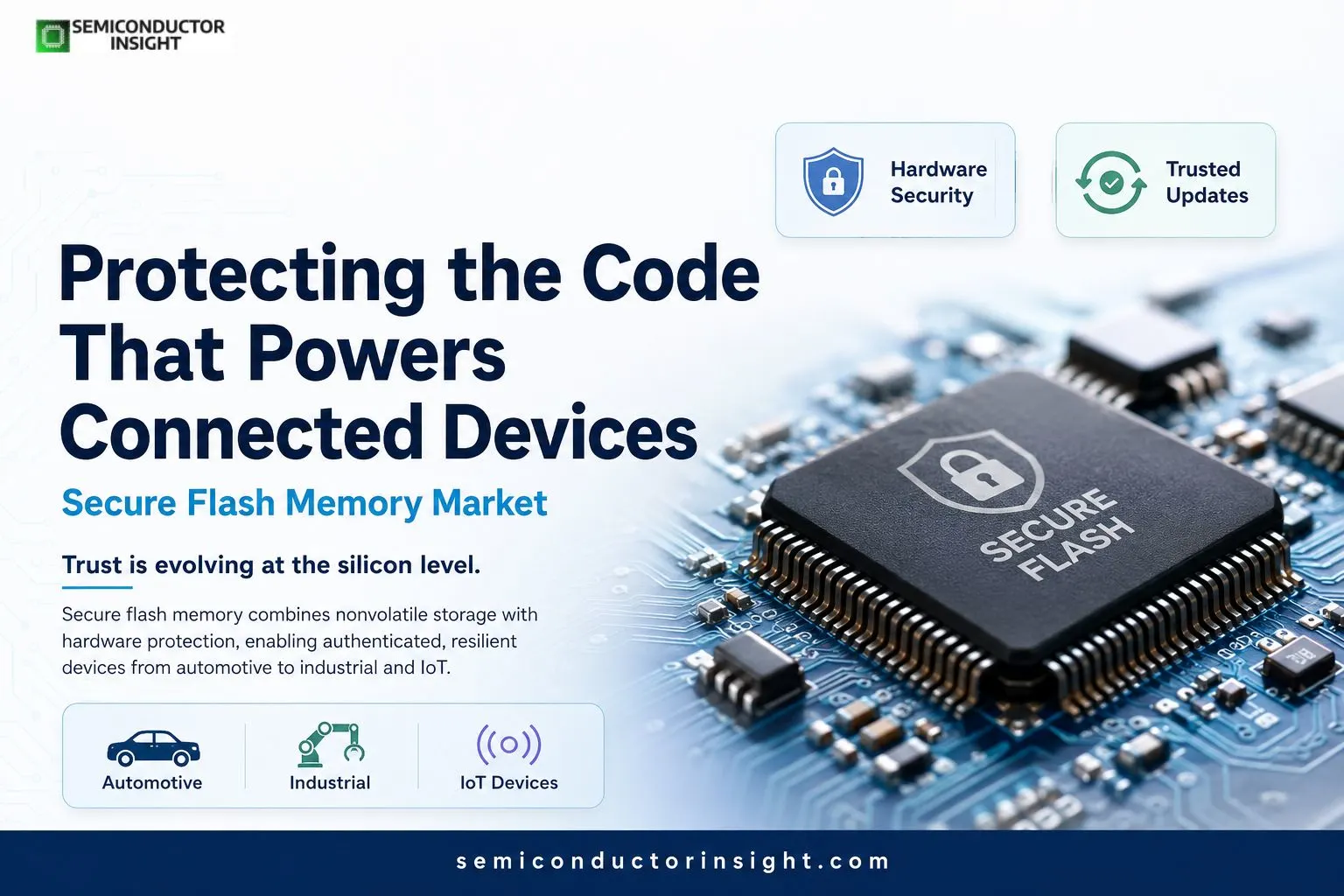
The secure flash memory market sits at this intersection of nonvolatile storage and hardware-assisted protection. Modern implementations can combine memory with features such as access control, protected regions, authentication mechanisms, secure boot support, encryption-related functions and mechanisms designed to prevent unauthorized modification.
Why Ordinary Storage Is No Longer Enough?
- A conventional memory device answers one basic question where should data be stored? Secure memory has to answer several more: who can access it, whether it has been modified, and whether the system should trust what it contains.
- This distinction is becoming increasingly relevant as manufacturers build products that receive firmware updates throughout their operating lives.
- Microchip, for example, provides flash-memory features including code protection, memory-section access protection, self-programming and storage areas that can be separated from executable program memory.
- That means memory architecture is becoming part of the device’s security boundary rather than simply its storage subsystem.
Leading Metrics Driving Advances in Memory Performance and Stability
Memory selection also depends heavily on endurance and retention. These characteristics become particularly important in embedded equipment expected to operate for years.
Microchip specifications for different microcontroller families show examples of 100,000 EEPROM erase/write cycles, while program flash ratings can range from 1,000 to 10,000 cycles, depending on the device. Several documented devices specify approximately 40 years of characteristic data retention under stated conditions.
These figures should not be treated as universal specifications for every flash or EEPROM product. They illustrate why engineers must match the memory technology to the frequency and nature of data updates.
EEPROM vs. Flash Memory
The difference becomes clearer when looking at how the two technologies handle data.
EEPROM is designed for relatively granular data modification. Flash memory generally operates around larger erase units, making it more suitable for storing firmware and larger blocks of persistent information. Microchip’s technical documentation describes EEPROM as supporting byte-level reading and writing, while flash programming commonly involves page or row operations.
A practical engineering comparison looks like this:
EEPROM → frequent small configuration changes → calibration data → counters → device settings
Flash → firmware → larger data blocks → boot images → application code
For secure applications, however, the choice is no longer simply EEPROM versus flash. Designers increasingly evaluate whether the memory includes appropriate protection mechanisms and whether those mechanisms integrate cleanly with the processor’s secure-boot and firmware-update architecture.
Automotive Electronics Are Raising the Bar
- Connected vehicles provide a particularly demanding environment for secure nonvolatile memory.
- Automotive controllers can contain software responsible for power management, body electronics, connectivity, sensing and other functions. As vehicles receive more software updates, protecting stored firmware becomes increasingly important.
- JEDEC currently lists flash memory among its major standards areas and has an upcoming Automotive Electronics Forum scheduled for September 17, 2026, reflecting the continuing importance of standardized memory and semiconductor technologies within automotive electronics.
- The requirement is straightforward: an electronic control system should be able to distinguish legitimate software from unauthorized code before that software is allowed to execute.
Secure Storage Is Following the Edge
The same principle extends beyond vehicles. Industrial controllers, smart meters, networking equipment, medical electronics, consumer devices and IoT endpoints increasingly operate outside tightly controlled data-center environments.
An edge device may spend years in the field while receiving software updates remotely. Secure memory therefore becomes useful for protecting firmware, cryptographic material, configuration information and device-specific credentials. The closer computing moves toward the physical environment, the more important it becomes to establish trust at the hardware level.
To find out more, feel free to browse our latest updated report: https://semiconductorinsight.com/report/secure-flash-memory-market/
The New Design Equation
The emerging design process can be viewed simply:
Connected device → Persistent software → Remote update capability → Security verification → Protected nonvolatile storage
This sequence explains why secure flash is becoming more than a memory category. Engineers are increasingly evaluating endurance, retention, access control, update mechanisms and hardware security together.
The result is a shift in semiconductor design philosophy. Memory is no longer merely where a device keeps its software after power is removed. In many connected systems, it is becoming one of the places where the device establishes what software, data and identities it can trust.

Comments (0)