
EEPROM vs. EPROM Memory for Automotive Electronics Market 2026: Which Technology Delivers Better Reliability?
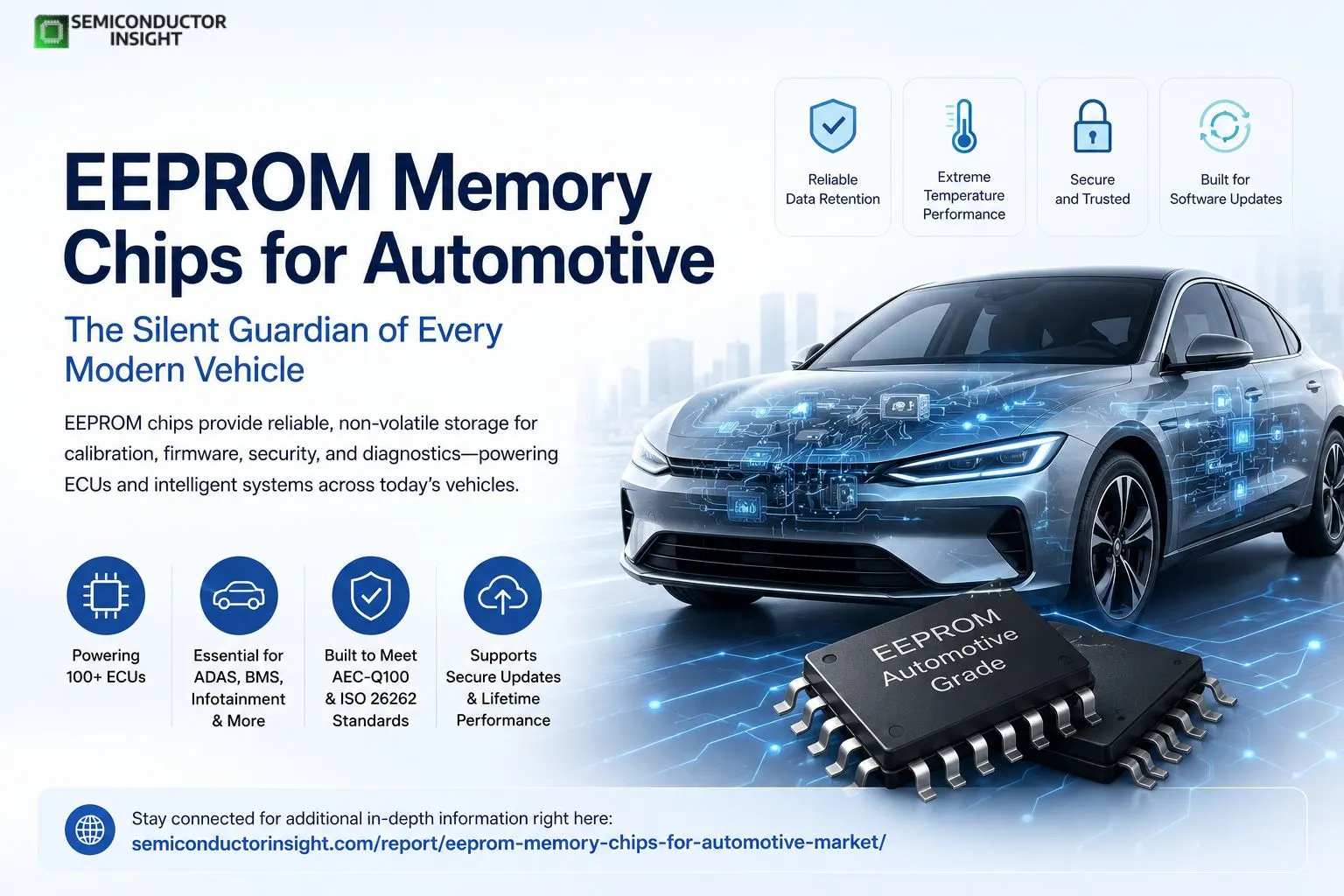
Modern automobiles no longer rely solely on mechanical engineering. Today’s passenger cars, commercial vehicles, and electric platforms integrate hundreds of semiconductor components that continuously store, process, and update critical information. At the center of this digital transformation, EEPROM (Electrically Erasable Programmable Read-Only Memory) chips provide dependable non-volatile storage for calibration settings, firmware parameters, security credentials, and diagnostic records.
This means that you can change individual bytes without affecting the rest of the data. Regular memories require the whole memory to be rewritten. Therefore, EEPROM is now a crucial component for automotive electronic control units (ECUs), battery management systems, infotainment modules, advanced driver assistance systems (ADAS), and vehicle networking applications, where reliability over the entire life of a vehicle is paramount.
Digital Vehicles Depend on Persistent Memory More Than Ever
- The rapid adoption of software-defined vehicles has significantly increased the demand for embedded memory capable of surviving frequent software updates while maintaining long-term data retention. A premium electric vehicle can now contain 100 to over 150 ECUs, depending on vehicle architecture, each requiring secure storage for configuration parameters and operating information.
- According to the International Energy Agency (IEA), global electric car sales surpassed 17 million units during 2024, while connected vehicle technologies continue expanding across major automotive markets. Every additional electronic subsystem increases the requirement for dependable memory capable of operating across temperature extremes ranging from -40°C to +125°C, the standard range for automotive-grade integrated circuits.
- EEPROM remains particularly valuable because it stores critical information even after power interruptions, ensuring that essential vehicle settings remain intact during maintenance, battery replacement, or unexpected shutdowns.
Where EEPROM Quietly Keeps Modern Cars Running
Although invisible to drivers, EEPROM operates behind numerous everyday automotive functions. Airbag controllers store calibration data that must remain unchanged for years. Engine control modules preserve fuel mapping and emission parameters. Battery management systems maintain identification information and charging history that help maximize battery efficiency in electric vehicles.
Modern vehicles also use EEPROM for anti-theft systems, immobilizer authentication, digital key storage, steering calibration, seat memory, mirror positioning, climate control preferences, and sensor configuration. As automotive electronics become increasingly personalized, dependable non-volatile memory plays a greater role in maintaining seamless user experiences.
Understanding the Difference between EEPROM and EPROM in Automotive Electronics
While both EEPROM and EPROM belong to the family of non-volatile memory technologies, their practical roles differ significantly within automotive electronics.
EPROM stores information permanently until erased using ultraviolet (UV) light, requiring removal of the chip from the circuit before reprogramming. This process makes EPROM suitable for development environments or applications where updates are infrequent.
EEPROM, however, can be electrically erased and rewritten without removing the device from the system. Engineers can modify individual bytes rather than rewriting the entire memory array, making EEPROM highly practical for automotive firmware adjustments, manufacturing calibration, diagnostics, and over-the-air software maintenance.
As vehicles increasingly receive software updates throughout their operational life, EEPROM provides the flexibility required by modern automotive electronic architectures, while EPROM has largely become limited to legacy or specialized applications.
Automotive Safety Standards Are Raising the Bar for Memory Reliability
- Automotive semiconductor suppliers must satisfy rigorous qualification standards before components reach production vehicles. Standards such as AEC-Q100 validate integrated circuits under thermal cycling, vibration, humidity, electrical stress, and mechanical testing to ensure long-term durability.
- Functional safety requirements under ISO 26262 have also increased attention on memory integrity. EEPROM devices supporting safety-critical ECUs often incorporate built-in error detection, error correction codes (ECC), redundancy mechanisms, and data verification features that reduce the likelihood of corruption throughout years of vehicle operation.
- These safeguards are increasingly important as autonomous driving functions and software-intensive vehicle platforms continue expanding globally.
Stay connected for additional in-depth information right here: https://semiconductorinsight.com/report/eeprom-memory-chips-for-automotive-market/
Recent Industry Momentum Highlights Expanding Opportunities
Automotive semiconductor innovation continues accelerating across multiple regions. Major semiconductor manufacturers are introducing EEPROM families with improved endurance, lower operating voltages, higher write-cycle capability, and enhanced cybersecurity support for next-generation automotive platforms.
Vehicle manufacturers are simultaneously consolidating multiple ECUs into centralized computing architectures while increasing demand for secure memory that supports firmware authentication and encrypted communication. Industry events including electronica, CES, and Automotive World Japan have recently showcased memory technologies designed specifically for intelligent mobility applications.
The ongoing expansion of electric vehicles, advanced safety systems, and connected transportation ensures that EEPROM will remain an essential building block within automotive semiconductor ecosystems, quietly supporting billions of reliable data transactions every day.

Comments (0)