
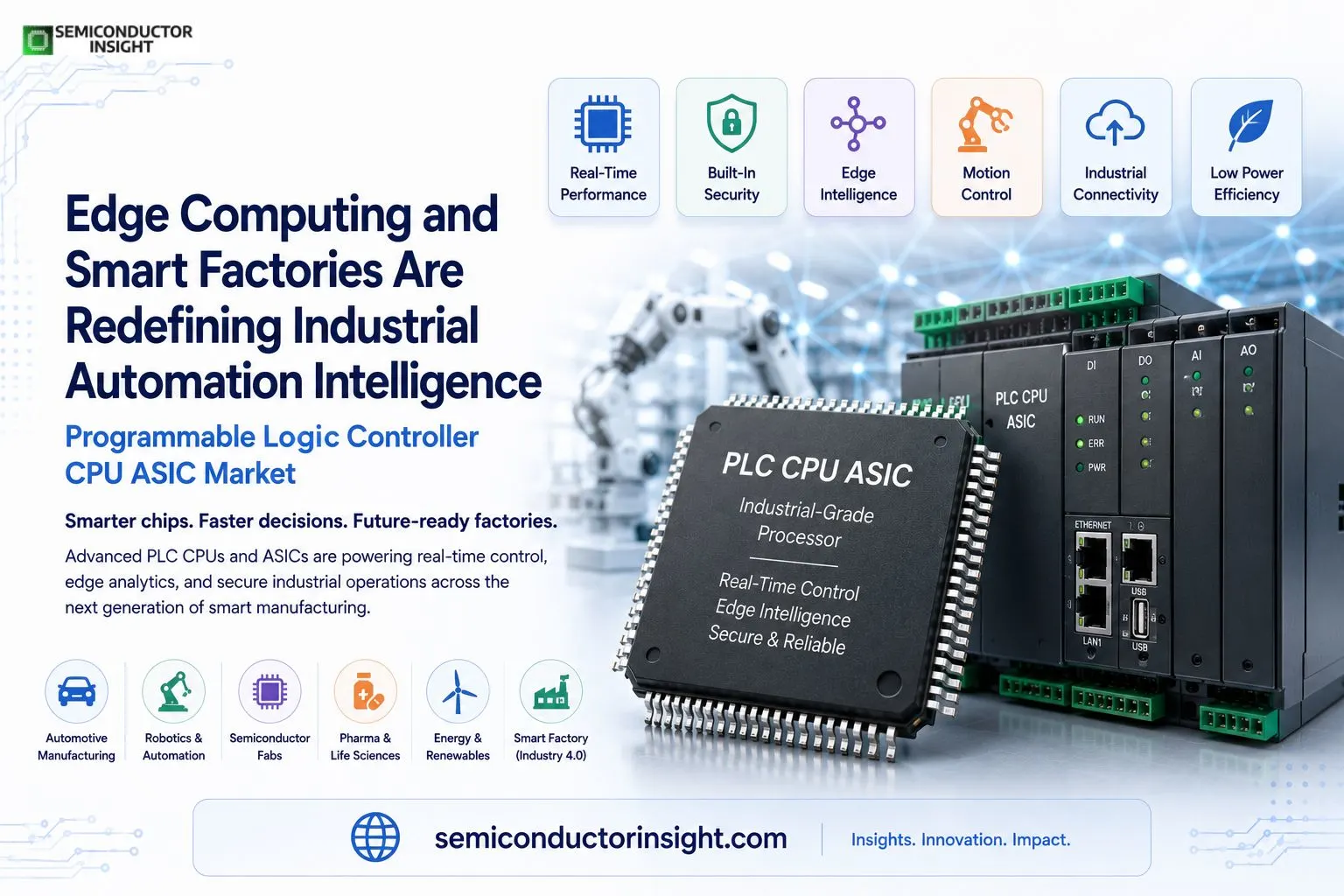
Edge Computing and Smart Factories Are Redefining Programmable Logic Controller CPU ASIC Market
Innovation in semiconductors is becoming as crucial as mechanical engineering in the new era of industrial automation. Programmable Logic controls (PLCs) are no longer merely machine controls in contemporary manufacturing. With the help of sophisticated CPUs and application-specific integrated circuits (ASICs), they are developing into intelligent computing platforms that can manage industrial cybersecurity, robotics synchronisation, real-time analytics, and AI-supported diagnostics.
The growing integration of smart manufacturing, semiconductor-driven automation, and Industry 4.0 infrastructure is rapidly transforming the global Programmable Logic Controller CPU ASIC Market. From automotive plants and semiconductor fabs to pharmaceutical production lines and renewable energy systems, PLC processors are becoming faster, smaller, more energy-efficient, and increasingly connected.
The Semiconductor Core Behind Modern PLC Systems
A PLC CPU acts as the brain of an industrial automation system. It continuously receives data from sensors, processes instructions in milliseconds, and controls actuators, robotic systems, conveyors, motors, and industrial equipment. ASICs, meanwhile, are increasingly being designed for dedicated industrial workloads such as motion control, deterministic communication, and edge AI acceleration.
Unlike traditional industrial controllers from a decade ago, newer PLC architectures now integrate:
- Multi-core embedded processors
- Real-time Ethernet communication chips
- AI-enabled edge analytics
- FPGA-assisted industrial control
- Secure boot semiconductor modules
- Low-latency ASIC accelerators
- Industrial cybersecurity processors
The shift toward software-defined factories is pushing semiconductor manufacturers to design PLC chipsets capable of operating in harsh industrial environments with ultra-high reliability and minimal downtime.
For additional report info, feel free to view our most recent edition: https://semiconductorinsight.com/report/programmable-logic-controller-plc-cpu-asic-market/
Semiconductor Manufacturing Expansion Is Fuelling Automation Demand
Governments worldwide are heavily investing in semiconductor ecosystems, and this directly benefits industrial automation infrastructure. India’s semiconductor mission alone has approved multiple semiconductor and chip-design projects under government-backed initiatives focused on domestic chip innovation and industrial electronics development.
At the same time, advanced manufacturing plants require highly automated production systems that depend on powerful PLC CPUs and industrial ASICs. Semiconductor fabrication facilities themselves use thousands of PLC-controlled systems for:
- Wafer handling automation
- Chemical process monitoring
- Vacuum chamber control
- Robotic arm coordination
- Cleanroom environmental systems
- Precision motion control
This creates a circular growth cycle where semiconductor plants increase demand for industrial automation chips while also manufacturing the processors needed for next-generation PLC systems.
Edge Intelligence Is Replacing Conventional Automation Logic
One of the most significant shifts in the PLC CPU ASIC landscape is the move away from isolated controllers toward edge intelligence platforms. Traditional PLCs were mainly designed to execute ladder logic, but modern PLC processors now support machine vision integration, predictive maintenance algorithms, real-time data analytics, cloud-connected diagnostics, AI-assisted fault prediction, and digital twin synchronization. As a result, industrial engineers increasingly expect PLC CPUs to function more like rugged industrial computers, capable of supporting both operational technology and information technology requirements at the same time.
This shift has also brought cybersecurity into sharper focus. With industrial systems becoming more interconnected, exposure to cyber risks has increased, driving stronger demand for secure industrial ASICs with built-in encryption, authentication, and hardware-level cybersecurity features.
Smart Factories Need Faster Industrial Chips
The rise of smart factories is dramatically increasing processor requirements inside PLC systems. Modern automotive manufacturing plants can contain tens of thousands of sensors communicating continuously across industrial Ethernet networks.
This is driving strong demand for:
- Low-power industrial processors
- Deterministic networking ASICs
- Real-time communication controllers
- High-speed motion control chips
- Industrial AI accelerators
Factory automation suppliers are also shifting toward modular PLC systems with scalable CPU architectures capable of supporting robotics, AI inspection systems, and cloud manufacturing platforms simultaneously.
Factory Sensors
↓
Industrial PLC CPU
↓
ASIC-Based Real-Time Processing
↓
Edge Analytics and AI Decisions
↓
Robotics and Automated Machinery
AI and Software Automation Are Entering PLC Engineering
Industrial automation is no longer limited to hardware innovation. AI-assisted engineering tools are now helping automate PLC logic generation and industrial process design.
A recent industrial automation research study demonstrated that AI-supported control logic generation platforms could automate over 90% of certain engineering tasks for distributed industrial systems.
This transition is encouraging semiconductor companies to develop more flexible PLC CPUs capable of supporting advanced software ecosystems, virtualization, and AI-enabled industrial workloads.
Meanwhile, automation engineers across industrial communities increasingly describe PLC systems as evolving platforms rather than fixed-function controllers. Discussions within industrial automation communities highlight the growing importance of cyber security, Ethernet integration, edge computing, and software-centric automation architectures.
Industrial Automation Is Becoming a Semiconductor Battlefield
The modern factory floor is now deeply dependent on semiconductor innovation. As industries move toward autonomous manufacturing, connected supply chains, and AI-enabled industrial operations, PLC CPUs and ASICs are becoming strategic technologies rather than background components.
Companies developing industrial semiconductors are focusing on reliability, deterministic performance, energy efficiency, cybersecurity, and edge AI capabilities to support the next generation of intelligent factories. With semiconductor investments expanding globally and smart manufacturing adoption accelerating across industries, Programmable Logic Controller CPU ASIC Market is emerging as one of the most critical intersections between industrial automation and semiconductor engineering.

Comments (0)