

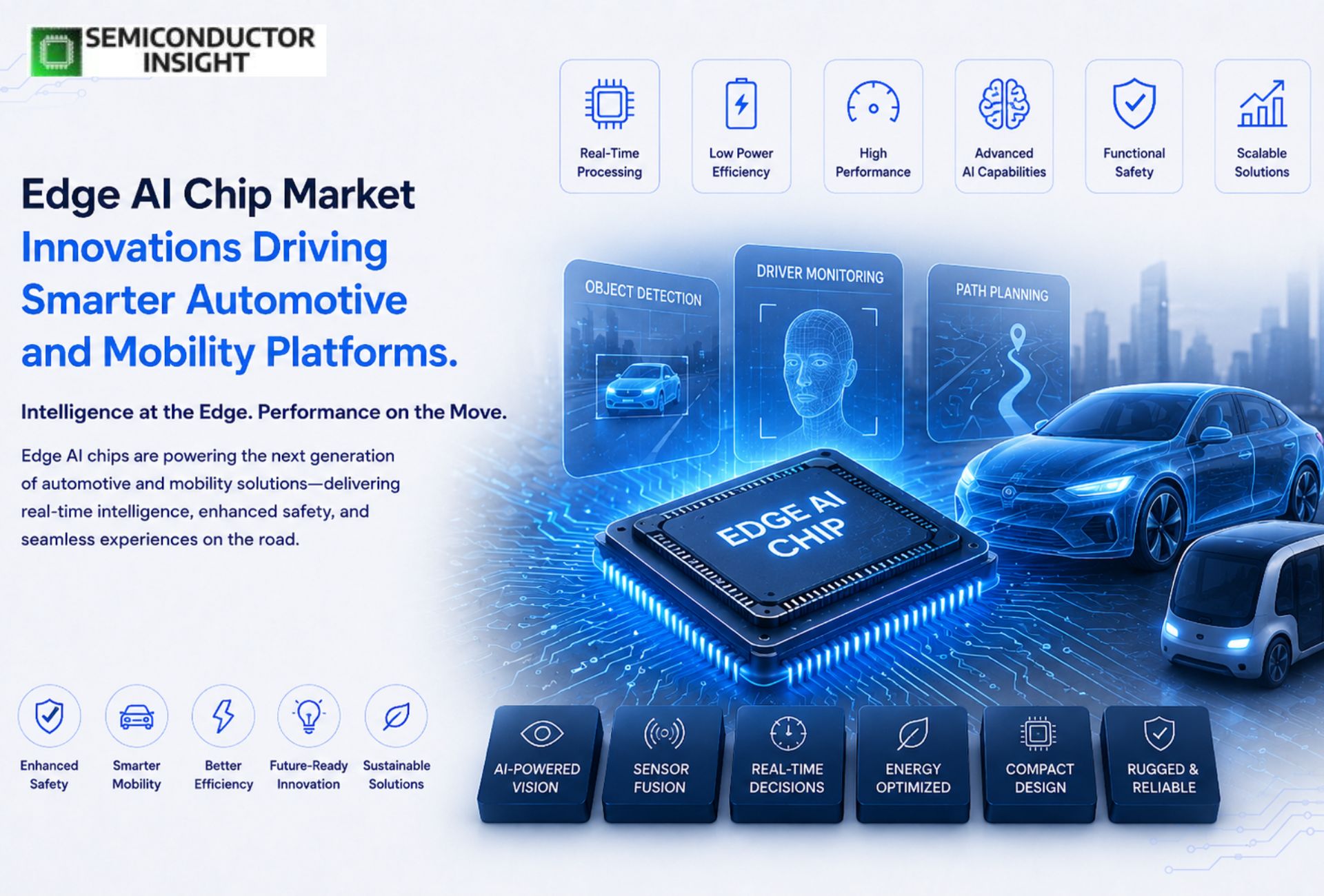
Edge AI Chip Market Innovations Driving Smarter Automotive and Mobility Platforms
Edge AI Chip Market refers to the global industry focused on the development, production, and deployment of semiconductor chips designed to process artificial intelligence algorithms directly on local devices or at the edge of a network, without depending entirely on centralized cloud data centres.
Artificial intelligence is no longer confined to hyperscale data centres and cloud infrastructure. A major shift is now unfolding across the semiconductor industry as AI workloads increasingly move closer to where data is created. This transition has placed edge AI chips at the centre of next-generation computing strategies.
- Edge AI chips are specialized semiconductor processors designed to execute AI algorithms directly on local devices rather than relying entirely on remote cloud servers.
- Smartphones, industrial robots, smart cameras, medical wearable, autonomous vehicles, and factory automation systems are rapidly adopting these chips to enable faster decision-making with lower latency.
- The global surge in connected devices is intensifying this transition. According to the International Telecommunication Union, billions of IoT-connected devices are now operating worldwide, generating enormous volumes of real-time data.
- Transmitting all of this information to centralized cloud systems creates bandwidth limitations, privacy concerns, and response delays. Edge AI hardware is increasingly viewed as the solution to these operational bottlenecks.
Technology companies are now designing processors capable of handling AI inference directly within compact, energy-efficient hardware environments. This architectural change is reshaping semiconductor priorities across consumer electronics, automotive systems, industrial automation, and healthcare technologies.
AI Smartphones Are Becoming a Major Semiconductor Battleground
One of the strongest growth areas for edge AI chips is the smartphone industry. Device manufacturers are integrating neural processing units and AI accelerators into mobile processors to support on-device generative AI, real-time translation, intelligent photography, and voice assistants.
Recent flagship smartphone launches from companies such as Apple Inc., Samsung Electronics, and Qualcomm have highlighted the growing importance of dedicated AI hardware inside mobile devices.
The rise of AI PCs is also reinforcing demand for edge AI semiconductor architectures. Several new laptop processors introduced in 2025 and 2026 now include integrated NPUs specifically designed to support local AI processing tasks. These systems reduce dependence on cloud connectivity while improving security for enterprise users handling sensitive information.
According to data published by the Consumer Technology Association, AI-enabled consumer devices represented one of the most discussed technology categories at recent global electronics events, including CES. Semiconductor firms are aggressively optimizing AI chip efficiency because consumers increasingly expect intelligent features without sacrificing battery performance.
Don’t Forget to Surf Our Updated Related Report for More Detailed Analysis: https://semiconductorinsight.com/report/edge-ai-devices-market/
Smart Factories Are Increasing Demand for Industrial Edge AI
Industrial automation is emerging as another powerful application area for edge AI chips. Manufacturing facilities are increasingly deploying AI-enabled cameras, robotics platforms, predictive maintenance systems, and machine vision technologies directly on factory floors.
Edge AI enables industrial equipment to process data locally with incredibly low latency, in contrast to cloud-based systems. In settings where production choices must be made quickly to prevent operational disturbances, this skill is crucial.
Factories adopting AI-enabled quality inspection systems can now identify microscopic defects in real time using embedded AI accelerators integrated into machine vision equipment. Semiconductor manufacturers themselves are using edge AI technologies within chip fabrication plants to optimize production efficiency and reduce defect rates.
The rise of Industry 4.0 initiatives across countries including Germany, Japan, South Korea, China, and the United States is accelerating investments in intelligent manufacturing infrastructure. Governments and industrial technology organizations continue promoting smart factory modernization strategies to improve industrial productivity and supply chain resilience.
AI Cameras and Video Analytics Are Expanding Edge Computing Applications
- Video analytics has become one of the fastest-growing workloads for edge AI processors. Security systems, traffic monitoring networks, retail analytics platforms, and smart city infrastructure increasingly require real-time visual interpretation without relying entirely on cloud servers.
- Modern AI-enabled surveillance cameras can perform facial recognition, object detection, crowd monitoring, and anomaly detection directly within local hardware environments. This reduces network congestion while improving response times for security operations.
- According to the National Institute of Standards and Technology, edge-based AI processing is gaining importance in applications requiring rapid image analysis and lower transmission delays.
- Retailers are also deploying AI-enabled edge cameras for inventory tracking, customer flow analysis, and automated checkout systems. These systems process visual information locally, allowing businesses to operate more efficiently while reducing cloud processing expenses.
- Healthcare institutions are exploring similar approaches for patient monitoring systems and AI-assisted medical imaging workflows where real-time analysis can improve clinical responsiveness.
Geopolitical Semiconductor Policies Are Influencing Edge AI Development
Government semiconductor policies are playing a major role in shaping the future of edge AI hardware. Countries worldwide are expanding domestic semiconductor investment programs to strengthen technology independence and reduce supply chain vulnerabilities.
The CHIPS and Science Act in the United States and similar semiconductor initiatives in Europe, Japan, South Korea, and India are accelerating investments in advanced chip manufacturing and AI hardware ecosystems.
Edge AI has become strategically important because it intersects with national priorities involving artificial intelligence leadership, cybersecurity, industrial modernization, and defense technologies.
Governments are also supporting semiconductor research partnerships between universities, chipmakers, and technology companies focused on next-generation AI architectures. Several research institutions are now studying neuromorphic computing and ultra-low-power AI processors inspired by biological neural systems.
This geopolitical emphasis on semiconductor resilience is expected to further intensify innovation within edge AI chip development over the next several years.
The Semiconductor Industry Is Entering an Edge Intelligence Era
The evolution of artificial intelligence is no longer defined solely by massive cloud data centres. Intelligence is increasingly shifting toward local devices capable of processing information instantly, securely, and efficiently.
Edge AI chips are now becoming the backbone of this transformation. From AI smartphones and industrial robotics to autonomous vehicles and healthcare wearables, these processors are redefining how intelligent systems interact with the physical world.
As semiconductor companies continue pushing the limits of energy efficiency, miniaturization, and AI acceleration, edge computing is expected to remain one of the most strategically important segments across the global semiconductor ecosystem.

Comments (0)