
EA’s Markerless Motion Capture Push in 2026 Signals a New Era for Character Animation
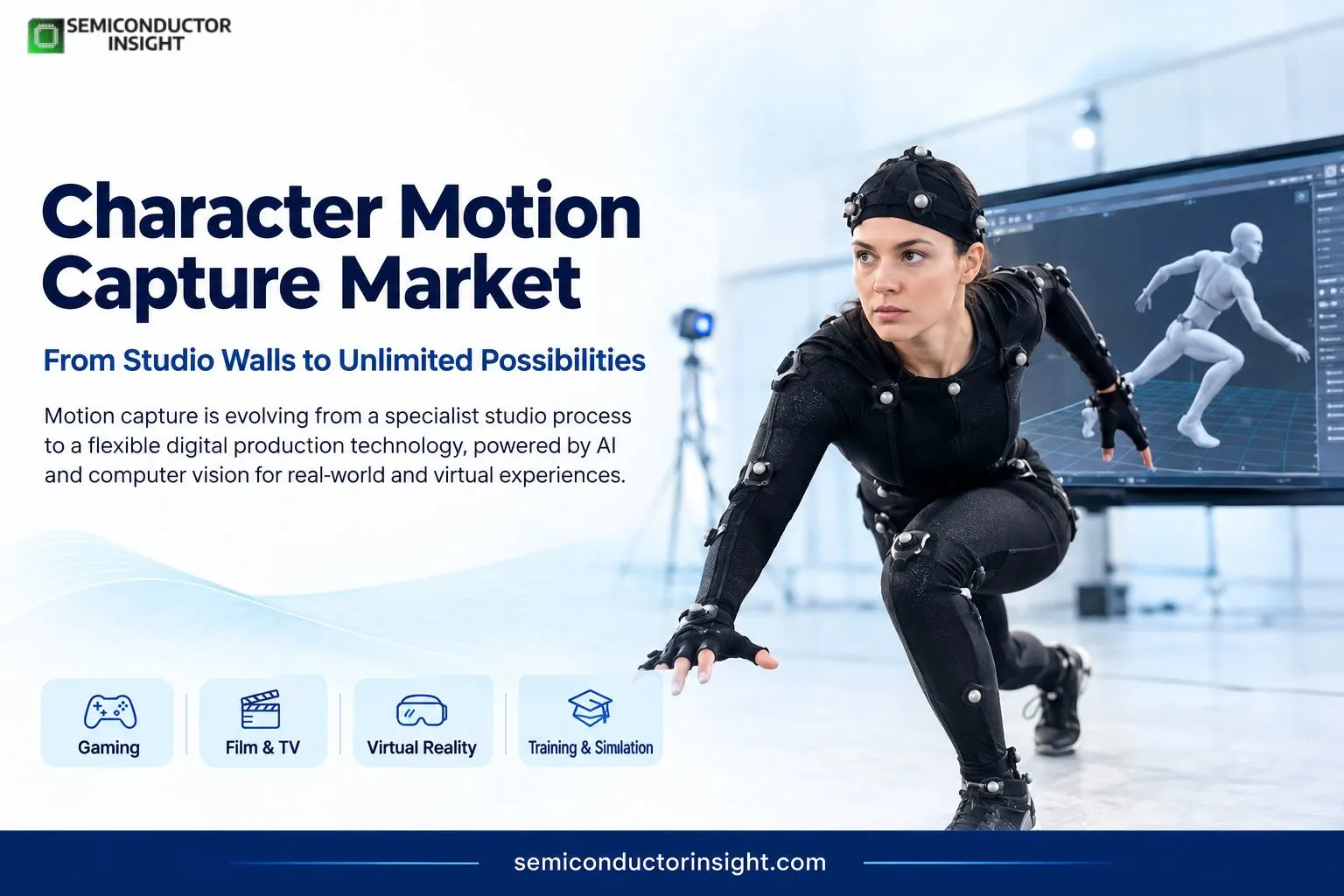
Character motion capture is moving from a specialist studio process toward a more flexible digital production technology. Instead of relying exclusively on actors wearing marker suits inside controlled environments, newer systems can extract body movement from video and translate it into animation data.
Autodesk describes markerless capture as a computer-vision process that converts video footage into 3D motion data for rigged characters. The approach is now being applied across games, film, television, virtual reality and other forms of digital content.
The Markerless Moment Has Arrived
- The most important change in the Character Motion Capture Market is the reduction in physical equipment required to record movement.
- In August 2026, Electronic Arts highlighted its exploration of markerless motion capture for game development, pointing to high-resolution and high-speed cameras combined with AI and computer vision.
- The company noted that performances can potentially be captured indoors or outdoors without conventional suits and with fewer cameras.
- This changes the economics and logistics of capturing spontaneous movement. Outdoor sports sequences, combat performances and location-based scenes can increasingly become viable capture environments.
You Can Freely Surf Our Latest Updated Report Here: https://semiconductorinsight.com/report/character-motion-capture-market/
One Performance Can Feed Several Digital Pipelines
Modern character capture is no longer limited to recording a skeleton and handing the data to an animator. Motion data can move through retargeting, inverse kinematics, facial animation, rendering and real-time engines.
NVIDIA ACE, for example, combines technologies covering speech, intelligence and animation for interactive digital humans. Its ecosystem includes Audio2Face-3D, Animation Graph, Unreal Engine integration and other components designed for digital-human workflows.
The significance for the market is that character motion capture is becoming part of a broader real-time character stack rather than operating as an isolated production step.
From Three Weeks to Several Days
Production speed is becoming one of the strongest reasons studios are experimenting with AI-assisted capture.
A case study published by Autodesk describes how Boxel Studio used Wonder Dynamics’ markerless technology during work involving Superman & Lois. A workflow that previously required roughly three weeks was reduced to a couple of days for the relevant process.
The attraction is not simply faster capture. Earlier access to usable motion data allows directors, VFX teams and animators to review scenes sooner and make creative changes before expensive downstream work accumulates.
The Technology Is Moving Into Game Production
- Gaming is becoming an important proving ground because character movement must respond to highly varied actions, environments and player interactions.
- At GDC 2025, Vicon introduced its Markerless solution for game studios, film productions and television teams.
- The company positioned the technology around rapid prototyping, previsualization, real-time visualization and capturing multiple performers and props.
- That shift matters because developers can use motion capture earlier in the development cycle, rather than reserving it only for final performance shoots.
2025 Brought More than Incremental Improvement
Southwest Research Institute launched BEAMoCap in April 2025, a camera-based system that uses AI and machine vision to predict movement across dozens of joints and body parts without conventional marker suits. The technology was subsequently recognized with a 2025 Technology Innovation Award from the National Association of Broadcasters.
The development illustrates how motion capture is increasingly intersecting with biomechanical modelling, computer vision and 3D character rigging.
The Character Is Becoming an Interactive System
The emerging opportunity extends beyond movies and games. Digital humans, virtual presenters, interactive avatars, training simulations and immersive experiences all require believable movement.
NVIDIA identifies gaming, media and entertainment, robotics, retail, telecommunications and other fields among the application areas for digital-human technologies.
This expands the addressable application base for character motion capture. A captured performance can increasingly become an input for an interactive character rather than simply an animation asset.
What Changes Next Inside the Capture Pipeline?
- The competitive focus is gradually moving from simply recording movement to producing clean, reusable and production-ready motion data.
- AI-based cleanup, automatic foot locking, retargeting and facial or hand tracking are becoming increasingly important.
- Autodesk’s current workflow, for example, incorporates automatic cleanup functions and compatibility with Maya, Blender, Unreal and 3ds Max through USD-based workflows.
For studios, this means the value of a capture system increasingly depends on what happens after the camera records the performance. The winning workflow is likely to be the one that turns raw movement into usable character animation with fewer manual corrections and faster integration into existing production pipelines.

Comments (0)