
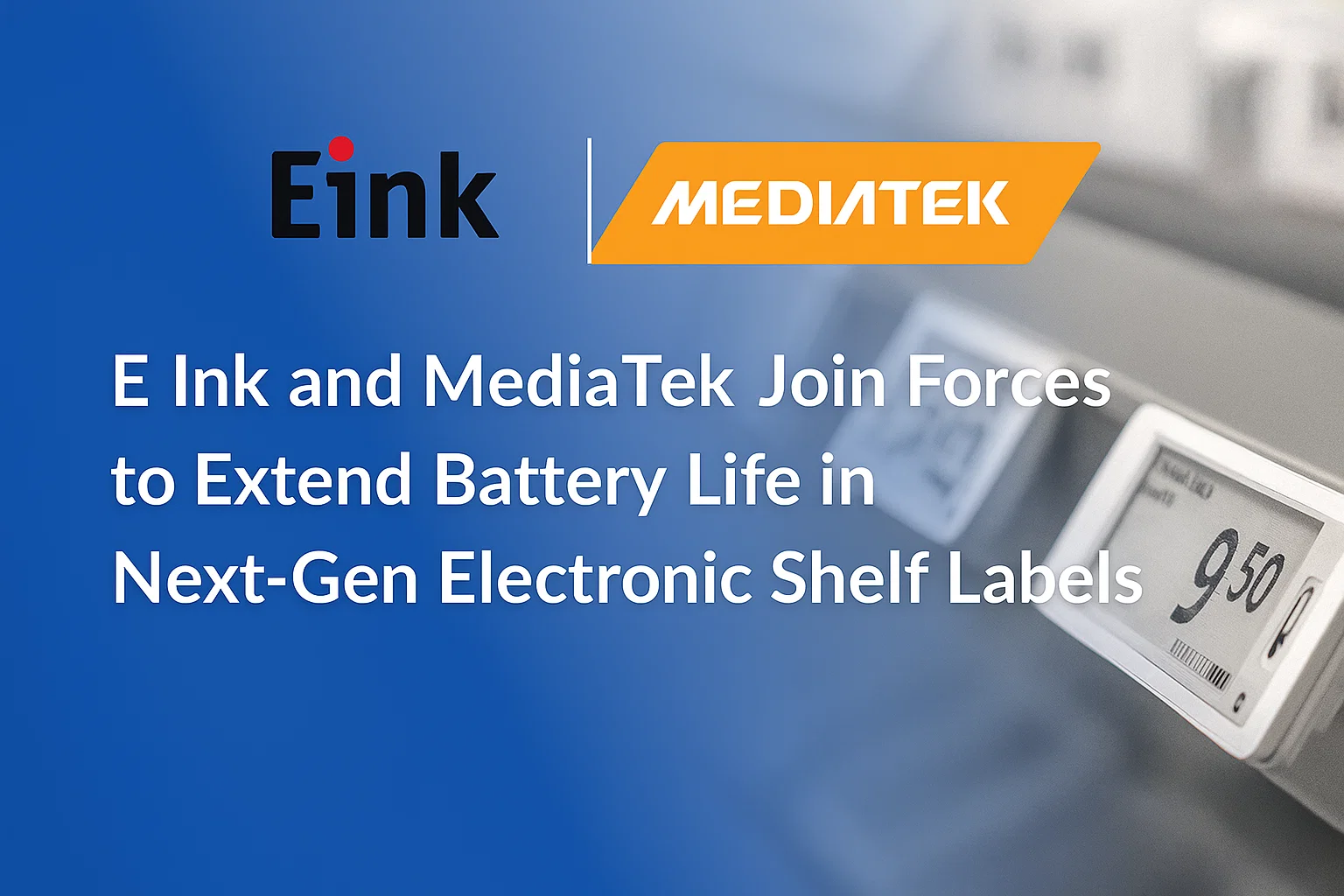
E Ink and MediaTek Join Forces to Extend Battery Life in Next-Gen Electronic Shelf Labels
The retail industry is undergoing a seismic transformation, driven by the convergence of smart technologies, automation, and the relentless pursuit of efficiency. At the heart of this transformation lies the Electronic Shelf Label (ESL) — a digital price tag system that replaces traditional paper labels with dynamic, real-time displays. As retailers increasingly adopt ESLs to streamline operations and improve customer experience, a critical but often overlooked component is fueling this revolution: the Driver Integrated Circuit (IC).
The ESL Driver IC market, valued at US$ 180 million in 2024, is expected to grow significantly, reaching US$ 425 million by 2032, with a projected CAGR of 10.7% from 2025 to 2032. This growth is not only a reflection of ESL adoption across supermarkets, electronics stores, and fashion outlets, but also of the technological strides being made by semiconductor and IoT players.
Access Your Free Sample Report- Electronic Shelf Label (ESL) Driver IC Market
Why ESL Driver ICs Matter
Before diving into the news, it’s essential to understand why ESL Driver ICs are crucial in retail digitization:
- Power Efficiency: ESLs must last 5–10 years on coin-cell batteries. Driver ICs control how efficiently power is consumed.
- Display Management: These ICs drive e-paper or LCD displays, ensuring crisp, reliable updates.
- Connectivity Integration: Modern ICs combine wireless protocols like Bluetooth Low Energy (BLE), Zigbee, and sub-GHz for scalable deployment.
- Scalability: Retailers may deploy hundreds of thousands of ESLs in one chain; driver ICs ensure synchronization and reliability.
In short, ESL Driver ICs are the invisible backbone enabling retailers to modernize without increasing operational costs.
Recent Developments in ESL Driver ICs
1. E Ink and MediaTek Collaboration (2024)
E Ink, the global leader in e-paper displays, has teamed up with MediaTek to co-develop low-power chip solutions tailored for ESLs. The collaboration is designed to push the boundaries of energy efficiency and refresh rates, allowing ESLs to update prices in near real-time.
This is a significant leap because traditional ESLs typically refresh every few minutes or hours. Faster refresh rates mean retailers can implement dynamic pricing strategies — adjusting prices based on demand, time of day, or inventory levels. For MediaTek, known primarily for its smartphone and IoT chips, this move represents a strategic entry into retail IoT solutions.
2. Nordic Semiconductor and Silicon Labs: The Battle for Wireless Dominance (2024)
Both Nordic Semiconductor and Silicon Labs introduced new ultra-low-power SoCs optimized for ESLs in 2024. These ICs focus on wireless reliability and extended battery life:
- Nordic Semiconductor: Launched Bluetooth LE SoCs that enable fast pairing, secure connections, and multi-protocol support.
- Silicon Labs: Introduced sub-GHz and multiprotocol wireless ICs that excel in dense retail environments, where thousands of ESLs need to be managed simultaneously.
This competition is fueling innovation and ensuring that ESL driver ICs evolve to support larger deployments without compromising performance.
3. Qualcomm’s Entry into Retail IoT (Late 2024)
In a surprising move, Qualcomm expanded its retail IoT portfolio to include low-power processors supporting ESL solutions. While Qualcomm has traditionally focused on mobile processors, its pivot into ESL technology highlights the convergence of mobile and retail ecosystems.
Qualcomm’s strength lies in its ability to integrate AI-driven edge computing, enabling ESLs to handle more than just static pricing. Future ESLs may process localized data for promotions, customer engagement, and even store analytics.
Download Sample Report PDF- Electronic Shelf Label (ESL) Driver IC Market
4. Semtech and LoRa Integration (2024)
Semtech, the company behind LoRa technology, announced its push into the ESL space, focusing on large retail environments. By leveraging LoRa, ESL systems can achieve long-range, low-power communication, making them especially suitable for warehouse-scale deployments.
While LoRa is not a direct display driver, its integration into ESL IC ecosystems demonstrates how connectivity and driver technologies are converging.
5. BOE and SES-imagotag Partnership (2024–2025)
BOE, a leading display manufacturer, has partnered with SES-imagotag, the world’s largest ESL provider, to launch next-gen ESL modules. These new modules feature integrated driver ICs with improved refresh speeds, lower power consumption, and enhanced durability.
The collaboration is particularly noteworthy because SES-imagotag supplies to global retail giants like Walmart and Carrefour. Their adoption of BOE’s advanced IC-driven displays is a signal that driver IC innovation directly translates to large-scale commercial success.
6. Supply Chain Shifts: Southeast Asia Rising (2024)
According to Nikkei Asia, ESL driver IC manufacturing is increasingly shifting to Southeast Asia, as companies diversify away from China amid geopolitical tensions. Vietnam, Malaysia, and Thailand are emerging as hubs for semiconductor packaging and assembly, ensuring supply chain resilience.
This shift is expected to stabilize ESL production costs while reducing risks of disruptions.
Market Outlook (2025–2032)
The ESL Driver IC market is on an upward trajectory. Key projections:
- Market Size: US$ 180 million in 2024 → US$ 425 million by 2032.
- CAGR:7% during 2025–2032.
- Primary Growth Drivers:
- Rising adoption of ESLs in supermarkets, hypermarkets, and specialty retail.
- Demand for real-time pricing and promotions.
- Integration of IoT, AI, and big data into retail ecosystems.
- Sustainability push: reducing paper waste and labor costs.
Challenges in the ESL Driver IC Industry
Despite robust growth, several challenges must be addressed:
- Standardization Issues: Multiple wireless protocols (BLE, Zigbee, LoRa) can complicate interoperability.
- Cost Pressures: ESL deployments involve hundreds of thousands of units; even small IC cost increases affect ROI.
- Security Concerns: Retailers demand ICs with built-in encryption to prevent tampering.
- Scalability: Managing tens of thousands of ESLs per store requires highly efficient driver ICs.
Opportunities Ahead
- AI-Enabled ESLs: With Qualcomm and others exploring AI at the edge, ESLs could evolve into smart engagement tools.
- 5G Integration: High-bandwidth ESLs could support multimedia retail experiences.
- Sustainability Benefits: Governments and eco-conscious retailers will favor ESL adoption for reducing paper use.
- Expansion into Non-Retail Sectors: ESLs could penetrate healthcare, logistics, and manufacturing, opening new markets for driver ICs.
Future Roadmap
By 2030, ESL Driver ICs are expected to feature:
- Hybrid Wireless Chips (supporting BLE, Wi-Fi, Zigbee, and LoRa in one package).
- AI-on-Chip Capabilities for predictive pricing and customer engagement.
- Ultra-Long-Life Batteries lasting up to 15 years, enabled by more efficient driver ICs.
- Sustainable Materials in IC packaging to align with global ESG goals.
The ESL Driver IC industry is at the forefront of retail’s digital revolution. With a projected market size of US$ 425 million by 2032, growing at a CAGR of 10.7%, this sector is one of the most dynamic in the broader retail IoT landscape.
Click Here To Download Full Sample Report- Electronic Shelf Label (ESL) Driver IC Market
From E Ink and MediaTek’s energy-efficient chips, to Nordic and Silicon Labs’ wireless innovations, to Qualcomm’s AI-driven retail IoT push, ESL driver IC development is evolving rapidly. Partnerships like BOE and SES-imagotag are proving that IC innovation is directly linked to market adoption, while geopolitical supply chain shifts are reshaping where and how these chips are produced.
Ultimately, ESL Driver ICs are more than just a technical component — they are enablers of smarter, greener, and more efficient retail operations. Retailers that embrace these technologies stand to benefit from enhanced customer experiences, reduced operational costs, and a future-ready infrastructure.
As we look ahead to 2032, the ESL Driver IC industry will not only grow in size but also in significance, shaping the very foundation of next-generation retail.

Comments (0)