

Dry Screw vs. Scroll Vacuum Pump Market 2026 Which Performs Better in Semiconductor Fabs
When discussing semiconductor manufacturing, conversations usually focus on lithography systems, AI processors, advanced packaging, or wafer fabrication. Yet one of the most indispensable technologies rarely receives attention the vacuum pump.
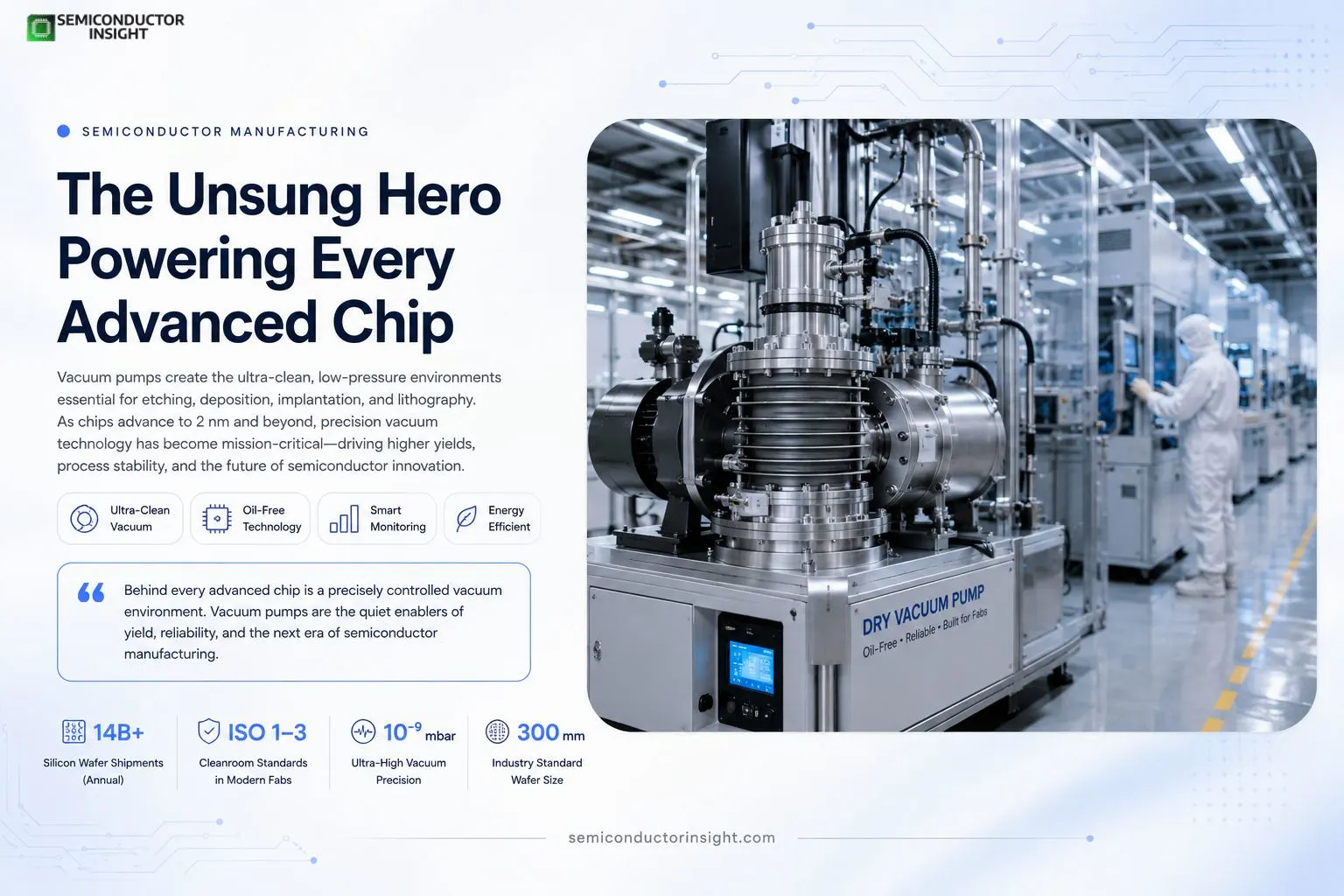
Inside semiconductor fabrication facilities, vacuum pumps create ultra-clean, low-pressure environments required for plasma etching, chemical vapor deposition (CVD), physical vapor deposition (PVD), ion implantation, atomic layer deposition (ALD), and extreme ultraviolet (EUV) lithography. Without precisely controlled vacuum conditions, even microscopic airborne particles or trace gases can compromise wafer quality and significantly reduce production yield.
As the semiconductor industry advances toward 2 nm process technology, increasingly complex chip architectures, and AI-driven manufacturing, the vacuum pump market has evolved from a supporting utility into a mission-critical component of modern fabrication infrastructure.
Why Ultra-Clean Vacuum Environments Matter More Than Ever?
Semiconductor manufacturing requires atomic-scale precision. Many fabrication steps occur under pressures far below atmospheric conditions to eliminate contamination and enable highly controlled chemical reactions.
Modern dry vacuum pumps, turbomolecular pumps, and cryogenic pumping systems work together to remove moisture, process gases, and microscopic contaminants before they interfere with wafer processing. Advanced fabs continuously monitor vacuum stability because even minute pressure variations can affect thin-film thickness, plasma uniformity, or etching accuracy.
According to technical resources from SEMI, the U.S. Department of Energy, semiconductor equipment manufacturers, and published engineering literature, maintaining contamination-free vacuum environments remains one of the most important factors influencing wafer yield and process repeatability.
A Vacuum System Supports Nearly Every Critical Manufacturing Stage
Vacuum technology plays a crucial role across the semiconductor fabrication process by connecting multiple production stages into one integrated manufacturing environment.
Rather than supporting just a single operation, it helps maintain the precise conditions needed at each step, from silicon wafer preparation and thin film deposition to photolithography, plasma etching, ion implantation, wafer cleaning, and advanced packaging. Each stage depends on carefully controlled vacuum levels to ensure accuracy, improve process performance, and reduce the risk of contamination.
Semiconductor Manufacturing Is Expanding at Historic Scale
- The demand for advanced vacuum systems is closely tied to global semiconductor production capacity. As chip manufacturing becomes more complex, the need for highly stable and precise vacuum environments continues to grow.
- According to current global benchmarks, silicon wafer shipments exceed 14 billion square inches annually, modern semiconductor cleanrooms typically operate under ISO Class 1 to ISO Class 3 conditions, EUV lithography uses a 13.5 nanometer wavelength, leading fabs commonly rely on 300 mm wafers, and many semiconductor processes require vacuum pressures ranging below 10^-3 to 10^-9 mbar depending on the application.
- These engineering requirements show why vacuum stability is critical, as it directly affects chip performance, manufacturing consistency, and overall production efficiency.
New Chip Architectures Are Changing Vacuum Technology Requirements
Artificial intelligence processors, high-bandwidth memory, advanced logic devices, and chiplet-based architectures introduce increasingly complex fabrication processes. Three-dimensional transistor structures, Gate-All-Around (GAA) technology, and heterogeneous integration require tighter process tolerances than previous semiconductor generations.
Consequently, vacuum systems must deliver cleaner gas handling, lower vibration, improved chemical resistance, and continuous operational reliability across thousands of production hours. Manufacturers increasingly deploy oil-free dry vacuum pumps because they minimize hydrocarbon contamination while reducing maintenance requirements in high-volume fabrication environments.
Sustainability Is Becoming an Engineering Priority inside Fabs
Semiconductor fabrication consumes substantial energy, water, and specialty gases. Vacuum systems are now being redesigned to improve overall facility sustainability rather than simply maximizing pumping capacity.
Recent equipment generations incorporate variable-speed motors, intelligent monitoring software, heat recovery systems, and predictive maintenance algorithms that reduce electricity consumption and extend equipment service life. Several major semiconductor manufacturers have also expanded digital monitoring platforms capable of identifying vacuum performance deviations before production interruptions occur.
These improvements align with broader environmental commitments announced by global chip manufacturers seeking to reduce operational emissions while expanding fabrication capacity.
Our most recent updated related study is available for free at this link: https://semiconductorinsight.com/report/semiconductor-dry-vacuum-pump-market/
Current Industry Developments Highlight the Growing Importance of Vacuum Technology
- The worldwide construction of advanced semiconductor fabrication facilities continues to increase demand for high-performance vacuum equipment. New manufacturing investments supported through initiatives such as the U.S. CHIPS and Science Act, the European Chips Act, and fabrication expansions across Taiwan, South Korea, Japan, and Singapore require highly reliable vacuum infrastructure from the earliest stages of facility planning.
- Meanwhile, leading semiconductor equipment companies continue introducing digital service platforms that combine sensors, cloud connectivity, and predictive analytics to monitor vacuum pump health in real time. These systems help reduce unplanned downtime while improving process consistency across thousands of production cycles.
- At the same time, rapid growth in AI accelerators, automotive semiconductors, power electronics, and advanced memory manufacturing has increased demand for vacuum technologies capable of supporting more chemically complex and thermally demanding fabrication environments.
Precision Engineering beyond Pressure Control
Modern vacuum pumps are no longer viewed simply as mechanical devices that remove air from process chambers. They have become intelligent engineering systems that contribute directly to wafer quality, equipment uptime, contamination control, energy optimization, and digital manufacturing. As semiconductor fabrication advances toward increasingly sophisticated process nodes and larger production volumes, vacuum technology continues to operate quietly in the background yet it remains one of the most fundamental technologies enabling every generation of advanced integrated circuits.

Comments (0)