
Directional Control Mastery Expanding Embedded Microwave Waveguide Isolator Market
Engineers working with sensitive microwave systems know how fragile high power amplifiers and oscillators can become when reflections bounce back from mismatched loads or antennas. Embedded microwave waveguide isolator market addresses this vulnerability by providing a passive, non reciprocal pathway that lets forward signals pass with minimal loss while directing unwanted reverse energy into an internal matched load.
These compact devices integrate directly into waveguide assemblies, becoming essential building blocks in modern semiconductor driven radar, satellite communication, and 5G infrastructure where space is tight and performance demands are extreme.
Understanding the Core Non Reciprocal Behavior
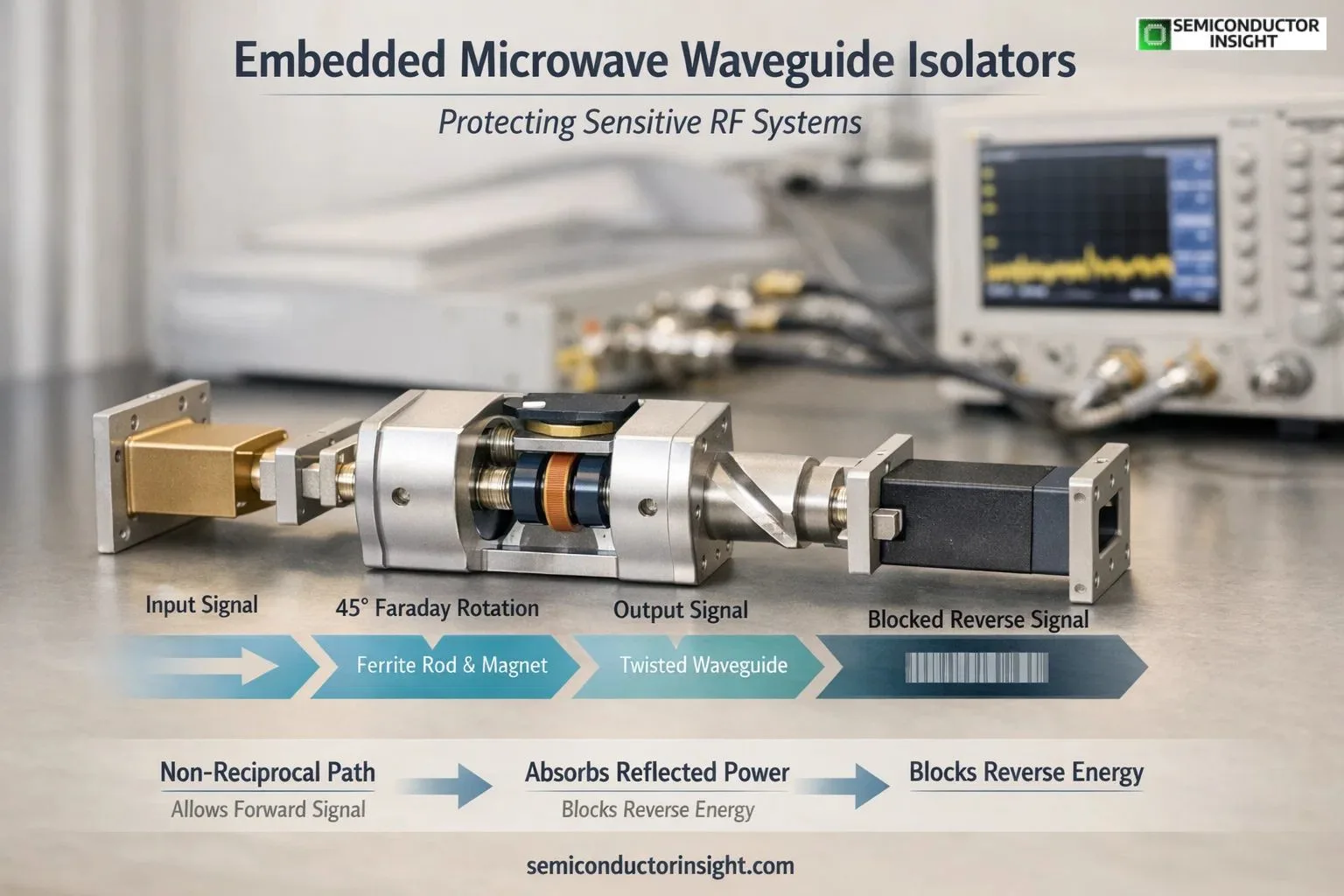
At the heart of every waveguide isolator lies the principle of non reciprocity, most commonly achieved through the Faraday rotation effect in magnetized ferrite materials. When a microwave signal travels forward through a circular waveguide section containing a ferrite rod under a longitudinal magnetic field, its polarization plane rotates by a precise angle, typically 45 degrees.
The output transition then aligns this rotated wave to pass through smoothly. Any signal attempting to travel backward undergoes the same rotation direction, misaligning it with resistive cards or absorbing elements that dissipate the energy harmlessly. This one way valve behavior protects expensive solid state power amplifiers from damage and prevents frequency pulling or instability in oscillators.
Key Construction Elements in Waveguide Designs
Embedded versions place the ferrite element, permanent magnet, and absorbing vane directly within standard rectangular or circular waveguide housings, often WR series sizes ranging from WR28 for Ka band up to larger structures for lower frequencies.
Transitions between rectangular TE10 mode and circular TE11 mode ensure seamless integration. Designers pay close attention to the bias point of the ferrite to balance low insertion loss in the forward direction with high isolation in reverse, typically aiming for minimal heat generation even at multi kilowatt power levels in industrial or defence applications.
Browse our latest report for the complete overview: https://semiconductorinsight.com/report/embedded-microwave-waveguide-isolator-market/
Signal Path through a Faraday rotation Waveguide Isolator
Input Rectangular Waveguide (TE10 Mode)
↓
Transition to Circular Waveguide
↓
Ferrite Rod under Axial Magnetic Field – Polarization Rotates +45° (Forward)
↓
Output Transition (Twisted 45°) – Signal Passes Cleanly
↓
Reverse Signal Rotates +45° Again – Misaligned and Absorbed by Resistive Card
Comparison of Isolation Approaches
| Isolation Type | Primary Mechanism | Typical Frequency Range | Key Advantage in Embedded Use |
| Faraday Rotation | Polarization twist in ferrite | X to Ka band | Excellent broadband performance |
| Resonance Absorption | Ferrite strips on waveguide walls | S to Ku band | Simple construction, high power handling |
| Field Displacement | Asymmetric ferrite placement | C to Ku band | Compact footprint for integration |
Latest Instances Showcasing Practical Advances
In 2025, aerospace teams integrated compact waveguide isolators into Ka band satellite payloads to handle higher data rates for global broadband services, achieving stable operation even during rapid beam steering.
Defence radar upgrades incorporated them in X band systems for improved target tracking under electronic countermeasures, where reflected power could otherwise destabilize solid state transmitters. Industrial microwave processing lines, such as those operating at 2450 MHz for material heating, adopted high power embedded isolators to protect generators during variable load conditions, extending equipment lifetime significantly.
Top players in the embedded isolator space
- Narda-MITEQ: Miniaturized airborne EW isolators
- Ferrite Microwave Tech.: Satellite payload isolators
- Dolph Microwave: Broadband embedded designs
- Teledyne Microwave: High-rel defence-grade units
- Advanced Microwave Comp.: 5G mm Wave supply chain
- Chengdu Guoguang: Asia-Pacific market leader
Material and Thermal Considerations for Reliability
Ferrite selection plays a critical role, with yttrium iron garnet or other rare earth doped compositions chosen for their low loss tangent and stable magnetic properties across temperature swings. Embedded designs often include careful heat sinking paths because even small forward losses at high power translate into heat that must be managed without shifting the magnetic bias point. Engineers combine these isolators with semiconductor components like MMIC amplifiers, creating hybrid assemblies that deliver robust performance in compact footprints suitable for airborne, space, or mobile platforms.
Emerging Techniques Enhancing Performance
Ongoing work focuses on optimizing waveguide transitions and ferrite geometries to support wider bandwidths needed for multi-function systems that switch between communication and sensing modes. Some approaches explore hybrid integration where waveguide isolators interface directly with planar circuits on high frequency laminates, bridging traditional hollow waveguide technology with modern semiconductor packaging. These refinements continue to make the technology more adaptable to the evolving demands of high frequency electronics.
Embedded microwave waveguide isolator market reflects the semiconductor industry’s push toward greater system integration and resilience. By quietly directing energy in one direction only, these components enable the reliable operation of complex microwave chains that power everything from weather monitoring satellites to advanced defence electronics, keeping signals clean and equipment protected in an increasingly connected world.
Engineers working with sensitive microwave systems know how fragile high power amplifiers and oscillators can become when reflections bounce back from mismatched loads or antennas. Embedded microwave waveguide isolator market addresses this vulnerability by providing a passive, non reciprocal pathway that lets forward signals pass with minimal loss while directing unwanted reverse energy into an internal matched load.
These compact devices integrate directly into waveguide assemblies, becoming essential building blocks in modern semiconductor driven radar, satellite communication, and 5G infrastructure where space is tight and performance demands are extreme.
Understanding the Core Non Reciprocal Behavior
At the heart of every waveguide isolator lies the principle of non reciprocity, most commonly achieved through the Faraday rotation effect in magnetized ferrite materials. When a microwave signal travels forward through a circular waveguide section containing a ferrite rod under a longitudinal magnetic field, its polarization plane rotates by a precise angle, typically 45 degrees.
The output transition then aligns this rotated wave to pass through smoothly. Any signal attempting to travel backward undergoes the same rotation direction, misaligning it with resistive cards or absorbing elements that dissipate the energy harmlessly. This one way valve behavior protects expensive solid state power amplifiers from damage and prevents frequency pulling or instability in oscillators.
Key Construction Elements in Waveguide Designs
Embedded versions place the ferrite element, permanent magnet, and absorbing vane directly within standard rectangular or circular waveguide housings, often WR series sizes ranging from WR28 for Ka band up to larger structures for lower frequencies.
Transitions between rectangular TE10 mode and circular TE11 mode ensure seamless integration. Designers pay close attention to the bias point of the ferrite to balance low insertion loss in the forward direction with high isolation in reverse, typically aiming for minimal heat generation even at multi kilowatt power levels in industrial or defence applications.
Browse our latest report for the complete overview: https://semiconductorinsight.com/report/embedded-microwave-waveguide-isolator-market/
Signal Path through a Faraday rotation Waveguide Isolator
Input Rectangular Waveguide (TE10 Mode)
↓
Transition to Circular Waveguide
↓
Ferrite Rod under Axial Magnetic Field – Polarization Rotates +45° (Forward)
↓
Output Transition (Twisted 45°) – Signal Passes Cleanly
↓
Reverse Signal Rotates +45° Again – Misaligned and Absorbed by Resistive Card
Comparison of Isolation Approaches
| Isolation Type | Primary Mechanism | Typical Frequency Range | Key Advantage in Embedded Use |
| Faraday Rotation | Polarization twist in ferrite | X to Ka band | Excellent broadband performance |
| Resonance Absorption | Ferrite strips on waveguide walls | S to Ku band | Simple construction, high power handling |
| Field Displacement | Asymmetric ferrite placement | C to Ku band | Compact footprint for integration |
Latest Instances Showcasing Practical Advances
In 2025, aerospace teams integrated compact waveguide isolators into Ka band satellite payloads to handle higher data rates for global broadband services, achieving stable operation even during rapid beam steering.
Defence radar upgrades incorporated them in X band systems for improved target tracking under electronic countermeasures, where reflected power could otherwise destabilize solid state transmitters. Industrial microwave processing lines, such as those operating at 2450 MHz for material heating, adopted high power embedded isolators to protect generators during variable load conditions, extending equipment lifetime significantly.
Top players in the embedded isolator space
- Narda-MITEQ: Miniaturized airborne EW isolators
- Ferrite Microwave Tech.: Satellite payload isolators
- Dolph Microwave: Broadband embedded designs
- Teledyne Microwave: High-rel defence-grade units
- Advanced Microwave Comp.: 5G mm Wave supply chain
- Chengdu Guoguang: Asia-Pacific market leader
Material and Thermal Considerations for Reliability
Ferrite selection plays a critical role, with yttrium iron garnet or other rare earth doped compositions chosen for their low loss tangent and stable magnetic properties across temperature swings. Embedded designs often include careful heat sinking paths because even small forward losses at high power translate into heat that must be managed without shifting the magnetic bias point. Engineers combine these isolators with semiconductor components like MMIC amplifiers, creating hybrid assemblies that deliver robust performance in compact footprints suitable for airborne, space, or mobile platforms.
Emerging Techniques Enhancing Performance
Ongoing work focuses on optimizing waveguide transitions and ferrite geometries to support wider bandwidths needed for multi-function systems that switch between communication and sensing modes. Some approaches explore hybrid integration where waveguide isolators interface directly with planar circuits on high frequency laminates, bridging traditional hollow waveguide technology with modern semiconductor packaging. These refinements continue to make the technology more adaptable to the evolving demands of high frequency electronics.
Embedded microwave waveguide isolator market reflects the semiconductor industry’s push toward greater system integration and resilience. By quietly directing energy in one direction only, these components enable the reliable operation of complex microwave chains that power everything from weather monitoring satellites to advanced defence electronics, keeping signals clean and equipment protected in an increasingly connected world.

Comments (0)