

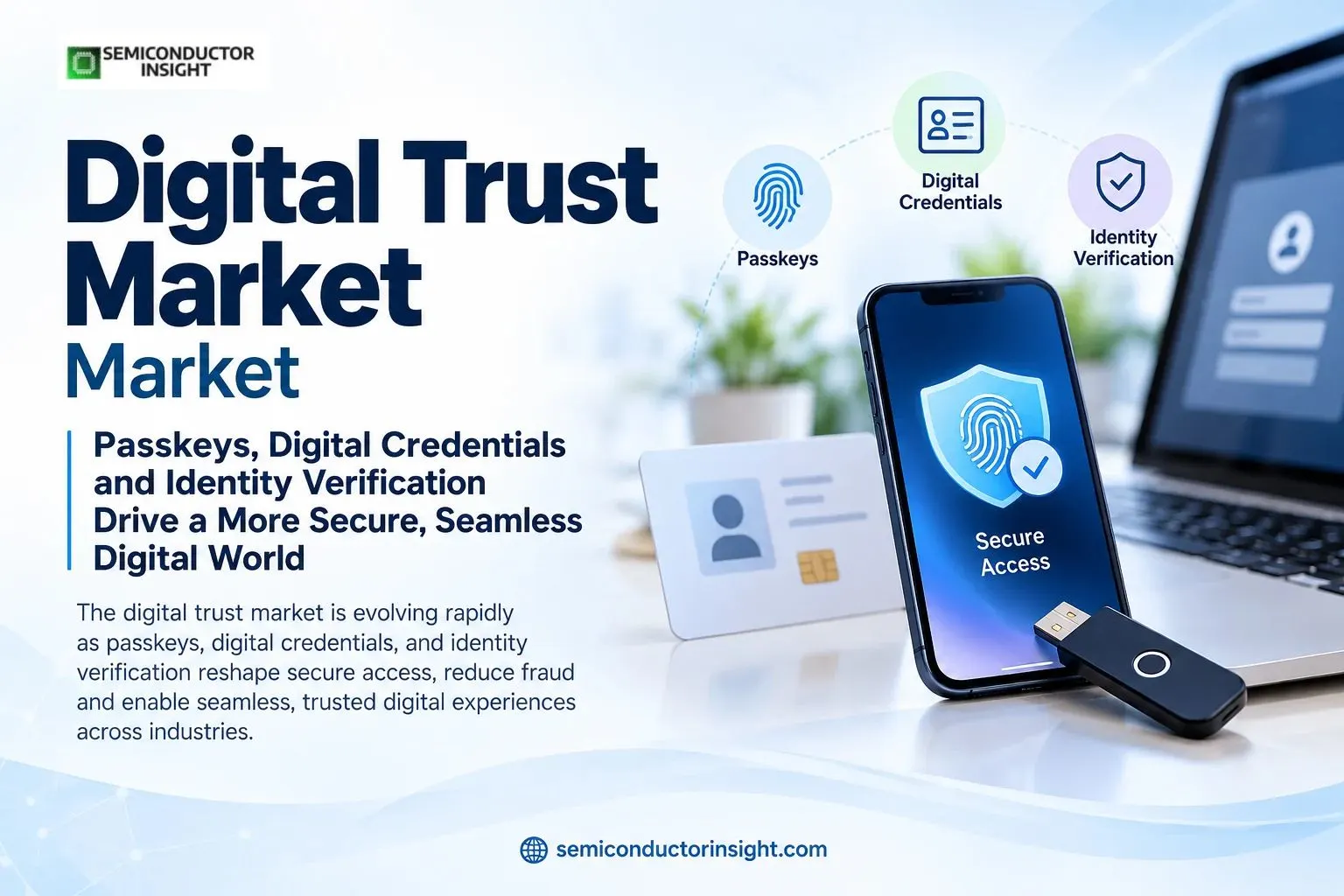
Digital Trust Market Trends in 2026 as Passkeys, Digital Credentials, and Identity Verification Gain Ground
Digital trust is becoming a fundamental requirement for the global digital economy. Every online payment, connected device, electronic signature, and AI-assisted transaction depends on the ability to establish who is participating, whether information is authentic, and whether the system can be relied upon.
Digital Trust Market therefore extends beyond conventional cybersecurity into digital identity, cryptographic hardware, privacy-preserving verification, and secure data exchange.
When Trust Becomes a Measurable Technology Requirement
- The World Economic Forum’s Global Cybersecurity Outlook 2026 identifies AI-related vulnerabilities and cyber-enabled fraud as increasingly important concerns.
- In its survey, 87% of respondents identified AI-related vulnerabilities as the fastest-growing cyber risk during 2025, while 73% reported that they or someone in their network had been affected by cyber-enabled fraud.
- These findings underline why businesses are investing in stronger identity verification and more reliable digital transactions.
- For semiconductor companies, this creates a direct connection between trust and hardware design.
- Secure elements, trusted platform modules, hardware security modules, and cryptographic processors can protect keys, authenticate devices, and support secure boot processes.
- Their role is particularly important in connected vehicles, industrial equipment, payment terminals, and Internet of Things deployments.
Digital Identity Is Moving Beyond Passwords
Passwords remain familiar, but their susceptibility to phishing and credential theft has encouraged wider adoption of passkeys, biometrics, and public-key cryptography. The US National Institute of Standards and Technology released its revised Digital Identity Guidelines, SP 800-63-4, in July 2025 following nearly 6,000 public comments across the development process. The updated guidance addresses identity proofing, authentication, federation, synced passkeys, and protections against forged media and injection attacks.
The change matters because digital identity is no longer limited to checking a username and password. Organizations increasingly need to establish whether a person is genuine, whether an authenticator belongs to that person, and whether the requested action is appropriate for the level of assurance required.
Europe’s Digital Wallet Initiative Opens New Use Cases
The European Union’s Digital Identity Wallet programme is an important example of digital trust moving into public infrastructure. Member States are expected to make wallets available to citizens, residents, and businesses by the end of 2026. The wallets are designed to support identity verification, document sharing, electronic signatures, and access to public and private services.
- The programme’s large-scale pilots involve more than 550 companies and public authorities across 26 EU Member States, alongside Norway, Iceland, and Ukraine.
- Potential applications include opening bank accounts, presenting digital driving licences, proving educational qualifications, and completing cross-border transactions.
For technology providers, these use cases require interoperable identity systems, protected credentials, reliable verification, and devices capable of supporting secure authentication. The broader opportunity is to make digital transactions easier without requiring users to disclose unnecessary personal information.
You Can Freely Surf Our Latest Updated Related Report Here: https://semiconductorinsight.com/report/us-ai-trusted-foundry-access-program-chip-market/
AI Is Changing the Definition of Authentic Information
Generative AI has made it easier to create convincing synthetic voices, images, documents, and videos. As a result, digital trust increasingly includes content provenance and the ability to establish where information originated and whether it has been altered.
Businesses are exploring cryptographic signatures, verifiable credentials, content provenance systems, and automated fraud detection to strengthen confidence in digital interactions. Yet no single technology can establish that every piece of content is truthful. Provenance can help verify origin and integrity, while separate processes may still be needed to assess accuracy and context.
AI agents introduce another requirement. When software acts on behalf of a person or organization, systems need to establish the agent’s identity, define its permissions, and maintain records of the actions it performs.
The Semiconductor Layer behind Trusted Devices
- Digital trust depends partly on security functions embedded within physical devices.
- Hardware-backed key storage can make sensitive cryptographic material more difficult to extract, while secure boot helps verify software before it executes.
- Device attestation can also provide evidence about a device’s identity or security state before it is granted access to a network.
- These capabilities are relevant to smartphones, smart meters, connected vehicles, industrial sensors, and payment infrastructure.
- Their effectiveness, however, depends on implementation, key management, software updates, and the security of the wider supply chain. A secure chip cannot compensate for every weakness in the surrounding system.
What Businesses Need to Get Right?
The next phase of digital trust will depend on combining usable identity systems with verifiable credentials, secure hardware, privacy safeguards, and continuous risk assessment. Organizations will need to balance strong verification with convenient access, particularly as AI agents and connected devices increase the number of digital identities interacting with business systems.
For semiconductor and technology providers, the opportunity extends beyond selling security components. It lies in enabling trusted interactions across the full lifecycle of a device, from manufacturing and provisioning to authentication, software updates, and retirement. As more economic activity moves through interconnected digital systems, trust is becoming an essential design requirement rather than an optional security feature.

Comments (0)