
Demand, Deployment, and Durability: Metallic Telecoms Cable Market Insights
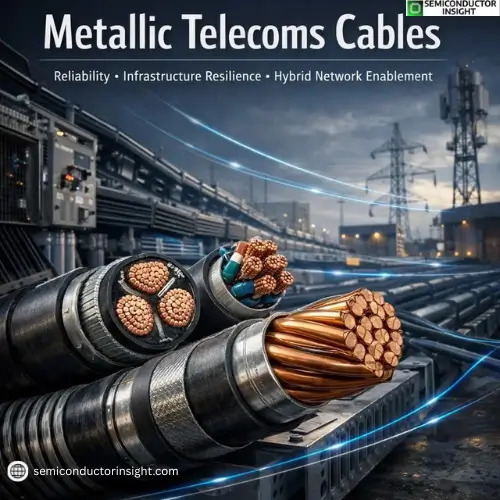
Long before high-speed wireless and optical fibre dominated headlines, metallic telecoms cables formed the silent framework of global communication. Even today, as networks modernize, copper-based and metallic cabling systems continue to carry voice signals, control data, and power across vast distances. Their reliability, physical resilience, and cost efficiency keep them firmly embedded in telecom architectures worldwide.
This blog explores how Metallic Telecoms Cable Market continues to evolve, not by competing with fibre, but by complementing it in ways that modern infrastructure still depends on.
What Metallic Telecoms Cables Mean in Today’s Network Design?
Metallic telecoms cables typically use copper or copper-alloy conductors to transmit electrical signals. They are widely used in access networks, legacy exchanges, industrial communications, rail signalling, and rural connectivity. In semiconductor-driven electronics environments, these cables also support grounding, shielding, and low-latency signal paths where optical solutions may be impractical.
Rather than fading out, metallic cables have found renewed purpose in hybrid network designs where robustness and predictability are essential.
Infrastructure Reality: Why Replacement Isn’t Always Practical
Across many regions, especially in developing and semi-urban markets, replacing existing metallic cable networks with fibre is neither immediate nor economical. Large portions of telecom infrastructure remain operational and well-maintained, making gradual upgrades far more realistic than full replacement.
Telecom operators often choose to reinforce, insulate, or reconfigure metallic cabling systems to meet evolving bandwidth and safety standards. This practical approach sustains steady demand across the market.
Industrial and Utility Networks Keep Demand Anchored
Outside commercial telecom services, metallic telecoms cables are deeply embedded in mission-critical environments. Power plants, manufacturing facilities, transport systems, and oil & gas operations rely on metallic cables for interference resistance and predictable signal behavior.
In such settings, reliability outweighs speed. This preference has created a stable demand base that continues regardless of consumer technology trends.
Performance Characteristics Buyers Still Prioritize
While optical solutions dominate long-distance data transmission, metallic cables offer advantages that remain difficult to replicate in certain applications:
- Strong electromagnetic compatibility for industrial environments
- Mechanical durability in harsh or exposed installations
- Ease of repair and modification without specialized equipment
Material Engineering Is Quietly Advancing
The market is benefiting from incremental but meaningful material improvements. Enhanced copper purity, improved insulation compounds, and advanced shielding designs are extending cable lifespan while reducing signal loss. Manufacturers are also focusing on fire-retardant jackets and corrosion-resistant coatings to meet modern safety regulations.
Such refinements allow metallic cables to remain compliant with evolving standards without sacrificing their core advantages.
Deployment Patterns Reflect Regional Priorities
Urban regions with high fibre penetration still maintain metallic cables for last-mile access, backup systems, and in-building wiring. Meanwhile, rural and remote regions continue to depend heavily on metallic telecoms cables due to cost efficiency and easier maintenance.
Government-funded connectivity programs often specify metallic cabling for public safety networks, railways, and emergency communication corridors, further reinforcing market stability.
Cost Structure and Supply Chain Considerations
Copper pricing naturally influences the market, but long-term supply contracts and recycling initiatives help manufacturers manage volatility. Many suppliers are investing in closed-loop material recovery to stabilize input costs while meeting sustainability expectations.
This balance between cost control and material performance is shaping procurement strategies across telecom and infrastructure operators.
Market Momentum without Noise
Metallic Telecoms Cable Market is growing silently, in contrast to semiconductor segments that are more visible. Rather than disruptive innovation, its momentum comes from infrastructure expansion, replacement cycles, and regulatory compliance.
Yet its importance remains fundamental. Without these cables, backup networks fail, industrial controls weaken, and communication resilience declines.
You Can Go Through Our Latest Updated Insights Here:
https://semiconductorinsight.com/report/global-metallic-telecoms-cable-market/
Strategic Insight for Industry Stakeholders
- Metallic Telecoms Cable Market is not a legacy segment it is an infrastructure stabilizer.
- Vendors that emphasize durability, compliance readiness, and integration with hybrid network systems are best positioned to maintain relevance as global connectivity continues to expand.
- Metallic telecoms cables remain a trusted foundation for communication systems where reliability, safety, and cost predictability matter more than raw speed making this market a critical enabler of modern connectivity.

Comments (0)