
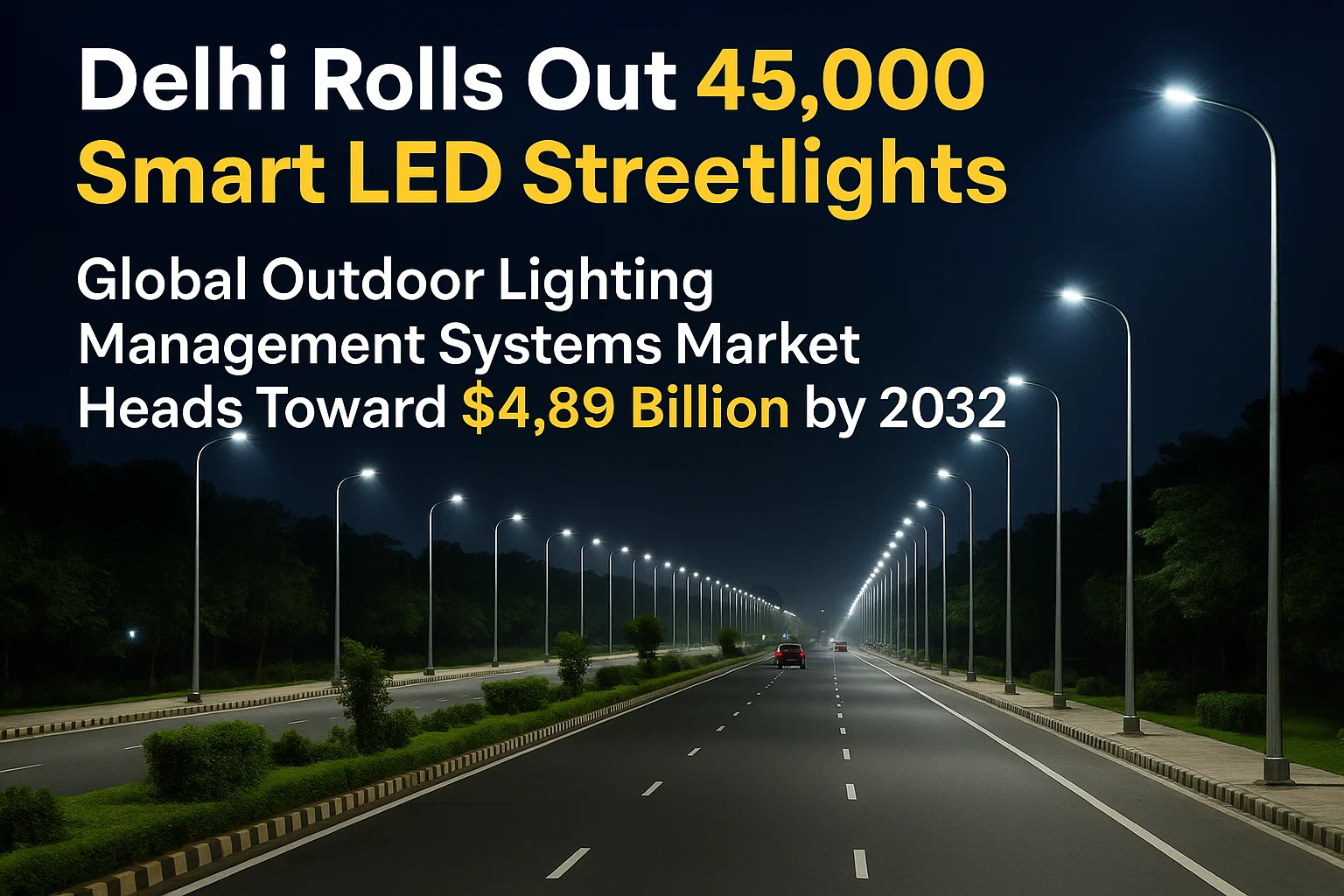
Delhi Rolls Out 45,000 Smart LED Streetlights as Global Outdoor Lighting Management Systems Market Heads Toward $4.89 Billion by 2032
Outdoor lighting is no longer just about illuminating streets and public spaces. Today, it is at the center of a technological revolution transforming cities, municipalities, and even private outdoor landscapes into smart, energy-efficient, and connected ecosystems. With governments pushing for sustainable infrastructure, rising urbanization, and advancements in smart city technologies, Outdoor Lighting Management Systems (OLMS) have become a vital enabler of digital urban transformation.
The Outdoor Lighting Management Systems market was valued at US$ 2.67 billion in 2024 and is projected to reach US$ 4.89 billion by 2032, growing at a CAGR of 7.8% between 2025 and 2032. This robust growth reflects a global transition from conventional lighting to intelligent, sensor-based, and centrally managed networks that optimize energy consumption, improve safety, and reduce maintenance costs.
Recent developments from leading cities, manufacturers, and technology innovators—such as Delhi’s adoption of 45,000 smart LED streetlights, Signify’s expansion of its Interact platform, Govee’s new outdoor lighting innovations, and TVILIGHT’s global deployments—demonstrate how rapidly the industry is evolving. Academic research and pilot projects integrating IoT, LoRaWAN, solar power, visible light communication (VLC), and terahertz (THz) networks are further expanding the scope of what outdoor lighting systems can achieve.
Access Your Free Sample Report- Outdoor Lighting Management Systems Market
Market Overview
The shift from traditional lighting to smart outdoor lighting is fueled by multiple factors:
- Government policies on energy efficiency: Cities worldwide are replacing sodium-vapor lamps with LED and smart-enabled luminaires to cut electricity consumption.
- Smart city initiatives: Lighting infrastructure is increasingly seen as the “digital backbone” of smart cities, doubling as nodes for sensors, connectivity, and even communications.
- Public safety & sustainability goals: Real-time monitoring, adaptive brightness, and motion-sensing capabilities improve citizen safety while reducing carbon footprints.
- Rising electricity costs: Centralized management systems allow municipalities to save millions annually through energy optimization and predictive maintenance.
By 2032, with nearly every major city adopting some form of connected outdoor lighting, OLMS will evolve into multi-service platforms that support traffic monitoring, air quality sensing, and vehicle-to-infrastructure (V2I) communication, making them indispensable for urban governance.
Recent Developments Driving the Market
1. Delhi’s 45,000 Smart LED Streetlights Initiative
One of the largest public lighting upgrades in India is underway in Delhi, where the Public Works Department is replacing 45,000 conventional sodium lights with smart LEDs.
- These LEDs are linked to a centralized dashboard and mobile app for real-time control.
- The system enables remote fault detection, performance tracking, and energy reporting, eliminating manual monitoring inefficiencies.
- Financially, the city expects ₹31.53 crore in annual savings on energy and maintenance.
- A unique “perform first, pay later” EMI-based contract model ensures accountability by shifting the performance risk to contractors.
This project exemplifies how emerging markets are leapfrogging to advanced lighting management while embedding transparency and efficiency in procurement models.
2. Govee’s Smart Outdoor Lighting Innovations
Consumer-driven outdoor lighting is also evolving with Govee’s recent product launches, including:
- Outdoor UpDown Wall Light with independent four-side color adjustment, allowing immersive architectural and decorative lighting.
- Dual-sensor outdoor lamp post light combining brightness and motion sensors for smarter energy use.
- New ranges of garden and string lights featuring durability, smart app control, and color adaptability.
These innovations highlight a trend where residential outdoor lighting merges with smart home ecosystems, making management systems more versatile across both public and private domains.
3. Signify’s Interact City Platform
Signify (formerly Philips Lighting) continues to dominate global smart lighting initiatives with its Interact City platform, which transforms streetlight infrastructure into multi-service smart nodes.
Key features include:
- Centralized lighting management across thousands of luminaires.
- Energy optimization algorithms that balance efficiency and illumination levels.
- Integration of sensors and connectivity for applications beyond lighting, such as environmental monitoring and traffic analytics.
Signify’s global deployments show how lighting management systems are becoming cornerstones of smart city architecture, offering scalability and interoperability.
4. TVILIGHT’s Global Deployments
TVILIGHT, a European leader in smart streetlighting solutions, has now deployed its systems in over 35 countries, including India, South Korea, and several Middle Eastern and European cities.
- Their systems use wireless nodes, adaptive controls, and cloud-based platforms to enable real-time monitoring.
- Cities adopting TVILIGHT solutions report 40–70% energy savings and reduced maintenance cycles.
- Expansion reflects the growing demand for interoperable and cost-efficient OLMS solutions
Download Sample Report PDF- Outdoor Lighting Management Systems Market
5. Academic & Research Innovations
Researchers and universities are pushing the boundaries of outdoor lighting beyond illumination.
- LoRaWAN + IoT + Solar Hybrid Street Lighting Systems: New prototypes integrate motion sensors, ambient light sensors, and solar power with long-range wireless communication, making them ideal for rural or remote deployments.
- VLC + Terahertz Integration: Experimental projects are testing how streetlights can serve as communication nodes for intelligent transportation systems (ITS), enabling vehicle-to-infrastructure (V2I) connectivity.
These advances indicate that future outdoor lighting networks could become part of citywide communication infrastructure, supporting autonomous vehicles and smart mobility.
Market Dynamics
Drivers
- Rising adoption of smart city initiatives
- Government mandates for LED adoption and energy efficiency.
- Growing need for public safety and secure urban infrastructure.
- Declining cost of IoT sensors and wireless connectivity.
- Increasing use of hybrid renewable-powered lighting in developing economies.
Challenges
- High upfront installation costs despite long-term savings.
- Cybersecurity risks as connected infrastructure becomes vulnerable to hacking.
- Lack of standardization in communication protocols (e.g., Zigbee, LoRaWAN, TALQ).
- Resistance in some regions due to budget constraints or lack of technical expertise.
Opportunities
- Integration with 5G, AI, and edge computing for predictive analytics.
- Expansion in Asia-Pacific and Middle Eastern smart city projects.
- Growth in residential and commercial outdoor lighting markets (e.g., smart gardens, campuses, and resorts).
- Development of multi-service poles hosting EV charging, surveillance, and Wi-Fi alongside lighting.
Regional Insights
North America
- Early adoption due to government funding for smart city projects.
- Cities like Los Angeles and Chicago are pioneers in connected LED streetlight upgrades.
- Private sector demand for campus and parking lot lighting is growing.
Europe
- Strong regulatory push for energy efficiency.
- Countries like Germany, the Netherlands, and the UK are leaders in smart lighting deployments.
- European players (Signify, TVILIGHT, Osram) dominate the innovation landscape.
Asia-Pacific
- Fastest-growing region due to urbanization, population density, and government programs.
- India (Delhi, Mumbai, Bengaluru) and China are scaling smart LED networks rapidly.
- Japan and South Korea integrate street lighting with ITS and disaster management systems.
Middle East & Africa
- GCC countries are investing heavily in smart city mega-projects (e.g., Saudi Arabia’s NEOM).
- African nations are adopting solar-powered smart streetlights to overcome unreliable grids.
Competitive Landscape
The market is highly competitive with a mix of global leaders and regional innovators. Key players include:
- Signify (Philips Lighting) – Leader in integrated smart city lighting platforms.
- TVILIGHT – Focused on adaptive and wireless streetlighting systems.
- GE Current – Known for scalable outdoor lighting management systems.
- Osram / ams Osram – Offering IoT-enabled luminaires.
- Cree Lighting – Strong in energy-efficient LED solutions.
- Echelon Corporation – Early pioneer in networked lighting control.
- Govee – Expanding consumer smart outdoor lighting.
Startups and regional players are also entering the market, particularly in IoT integration, renewable-powered lighting, and AI-enabled analytics.
Click Here To Download Full Sample Report- Outdoor Lighting Management Systems Market
Future Outlook
The future of Outdoor Lighting Management Systems is multi-layered and transformative:
- Smart City Integration: By 2032, most streetlight poles will double as multi-utility infrastructure, integrating EV charging, Wi-Fi hotspots, security cameras, and air quality sensors.
- AI-Powered Predictive Maintenance: Systems will increasingly use AI and machine learning to predict lamp failures, optimize brightness schedules, and dynamically adjust energy consumption.
- Communication Hubs: Lighting networks will support vehicle-to-everything (V2X) communication, enabling autonomous vehicle navigation and smart traffic flow.
- Green & Renewable Solutions: Solar, wind-assisted, and hybrid energy sources will dominate outdoor lighting in off-grid and developing regions.
- Decentralized Management: Cloud + edge computing will allow municipalities to manage large networks with low latency and localized intelligence.
With the market set to expand from US$ 2.67 billion in 2024 to US$ 4.89 billion by 2032 at a CAGR of 7.8%, the next decade will witness outdoor lighting transitioning from a cost center to a strategic asset for urban digital ecosystems.

Comments (0)