
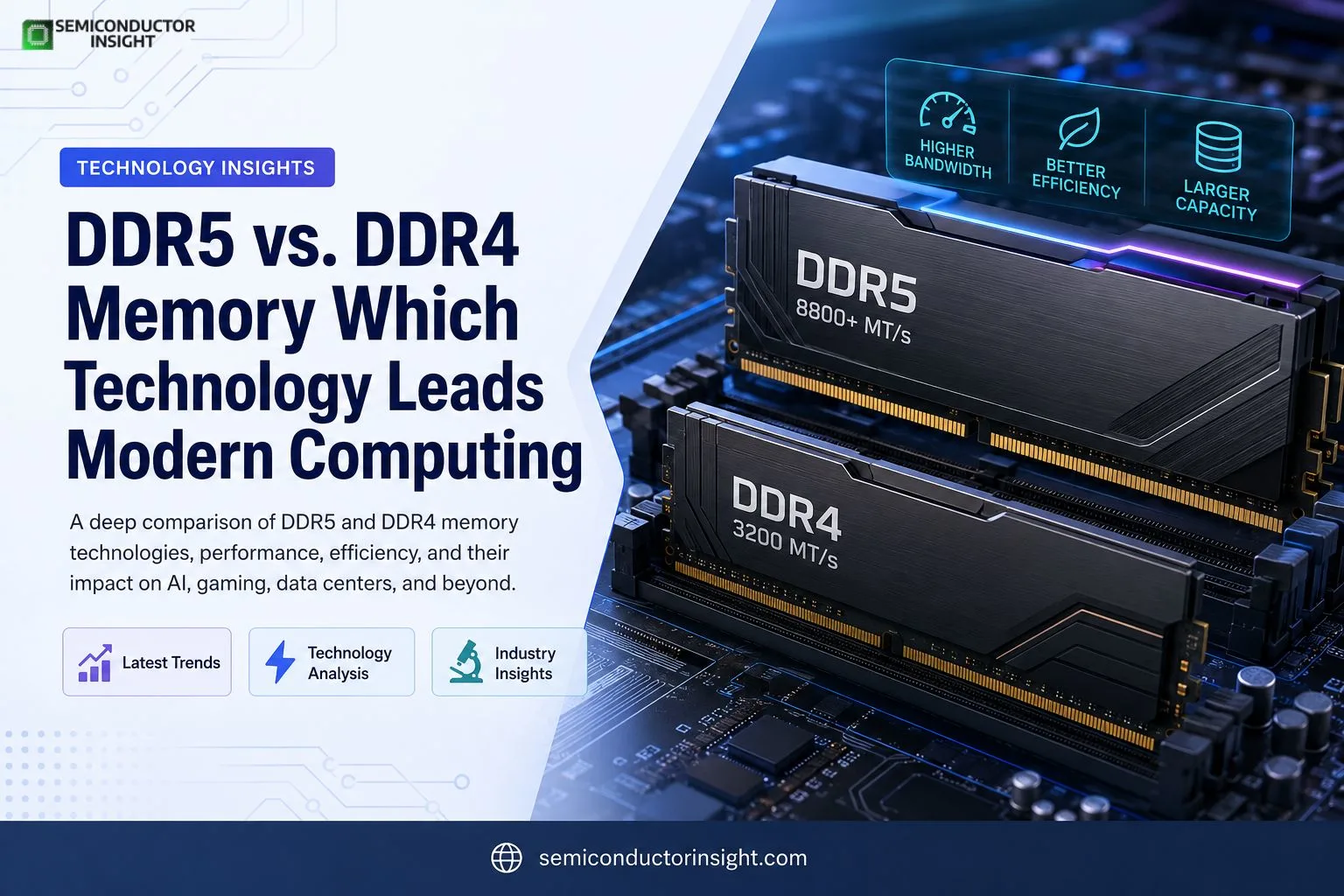
DDR5 vs. DDR4 Memory Market 2026 Which Technology Leads Modern Computing
The semiconductor industry is increasingly shifting attention from processor speed to memory performance. Artificial intelligence training, cloud computing, gaming systems, advanced laptops, and enterprise servers require significantly larger memory bandwidth, placing DDR5 technology at the center of modern computing.
DDR5 provides higher transfer rates, improved power efficiency, increased memory density, and larger capacities compared with previous memory generations. As processors become more powerful, memory systems are becoming equally important in determining overall computing performance.
According to industry publications and JEDEC standards, DDR5 memory speeds have expanded from 4800 MT/s to well beyond 8800 MT/s in advanced systems, allowing processors to handle larger workloads and data-intensive applications.
AI Servers Are Consuming Memory at Historic Levels
Artificial intelligence infrastructure has emerged as one of the strongest growth areas for DDR5 deployment. Modern AI servers may contain several terabytes of memory to support model training and inference operations.
Recent AI server configurations frequently deploy:
- 512 GB memory systems.
- 1 TB server memory configurations.
- Multi-terabyte AI training servers.
- High-bandwidth computing clusters.
- Advanced accelerator platforms.
Major cloud providers continue expanding AI infrastructure facilities, increasing demand for high-capacity DDR5 modules.
Several hyperscale facilities now install thousands of servers containing DDR5 memory systems to support generative AI workloads.
The New Language of Memory Speed
Memory performance measurements have become increasingly important as modern computing workloads demand higher bandwidth and greater capacity. Current DDR5 developments reflect these needs, with transfer speeds now exceeding 6400 MT/s and overclocked modules reaching beyond 9000 MT/s. Module capacities have expanded up to 128 GB, enabling systems to handle much larger datasets in memory.
At the same time, operating voltage has been reduced to approximately 1.1 volts and power management features have been significantly improved, boosting energy efficiency. Together, these advances allow workstations and servers to process larger datasets more quickly while reducing power consumption and improving overall system performance.
Gaming Systems Are Accelerating Consumer Adoption
Gaming platforms have become a key entry point for DDR5 technology. High-end gaming computers launched during 2025 and 2026 increasingly ship with larger and faster memory options, including 32 GB DDR5 configurations and 64 GB systems targeted at creators. Manufacturers are also offering high-frequency gaming modules, RGB memory solutions, and low-latency performance kits.
Because game engines, real-time rendering, and immersive virtual environments demand rapid memory access, DDR5 has emerged as an attractive solution for both enthusiasts and professional creators.
Data Centers Are Building Memory-Rich Architectures
Cloud providers increasingly prioritize memory capacity alongside processor performance.
Modern servers can support:
64 memory channels
↓
Hundreds of gigabytes per server
↓
Multiple processor sockets
↓
Large AI datasets
↓
Reduced data bottlenecks
This architectural shift is making memory a strategic semiconductor component rather than a supporting technology.
Smart Home Ecosystems Creating New Opportunities beyond Computing
Although DDR5 memory is primarily designed for computing applications, the growth of smart homes highlights the increasing intersection between memory advances and connected devices.
Several lighting companies have built ecosystems that integrate smoothly with popular smart-home platforms, including Signify (Philips Hue), Legrand’s smart lighting solutions, Lutron automation systems, TP-Link’s Kasa line, Nanoleaf lighting platforms, and GE Cync connected lighting.
These vendors commonly support voice assistants, mobile apps, and broader connected ecosystems. As smart-home hubs and edge devices grow more powerful, advances in memory technologies such as DDR5 indirectly enable the edge computing capabilities required to manage and coordinate these connected environments.
For More Detailed Insights, You Can Surf Our Latest Report Here: https://semiconductorinsight.com/report/ddr5-chip-market/
Semiconductor Manufacturers Expanding DDR5 Investments
Several companies continue introducing advanced DDR5 products.
Recent examples include:
- Higher-capacity server memory modules
- AI-focused memory solutions
- Low-power laptop memory
- Enterprise-grade registered DIMMs
- High-speed gaming memory products
Memory manufacturers have expanded fabrication capacity to address increasing demand from AI servers, enterprise computing, and advanced workstations.
AI Personal Computers Are Creating another Demand Wave
The emergence of AI PCs during 2025 and 2026 has introduced another important application for DDR5 memory.
AI-enabled laptops frequently include:
- Neural processing units.
- Local AI inference engines.
- Large language model support.
- Enhanced video processing.
- On-device generative AI functions.
These workloads require larger memory pools and faster bandwidth, making DDR5 increasingly standard across premium computing devices.
Memory Is Becoming the Foundation of Modern Computing
The computing industry is entering a period where memory performance directly influences artificial intelligence, cloud infrastructure, gaming experiences, enterprise workloads, and edge computing.
As AI servers expand, personal computers become smarter, and cloud infrastructure grows more complex, DDR5 is evolving from a memory upgrade into a fundamental technology supporting modern digital systems.
Content references are based on JEDEC standards documentation, semiconductor company product announcements, technical journals, IEEE publications, authorized memory manufacturer reports, technology magazines, data center publications, and semiconductor industry articles.

Comments (0)