
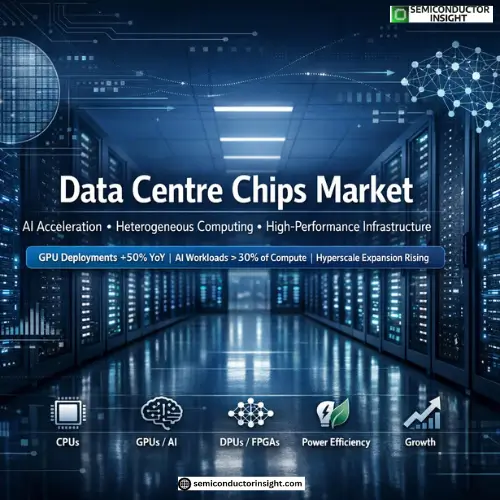
Data Centre Chips Market Growth Strengthens Infrastructure Performance and Scales Cloud Services
Data Centre Chips Market sits at the core of digital transformation. Modern data centres supporting cloud computing, AI, streaming platforms, and enterprise workloads demand chips that can process vast volumes of data with speed, power efficiency, and reliability.
Recent shifts show that data centres no longer rely solely on general-purpose processors. Instead, they are architected around heterogeneous computing, where specialty chips operate in tandem to deliver performance optimized for distinct workloads.
To Stay Tuned with More meaningful and In-Depth Related Insights, Do Visit here:
https://semiconductorinsight.com/report/data-center-chips-market/
Market Scope What Constitutes a Data Centre Chip?
Data centre chips encompass a wide range of silicon solutions:
- Central Processing Units (CPUs) for general compute tasks
- Graphics Processing Units (GPUs) optimized for parallel workloads
- AI Accelerators (e.g., Tensor Cores, NPUs) built for machine learning
- Data Processing Units (DPUs) handling networking and security offload
- Field-Programmable Gate Arrays (FPGAs) for customizable acceleration
This segmentation reflects the complex workload mix inside modern cloud and enterprise infrastructures. In previous years, AI workloads accounted for more than 30% of total data centre compute cycles in large hyperscale facilities, dramatically outpacing traditional virtualization and database tasks. This trend underlines the importance of specialized chip innovation.
Innovation in Chip Architectures: Heterogeneous Integration
The architecture of data centre silicon is evolving rapidly. Hyperscale operators are moving toward chiplet-based and modular designs that disaggregate functionality across smaller, tested silicon blocks. Instead of a single monolithic die, a data centre processor may combine multiple chiplets each fabricated on the most efficient node for its purpose.
This approach delivers:
- Improved yield and manufacturing efficiency
- Greater flexibility in assembling optimized compute fabrics
- Cost advantage vs. monolithic approaches
This shift mirrors broader semiconductor strategy trends, such as multichip packaging and 3D integration, which are accelerating time-to-market and enabling rapid innovation cycles.
AI Acceleration: A Central Demand Vector
Perhaps the strongest driver in the data centre chips market today is AI acceleration. Generative AI, large language models, and real-time analytics require massive computational throughput. Traditional CPUs alone cannot sustain these workloads economically.
As a result:
- GPU deployments in data centres have grown by over 50% year-over-year in several leading cloud providers.
- Custom AI silicon, such as tensor engines or purpose-built NPUs, now commands premium adoption in both hyperscale and enterprise colocation systems.
These accelerators are designed to execute matrix operations, deep learning inferencing, and training workloads far more efficiently than legacy CPU architectures.
DPUs and Networking: Offloading to Maintain Performance
Another trend reshaping demand is the rise of Data Processing Units (DPUs). These chips, often called smart NICs, offload networking, security, and storage management tasks from central CPUs. With data centre throughput reaching terabits per second per rack, DPUs ensure that compute resources remain focused on core workload execution.
DPUs integrate:
- High-speed packet processing
- Encryption/decryption acceleration
- Virtualization support
- Real-time telemetry
The result is an infrastructure that is both scalable and secure, with semiconductors that support performance without bottlenecks.
Power Efficiency and Thermal Design Impact Chip Demand
Data centre operators are intensely focused on power usage effectiveness (PUE), which measures how effectively energy is used within a facility. Semiconductor suppliers are responding with chips designed for:
- Dynamic power scaling
- Low idle draw
- Optimized PVT (process-voltage-temperature) response
In many modern racks, energy consumption for cooling and power distribution competes with core compute costs. As a result, chips optimized for energy efficiency without sacrificing throughput are gaining strategic adoption, particularly in regions with high electricity prices or carbon pricing regimes.
Regional Patterns in Data Centre Chip Adoption
North America and Western Europe continue to lead in chip adoption intensity, fuelled by massive hyperscale cloud deployments and AI R&D investment hubs. However, Asia-Pacific, especially China and India, is rapidly expanding data centre capacity. Government policies supporting digital infrastructure, 5G rollout, and AI innovation have catalysed annual server deployment growth rates of 20-25% in key markets.
These regional dynamics have direct implications for semiconductor suppliers, who balance production capacity with localized demand patterns and data sovereignty regulations.
Supply Chain, Node Transition, and Manufacturing Strategies
The competitive landscape for data centre chips is tightly linked to advanced manufacturing nodes. Leading-edge fabs (5 nm, 3 nm) enable higher transistor density and lower power per operation, but they come with significantly higher capital costs.
Consequently:
- Many vendors are adopting heterogeneous node strategies, placing high-performance cores on bleeding-edge nodes and peripheral logic on mature nodes.
- Chiplet strategies and advanced packaging reduce dependence on extreme scaling while delivering performance parity.
This agility in manufacturing strategy is increasingly important as geopolitical factors influence fab partnerships, export controls, and supply chain resilience.
Security and Reliability: Increasing Importance of Trusted Silicon
With rising cyber threats and distributed cloud architectures, hardware-level security features are becoming non-negotiable. Secure enclaves, encrypted memory regions, and silicon-rooted trust modules help ensure that data centre workloads especially multi-tenant and regulated workloads remain protected.
Reliability is equally significant: mission-critical applications cannot tolerate frequent hardware faults. As a result, semiconductor vendors invest heavily in fault tolerance, ECC memory integration, and real-time health monitoring within chip designs.
Looking forward, the data centre chips market is expected to grow as:
- AI, machine learning, and analytics dominate workload profiles
- Chip architectures become more modular and customizable
- Energy efficiency and security become integrated performance metrics
From this perspective, the data centre chips market is more than a supplier-buying cycle; it is a strategic infrastructure investment shaping the digital economy.

Comments (0)