
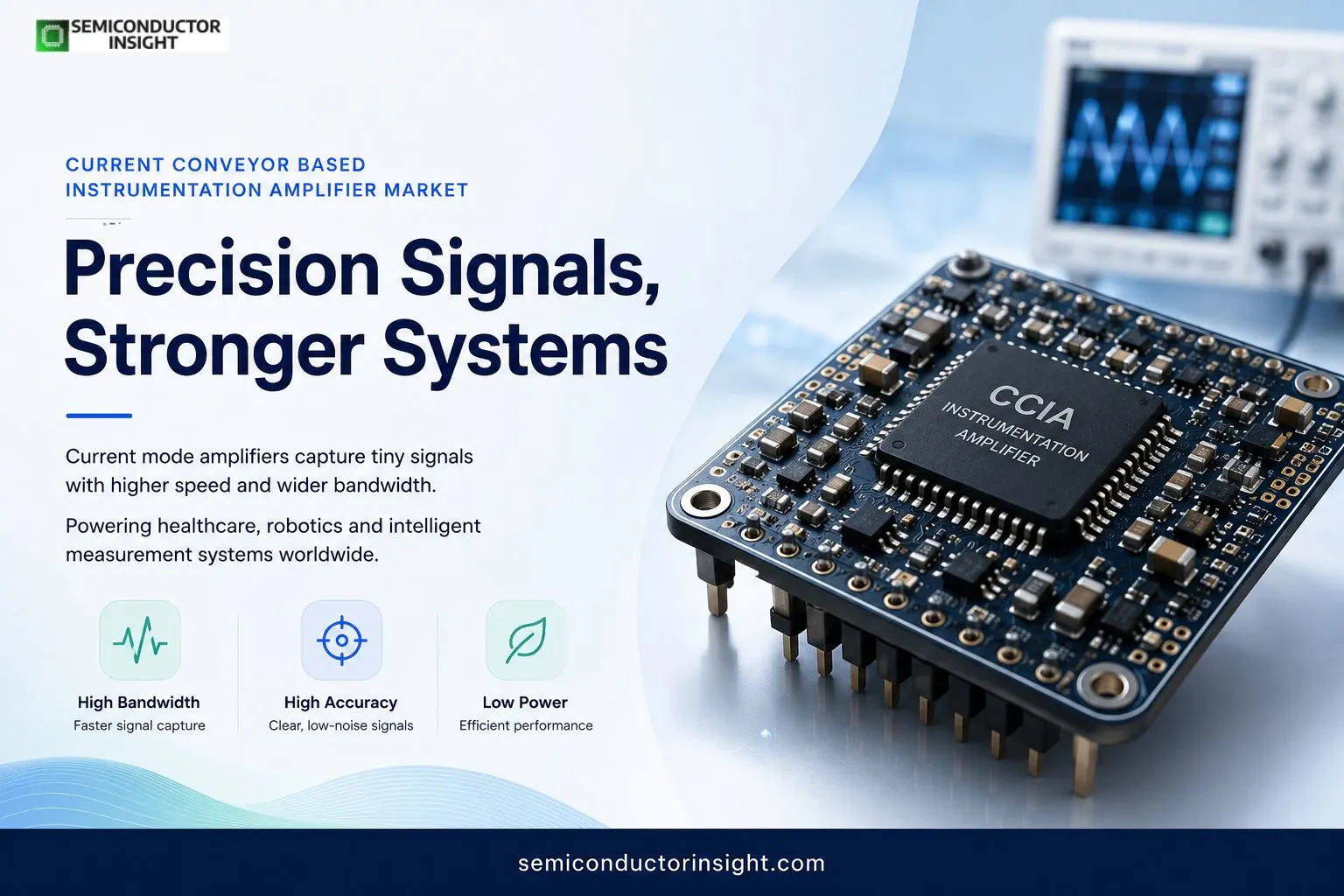
Current Conveyor Based Instrumentation Amplifier Market Where Precision Analog Design Meets High Speed Electronics
The evolution of semiconductor technology is no longer defined only by digital processing power. Modern electronic systems increasingly depend on precision analog front ends capable of capturing extremely small electrical signals while maintaining high bandwidth and low power consumption.
This shift has brought renewed attention to Current Conveyor Based Instrumentation Amplifier Market, where current mode signal processing is emerging as an efficient alternative to conventional operational amplifier architectures. From wearable medical devices and industrial sensors to automotive electronics and intelligent measurement systems, current conveyor based instrumentation amplifiers are enabling faster signal acquisition with improved linearity and wider operating bandwidth.
Why Current Mode Circuits Are Returning to the Spotlight?
Current conveyor circuits have the advantage of processing signals at much higher slew rates and wider frequency responses than conventional voltage-mode operational amplifiers, with minimal gain-bandwidth limitations. This makes them attractive for use in applications that require real-time analog signal conditioning.
Recent studies published through IEEE journals show that the second generation current conveyors (CCII) outperform conventional operational amplifier configurations in high frequency analog circuits, especially where low distortion and low propagation delay are desired. For mixed-signal integration, semiconductor geometries are moving below 10 nm and thus designers combine current conveyor architectures with CMOS technology more often to improve speed without significant power increase.
Precision Electronics Are Expanding the Application Landscape
- Instrumentation amplifiers remain fundamental components in systems where microvolt-level signals must be amplified without introducing excessive noise.
- Healthcare electronics provide one of the strongest examples. Electrocardiogram (ECG) signals typically range between 0.5 millivolts and 4 millivolts, while electroencephalogram (EEG) signals are often only 10 to 100 microvolts.
- Processing signals at these levels requires exceptionally low input offset voltage and high common-mode rejection, making advanced instrumentation amplifier designs indispensable.
- Industrial automation also continues expanding demand. According to the International Federation of Robotics, more than 4.28 million industrial robots are now operating in factories worldwide.
- Each robotic platform integrates multiple precision sensing modules that depend on high-performance analog signal conditioning before digital processing.
Semiconductor Manufacturing Is Reinforcing Analog Innovation
Global semiconductor investment is creating opportunities beyond processors and memory devices.
The Semiconductor Industry Association reported worldwide semiconductor sales exceeding USD 600 billion during recent industry cycles, while analog integrated circuits continue representing an essential portion of mixed-signal device production. Government-backed manufacturing initiatives across the United States, Europe, Japan, South Korea, and India are supporting new fabrication capacity capable of producing advanced analog and mixed-signal devices alongside digital logic.
As fabrication processes mature, designers are integrating current conveyor circuits with analog-to-digital converters, sensor interfaces, and low-power microcontrollers on single chips, reducing board complexity while improving overall system reliability.
Emerging Design Priorities Are Changing Amplifier Architecture
Several technology trends are reshaping instrumentation amplifier development.
Wearable electronics increasingly require supply voltages below 1.8 volts, pushing engineers toward current conveyor circuits capable of maintaining stable operation under low-voltage conditions. Automotive electronics are simultaneously demanding wider temperature tolerance for battery management systems, electric power steering, and advanced driver assistance platforms.
Artificial intelligence at the edge is creating another opportunity. Smart sensors increasingly preprocess analog information before digital conversion, allowing current conveyor based instrumentation amplifiers to reduce noise and improve signal integrity before machine learning algorithms analyze incoming data.
Research Laboratories Are Moving Beyond Conventional Analog Blocks
- University laboratories and semiconductor research centers are actively exploring programmable current conveyor architectures capable of adapting gain, bandwidth, and power consumption dynamically.
- Recent publications describe reconfigurable analog front-end circuits suitable for biomedical monitoring, wireless sensor networks, and Internet of Things devices where energy efficiency is becoming equally important as measurement accuracy.
- Researchers are also integrating current conveyor topologies with memristor-based analog circuits and neuromorphic computing platforms, opening possibilities for future mixed-signal processors that combine conventional semiconductor logic with brain-inspired architectures.
Lastly before we wrap up, don’t forget to look at our most recent exclusive report for in-depth insights: https://semiconductorinsight.com/report/current-conveyor-based-instrumentation-amplifier-market/
Where Precision Meets Next Generation Semiconductor Systems
Current Conveyor Based Instrumentation Amplifier Market is steadily evolving from an academic circuit concept into a practical building block for next-generation electronics. As medical diagnostics, industrial automation, edge AI, automotive sensing, and smart instrumentation continue demanding faster analog processing with lower power consumption, current conveyor architectures are finding renewed relevance.
Their ability to combine wide bandwidth, high linearity, compact integration, and efficient signal conditioning positions them as an increasingly valuable component within tomorrow’s precision semiconductor ecosystem.

Comments (0)