

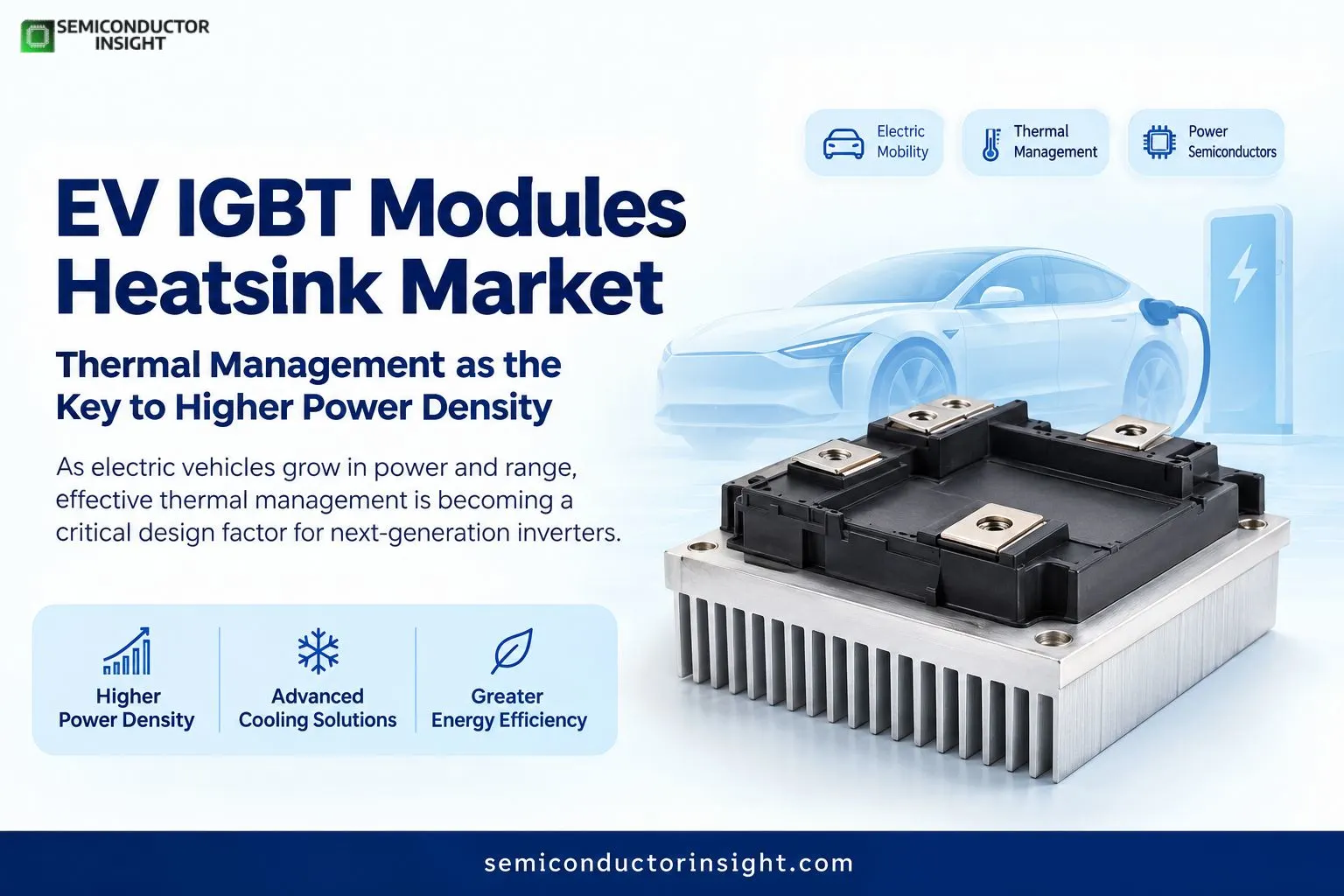
Conventional Heatsinks vs. Direct Cooling as the EV IGBT Modules Heatsink Market Evolves
The electric vehicle powertrain has an unusual engineering problem: the smaller and more powerful the inverter becomes, the harder it is to get rid of the heat generated inside it. IGBT modules sit at the centre of this problem.
They switch high electrical currents to control the traction motor, while the associated heatsink or cooling structure must continuously carry thermal energy away from the semiconductor package. As EV platforms move toward greater power density, thermal management is becoming less of a supporting component and more of an architectural decision.
The EV Surge Is Changing the Thermal Equation
- The scale of electrification explains why this niche component is attracting greater engineering attention.
- Global electric car sales exceeded 20 million units in 2025, representing roughly one in four new cars sold worldwide.
- The IEA expects sales to reach around 23 million in 2026, equivalent to approximately 29% of global car sales.
- This translates into a much larger installed base of traction inverters, power modules and thermal-management assemblies.
The relationship is straightforward:
More EVs → More traction inverters → More power semiconductor modules → Greater heat generation → More sophisticated thermal paths
Why a Heatsink Is No Longer Just a Metal Block?
An EV inverter can experience substantial heat during acceleration, regenerative braking and sustained high-load operation. The heatsink’s job is therefore not simply to absorb heat. It must establish a low-resistance path from the semiconductor junction through the module, thermal interface material, baseplate and cooling medium.
Infineon’s automotive HybridPACK DC6i provides a useful illustration of this design direction. The module is rated at 750 V and 650 A, supports operation around 100 kW inverter designs, incorporates a direct-cooled baseplate and includes an integrated NTC temperature sensor. Its operating junction temperature is specified at 150°C, with short-time extended operation up to 175°C.
That combination demonstrates why heatsink design increasingly has to be considered together with the semiconductor package rather than as an independent component.
Direct Cooling Is Changing the Physical Layout
One of the most important developments is the move toward direct cooling. Instead of allowing heat to travel through multiple conventional layers before reaching the cooling structure, direct-cooled designs shorten the thermal path.
Automotive power-module portfolios now include single-side and dual-side cooling architectures. onsemi, for example, lists automotive IGBT modules at 750 V with current ratings of 500 A, 600 A, 660 A and 800 A, including direct-cooling and dual-side-cooling configurations.
The engineering objective is clear: move greater quantities of heat away from a smaller package without creating excessive thermal gradients.
The Liquid-Cooled Inverter Has Become a Practical Reference Architecture
- Liquid cooling is particularly relevant because vehicle manufacturers already operate sophisticated coolant loops for batteries, motors and power electronics. A documented onsemi automotive reference design for a 25 kW belt starter-generator/integrated starter-generator system used a three-phase automotive liquid-cooled inverter stage with a liquid-cooled heatsink.
- This approach allows the heatsink to exchange heat directly with a flowing coolant rather than relying entirely on ambient air.
IGBT junction → chip/package → thermal interface → cooled baseplate → coolant → vehicle thermal loop
- The closer each stage can be brought together, the easier it becomes to control temperature under rapidly changing electrical loads.
Current Ratings Are Pushing Thermal Design Harder
The numbers attached to automotive IGBT technology show how demanding these systems have become. onsemi’s automotive traction-inverter portfolio includes 750 V modules rated at up to 950 A, while its commercial-vehicle power-module portfolio includes a 650 V, 450 A IGBT module with a specified module operating junction temperature of 175°C.
These figures do not mean every EV uses such ratings. Instead, they show the range of electrical conditions that thermal engineers must increasingly accommodate across passenger vehicles, hybrids and commercial platforms.
IGBT Is Still Relevant Even as SiC Expands
Silicon carbide has become an important alternative in high-efficiency traction applications, but IGBT technology remains significant because of its established manufacturing ecosystem, cost characteristics and suitability for numerous vehicle architectures.
The transition is therefore not simply IGBT versus SiC. It is also about whether the thermal architecture can support the semiconductor technology selected for a particular voltage, switching frequency, vehicle power level and cost target.
That is why companies are developing both IGBT and SiC modules alongside increasingly sophisticated cooling approaches. onsemi’s traction-inverter portfolio, for instance, contains automotive IGBT modules as well as 900 V and 1200 V SiC power modules.
Packaging and Heatsink Design Are Becoming One Engineering Problem
The boundaries between semiconductor packaging and thermal hardware are becoming increasingly blurred. Copper baseplates, thermal interface materials, direct cooling, integrated temperature sensing and low-inductance module construction are being developed as interconnected features.
Infineon highlights optimized thermal resistance to the heatsink and pre-applied thermal interface material in its power-module technologies, while automotive modules increasingly integrate temperature sensing directly into the power package.
This means future heatsink selection will increasingly depend on the complete inverter assembly rather than on thermal conductivity alone.
At Last, before Ending, Don’t Forget to Browse Our Recent Exclusive Report for Detailed Insights: https://semiconductorinsight.com/report/ev-igbt-modules-heatsink-market/
What the 2026 EV Cycle Means for Thermal Hardware?
- The latest EV numbers make the direction difficult to overlook.
- In the first half of 2026, global electric-car sales were 24% of total car sales, while the second quarter saw electric-car sales rise 35% from the first quarter and record quarterly sales in 50 countries.
- More than 90 countries recorded year-on-year EV sales growth during the first half of the year.
- For the EV IGBT modules heatsink market, the opportunity is consequently tied to a deeper change than vehicle-unit growth alone.
- Higher inverter currents, compact packaging, direct cooling, liquid thermal loops and increasingly integrated power electronics are collectively changing what a heatsink needs to accomplish.
The next generation of thermal hardware will be judged not merely by how much heat it can remove, but by how efficiently it fits into the inverter, how consistently it maintains semiconductor temperature, and how little space and mass it adds to the vehicle. That makes thermal architecture an increasingly important part of electric-powertrain design rather than a secondary mechanical consideration.

Comments (0)