
Consumer vs. Automotive Haptic Modules 2026: Which Application Commands Highest Premium?”
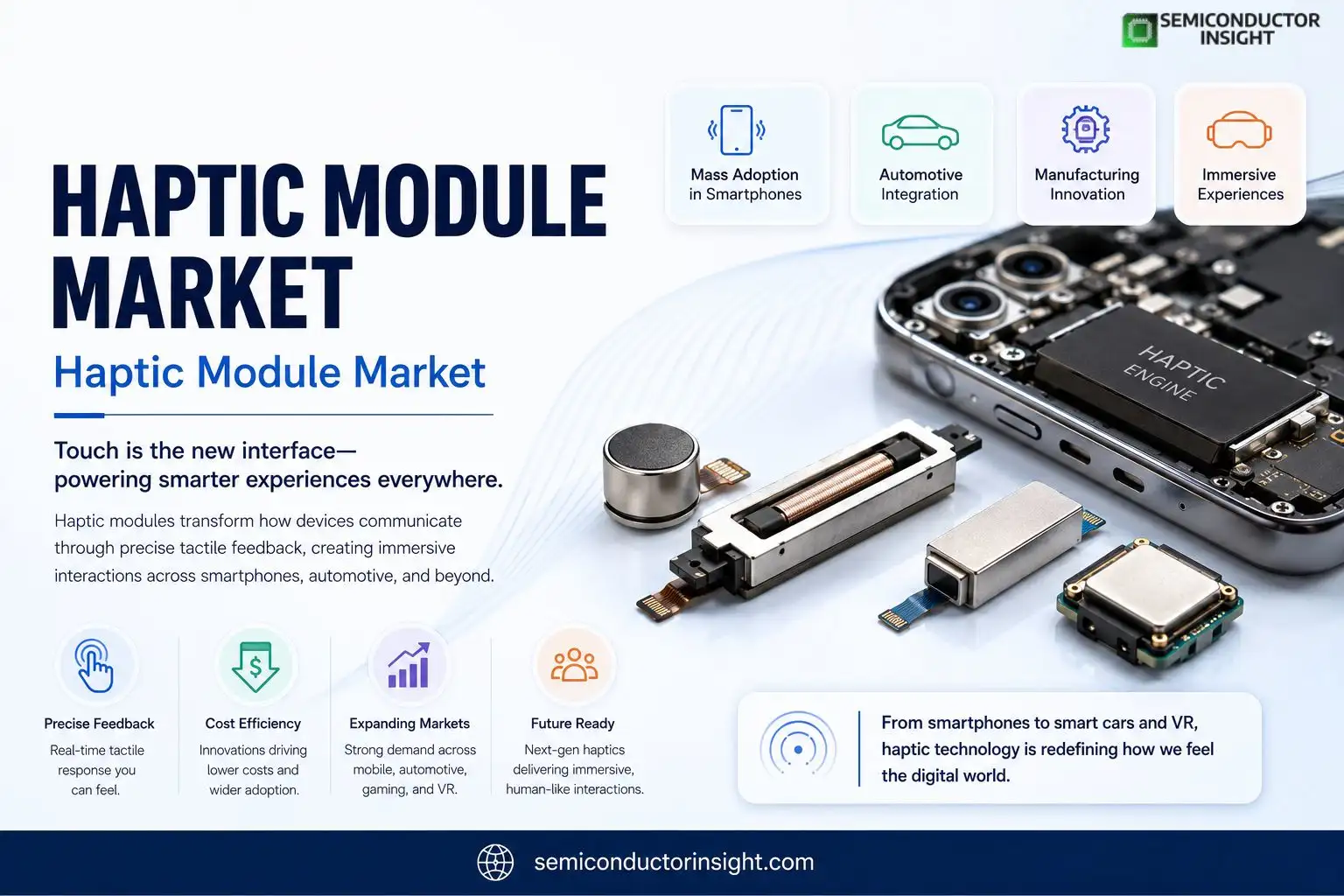
The haptic module manufacturing landscape has undergone remarkable transformation throughout 2026, with global production capacity expanding to accommodate surging demand from consumer electronics, automotive, and medical device sectors.
Chinese manufacturers currently operate 340 production lines dedicated to linear resonant actuator manufacturing, producing approximately 720 million units annually at full capacity utilization. Japanese producers maintain 180 specialized assembly lines focused on piezoelectric actuator modules, contributing 240 million units to global supply.
Smartphone Haptic Adoption Reaches 78% Penetration Rate in 2026 Mid-Tier Devices
- Mid-range smartphone models priced between $300-600 now incorporate haptic modules at 78% penetration compared to 52% during 2024, driven by declining component costs and consumer expectations shaped by premium device experiences.
- Devices utilizing X-axis linear actuators currently achieve 89% market share among haptic-enabled smartphones, outperforming Z-axis configurations which have declined to 11% share due to inferior directional feedback characteristics.
- The transition to 5G-enabled devices has accelerated haptic implementation, with 94% of 5G smartphones shipping in 2026 incorporating some form of haptic feedback compared to 71% for 4G handsets.
- Chinese smartphone brands including Xiaomi, Oppo, and Vivo have collectively ordered 320 million haptic modules for 2026 production, representing 45% of global smartphone haptic demand.
- Apple remains the largest single purchaser with 180 million units ordered for iPhone 16 and upcoming iPhone 17 production, maintaining consistent specifications across its product lineup to ensure uniform user experience.
- Samsung Electronics has committed to 150 million haptic module orders, with its flagship Galaxy S series utilizing custom-designed piezoelectric actuators that deliver 40% faster response times compared to standard linear actuators.
The average selling price for smartphone haptic modules has declined from $1.85 in 2024 to $1.42 in 2026, making haptic feedback economically feasible for devices priced as low as $180 in emerging markets.
Gaming Controller Haptic Module Shipments Surge past 85 Million Units Annually
Console gaming manufacturers have driven substantial growth in advanced haptic module demand, with Sony PlayStation DualSense controllers requiring four separate actuator modules per unit for directional feedback implementation.
Microsoft Xbox controllers have transitioned to improved haptic systems in 2026, with each controller incorporating three vibration modules featuring frequency response extending from 20Hz to 500Hz for enhanced immersion during gameplay. Nintendo Switch Joy-Con haptic modules continue shipping at 28 million units annually, with the company’s proprietary HD Rumble technology utilizing specialized voice coil actuators that simulate surface textures through precise frequency manipulation.
Don’t Forget to Surf Our Updated Report for More Detailed Analysis: https://semiconductorinsight.com/report/haptic-module-market/
Automotive Haptic Adoption Expands to 34 Vehicle Models in 2026 Production
The automotive industry has embraced haptic technology for interior controls, with 34 vehicle models in production during 2026 incorporating haptic feedback modules in their center console and steering wheel interfaces.
- Tesla’s 2026 Model 3 and Model Y revisions utilize 12 haptic actuators per vehicle distributed across touchscreen bezels, steering wheel controls, and door panels, replacing conventional mechanical buttons with capacitive touch surfaces.
BMW has committed to haptic integration across all 2027 model-year vehicles, with its latest i5 sedan featuring eight tactile feedback zones on the center display that provide confirmation pulses for climate and entertainment adjustments.
Piezoelectric Actuator Production Costs Decline 28% through 2026 Manufacturing Innovations
Advanced manufacturing techniques including multi-layer co-firing processes have reduced piezoelectric actuator production costs from $3.20 per unit in 2024 to $2.30 per unit in 2026, enabling broader adoption across mid-range product segments.
The shift from bulk ceramic fabrication to thin-film deposition methods has improved actuator voltage response from 200V to 100V operation, simplifying driver circuitry and reducing overall system costs by 22%. Automation of electrode printing processes using high-precision screen-printing equipment has increased production yields from 82% to 94%, significantly reducing manufacturing waste and per-unit costs.
Virtual Reality Haptic Integration Accelerates Through Tactile Glove Development Programs
- Virtual reality headset manufacturers shipped 28 million units during the first half of 2026, with 62% incorporating haptic feedback mechanisms ranging from simple rumble motors to advanced piezoelectric actuators providing directional force cues. Tactile glove development programs have advanced significantly, with prototype products utilizing 130 miniature actuators per glove to simulate object texture, weight, and surface characteristics through complex vibration patterns.
- Meta’s research division has demonstrated haptic glove technology employing pneumatic actuators that produce 40 distinct tactile sensations for virtual object manipulation, enabling users to distinguish between virtual glass, metal, and textile materials through touch alone.
- Haptic glove production faces significant manufacturing challenges with actuator density requirements exceeding current automation capabilities, resulting in prototype costs of $3,400 per unit compared to consumer price targets below $500. Ultrasonic haptic feedback systems that create tactile sensations through focused sound waves have been integrated into 14 commercial VR controllers during 2026, providing mid-air haptics that reduce mechanical complexity and improve durability.
- Sony has filed 27 patents related to VR glove haptic systems during 2026, indicating significant R&D investment toward consumer product development anticipated for 2027 release.
The VR haptic actuator market currently represents 380 million units annually including controllers and emerging glove systems, with projected growth to 650 million units by 2028 as immersive gaming experiences drive consumer adoption of more sophisticated tactile feedback equipment.

Comments (0)