
Haptic Module Market Insights
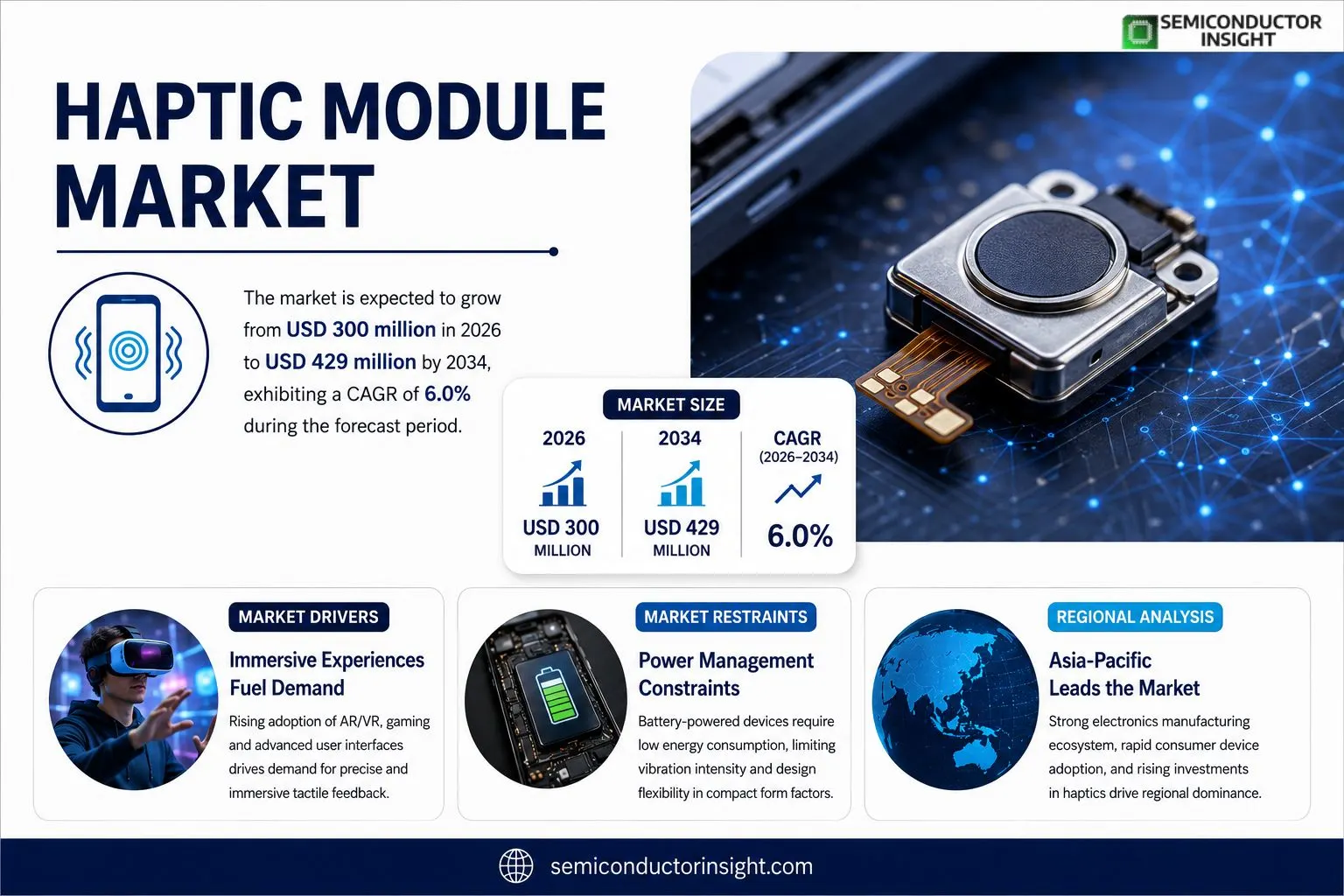
Haptic Module market size was valued at USD 289 million in 2025. The market is expected to increase from USD 300 million in 2026 to USD 429 million by 2034, exhibiting a CAGR of 6.0% during the forecast period.
A haptic module integrates a haptic actuatorsuch as an eccentric rotating mass motor, linear resonant actuator, or piezo elementwith supporting mechanical structure, electrical connections, and often a dedicated driver or control circuitry. This compact unit converts electrical signals into controlled vibrations or forces, delivering consistent tactile feedback for smartphones, wearables, automotive interfaces, and gaming devices.Growth is supported by rising consumer demand for richer touch experiences, ongoing miniaturization of electronic devices, and expanding applications in AR/VR and automotive systems. Cost pressures remain as OEMs seek lower‑price solutions while maintaining performance, prompting manufacturers to innovate around power efficiency and integration complexity.
MARKET DRIVERS
Immersive Experiences Fuel Demand
The surge in augmented and virtual reality platforms has pushed manufacturers to embed richer tactile feedback. Haptic Module Market players are scaling production to meet the need for precise vibration patterns that anchor users in digital environments, thereby raising the perceived value of head‑mounted displays and handheld controllers.
Automotive Interfaces Evolve
Advanced driver‑assistance systems now rely on touch cues to convey alerts without distracting the driver. This shift encourages automakers to source compact, low‑latency haptic modules, creating a steady pipeline of orders for suppliers that can demonstrate durability under temperature extremes.
➤ Strategic partnerships between semiconductor firms and tactile‑engine manufacturers are accelerating integration cycles, reducing time‑to‑market for next‑generation cockpit solutions.
Beyond consumer electronics, industrial automation is embracing force‑feedback devices to improve operator precision. Companies that can deliver modules with configurable force envelopes are gaining traction among robotics integrators seeking to cut downtime.
MARKET CHALLENGES
Cost Sensitivity Across Segments
While premium devices justify higher component prices, mass‑market smartphones remain price‑pressured. Producers face the dilemma of embedding sophisticated tactile actuation without inflating bill‑of‑materials, prompting a search for cost‑effective materials and streamlined assembly lines.
Other Challenges
Power Management Constraints
Battery‑driven applications demand haptic solutions that consume minimal energy. Designers must balance actuator strength with power draw, a trade‑off that frequently limits the intensity of feedback in wearables and IoT devices.
MARKET RESTRAINTS
Regulatory and Safety Hurdles
In sectors such as medical simulation, haptic modules must satisfy stringent safety certifications. The rigorous testing cycles and documentation requirements extend product development timelines, curbing the speed at which new designs can enter the Haptic Module Market.
MARKET OPPORTUNITIES
5G‑Enabled Tactile Streaming
Emerging 5G networks enable low‑latency transmission of tactile data, opening avenues for remote haptic experiences in gaming, tele‑operation, and virtual training. Companies that can package modules with embedded edge‑processing capabilities stand to capture a growing niche of service‑oriented customers.
Haptic Module Market Trends
Integration into Mobile and Wearable Devices
The Haptic Module Market is witnessing a decisive shift as manufacturers embed tactile units directly into the chassis of smartphones and wearables. By consolidating the actuator, driver circuitry and packaging into a single calibrated block, designers eliminate separate component layouts, which shortens development cycles and reduces risk of mechanical mismatches. This integration aligns with the industry’s push toward slimmer profiles and higher touch‑sensitivity, allowing device makers to deliver richer feedback without sacrificing battery life. The compact nature of modern modulesoften priced between US$0.5 and US$5makes them attractive for high‑volume production, encouraging OEMs to specify them as standard parts rather than optional accessories. Consequently, supply chains are seeing tighter coupling between semiconductor fabs, magnetic material providers and the specialized module assemblers that bundle these elements into ready‑to‑use units.
Other Trends
Cost and Power Efficiency Pressures
Cost and power efficiency have become decisive considerations for buyers. As smartphones approach the sub‑5‑nanometer node and wearables shrink to sub‑50‑gram, the allowable power budget for haptic feedback drops sharply. Designers therefore favor linear resonant actuators and piezoelectric elements that deliver perceptible vibration at lower voltage swings, even though such devices command a premium price. Simultaneously, OEMs pressure module suppliers to tighten bill‑of‑materials, prompting a wave of design‑for‑manufacturing optimizations such as integrated driver ICs and reduced‑leadframe footprints. The net effect is a market segment where price elasticity coexists with a demand for higher performance, forcing suppliers to balance upfront engineering costs against long‑term volume gains.
Software‑Defined Haptic Experiences
Software‑defined haptics is reshaping the Haptic Module Market by decoupling tactile patterns from hardware constraints. With firmware that can modulate pulse width, frequency and amplitude on the fly, a single module can support multiple user‑experience scenariosfrom subtle notification taps to immersive gaming cueswithout physical redesign. This flexibility encourages automotive manufacturers and AR/VR platform providers to adopt haptic modules as a core interface element, knowing that future software updates can extend functionality. For module producers, the trend translates into a value‑added service model, where firmware licensing and customization become revenue streams alongside the hardware sale. Companies that invest early in robust driver architectures and open‑API ecosystems are likely to capture a larger share of the evolving ecosystem.
COMPETITIVE LANDSCAPE
Key Industry Players
Haptic Module Market – Competitive Landscape Overview
Synaptics dominates the high‑volume segment, supplying integrated haptic modules to the majority of flagship smartphones and premium wearables. Its breadth of driver‑IC expertise and close ties with major OEMs create a de‑facto standard for ERM‑based solutions, allowing it to leverage economies of scale while maintaining tight control over firmware calibration. This scale advantage also forces smaller manufacturers to focus on differentiated actuation technologies or niche applications where Synaptics’ price point is less competitive. The market structure therefore resembles a tiered hierarchy: a handful of full‑stack suppliers command the bulk of revenue, while a second tier of specialists supplies customized LRA or piezo modules for emerging AR/VR and automotive touch‑panel projects.Beyond the leader, a diverse set of players occupies niches that reflect divergent end‑user demands. Cirque has carved out a reputation for high‑fidelity VR haptics, leveraging proprietary micro‑actuator arrays that deliver localized feedback for immersive controllers. Azoteq concentrates on automotive and industrial panels, where robust sealed packages and low‑power drivers are prized. Tangio and RichTap focus on cost‑sensitive wearables, offering sub‑$1 modules with simplified driver integration. Meanwhile firms such as Shenzhen Goodix Technology, Liteon, Jiangsu Transimage Technology, Shanghai Awinic Technology, Beijing Taifang Technology, Boréas Technologies, TDK and Alps Alpine each bring regional manufacturing strength or material‑science expertise that sustains a competitive supply base across Asia‑Pacific and Europe.
List of Key Haptic Module Companies Profiled
- Synaptics
- Cirque
- Azoteq
- Tangio
- Boréas Technologies
- Shenzhen Goodix Technology
- Liteon
- Jiangsu Transimage Technology
- Shanghai Awinic Technology
- RichTap
- Beijing Taifang Technology
- TDK
- Alps Alpine
Segment Analysis:
| Segment Category | Sub-Segments | Key Insights |
| By Type |
|
Electromagnetic Actuation leads the market because:
|
| By Application |
|
Mobile Terminals dominate due to:
|
| By End User |
|
Consumer Electronics OEMs are the primary drivers because:
|
| By Drive Architecture |
|
Closed‑loop Drivers are gaining traction because:
|
| By Integration Level |
|
Advanced Multi‑Modal Modules are emerging as the preferred choice because:
|
Regional Analysis: Haptic Module Market
North America
The corridor between Boston’s biotech labs and Austin’s hardware incubators fuels cross‑disciplinary prototypes, enabling haptic modules that blend tactile realism with biometric sensing. Companies that can co‑develop such hybrid devices are redefining user interaction paradigms across medical training and remote collaboration.
Proximity to semiconductor fabs and component distributors shortens lead times, allowing North American manufacturers to respond to design changes within days rather than weeks. This agility is a decisive factor when original equipment manufacturers demand iterative testing cycles.
The FDA’s emerging guidance on haptic feedback for therapeutic devices encourages early engagement, while the FCC’s standards for electromagnetic compatibility ensure that new modules can be integrated without extensive redesign.
Brands seeking to differentiate in crowded consumer markets view precise vibration patterns as a premium feature. This perception pushes marketers to allocate larger budgets toward tactile experiences that reinforce brand identity.
Europe
European manufacturers leverage a mature standards framework that harmonizes device certification across the EU, simplifying cross‑border distribution. German engineering firms excel in high‑precision actuation, while Scandinavian design studios prioritize minimalistic aesthetics that translate into sleek haptic housings. Collaborative research programs funded by Horizon Europe stimulate joint ventures between academia and industry, especially in haptics for virtual prototyping and tactile e‑learning platforms. The combined effect is a market where technical excellence meets regulatory certainty, encouraging OEMs to source modules from established regional suppliers.
Asia‑Pacific
In the Asia‑Pacific corridor, rapid consumer adoption of smartphones and gaming consoles creates a fertile ground for tactile innovations. Japanese firms lead in miniature motor technology, while South Korean companies integrate haptic feedback directly into display panels, blurring the line between hardware and user interface. Emerging manufacturing hubs in Vietnam and India provide cost‑effective production capacity, attracting brands looking to balance quality with price. The region’s emphasis on experiential retail also fuels demand for immersive haptic installations in malls and transport hubs.
South America
South American interest in haptic solutions is anchored by a growing mobile gaming community and a nascent automotive electrification agenda. Brazilian startups experiment with low‑power vibration modules suited for affordable wearables, while Argentine research institutes explore haptic cues for assistive technologies aimed at aging populations. Although the supply chain is less mature than in other regions, partnerships with North American firms are accelerating knowledge transfer and establishing local assembly lines.
Middle East & Africa
The Middle East & Africa segment is characterized by selective investment in high‑impact applications such as defense training simulators and premium hospitality experiences. United Arab Emirates’ smart‑city initiatives incorporate haptic feedback into public‑space wayfinding systems, demonstrating a willingness to fund cutting‑edge prototypes. In Africa, pilot projects leverage low‑cost haptic modules to enrich educational tools in remote schools, highlighting a pragmatic approach where functionality outweighs elaborate design.
Report Scope
This market research report provides a comprehensive analysis of the Haptic Module Market , covering the forecast period 2026–2034. It offers detailed insights into market dynamics, technological advancements, competitive landscape, and key trends shaping the industry.
Key focus areas of the report include:
- Market Overview: The report begins with an overview outlining its current market scenario, key growth indicators, and industry transformation drivers. It discusses macroeconomic factors, demand–supply balance, regulatory landscape, and the strategic role of semiconductors in powering advancements across industries such as automotive, telecommunications, consumer electronics, and industrial automation.
- Market Size & Forecast: Historical data and future projections for revenue, unit shipments, and market value across major regions and segments.
- Segmentation Analysis: Detailed breakdown by product type, technology, application, and end-user industry to identify high-growth segments and investment opportunities.
- Regional Insights: Insights into market performance across North America, Europe, Asia-Pacific, Latin America, and the Middle East & Africa, including country-level analysis where relevant.
- Competitive Landscape: Profiles of leading market participants, including their product offerings, R&D focus, manufacturing capacity, pricing strategies, and recent developments such as mergers, acquisitions, and partnerships.
- Technology Trends & Innovation: Assessment of emerging technologies, integration of AI/IoT, semiconductor design trends, fabrication techniques, and evolving industry standards.
- Market Drivers & Restraints: Evaluation of factors driving market growth along with challenges, supply chain constraints, regulatory issues, and market-entry barriers.
- Stakeholder Insights: Insights for component suppliers, OEMs, system integrators, investors, and policymakers regarding the evolving ecosystem and strategic opportunities.
Primary and secondary research methods are employed, including interviews with industry experts, data from verified sources, and real-time market intelligence to ensure the accuracy and reliability of the insights presented.
FREQUENTLY ASKED QUESTIONS:
What is the current market size of Haptic Module Market?
-> Haptic Module Market was valued at USD 289 million in 2025 and is expected to reach USD 429 million by 2034 at a CAGR of 6.0% during the forecast period.
Which key companies operate in Haptic Module Market?
-> Key players include Synaptics, Cirque, Azoteq, Tangio, Boréas Technologies, Shenzhen Goodix Technology, Liteon, Jiangsu Transimage Technology, Shanghai Awinic Technology, RichTap, Beijing Taifang Technology.
What are the key growth drivers?
-> Key growth drivers include enhancing user experience, device miniaturization, rising demand for tactile feedback in smartphones, wearables, gaming devices, and emerging AR/VR applications, as well as advancements in human‑machine interfaces.
Which region dominates the market?
-> Asia‑Pacific dominates the market due to its strong electronics manufacturing base and rapid adoption of consumer devices, while Europe remains a significant market.
What are the emerging trends?
-> Emerging trends include miniaturization, lower power consumption, software‑defined haptics, integration with AR/VR, and development of more immersive tactile solutions.
Get Sample Report PDF for Exclusive Insights
Report Sample Includes
- Table of Contents
- List of Tables & Figures
- Charts, Research Methodology, and more...
 Download Sample Report PDF