
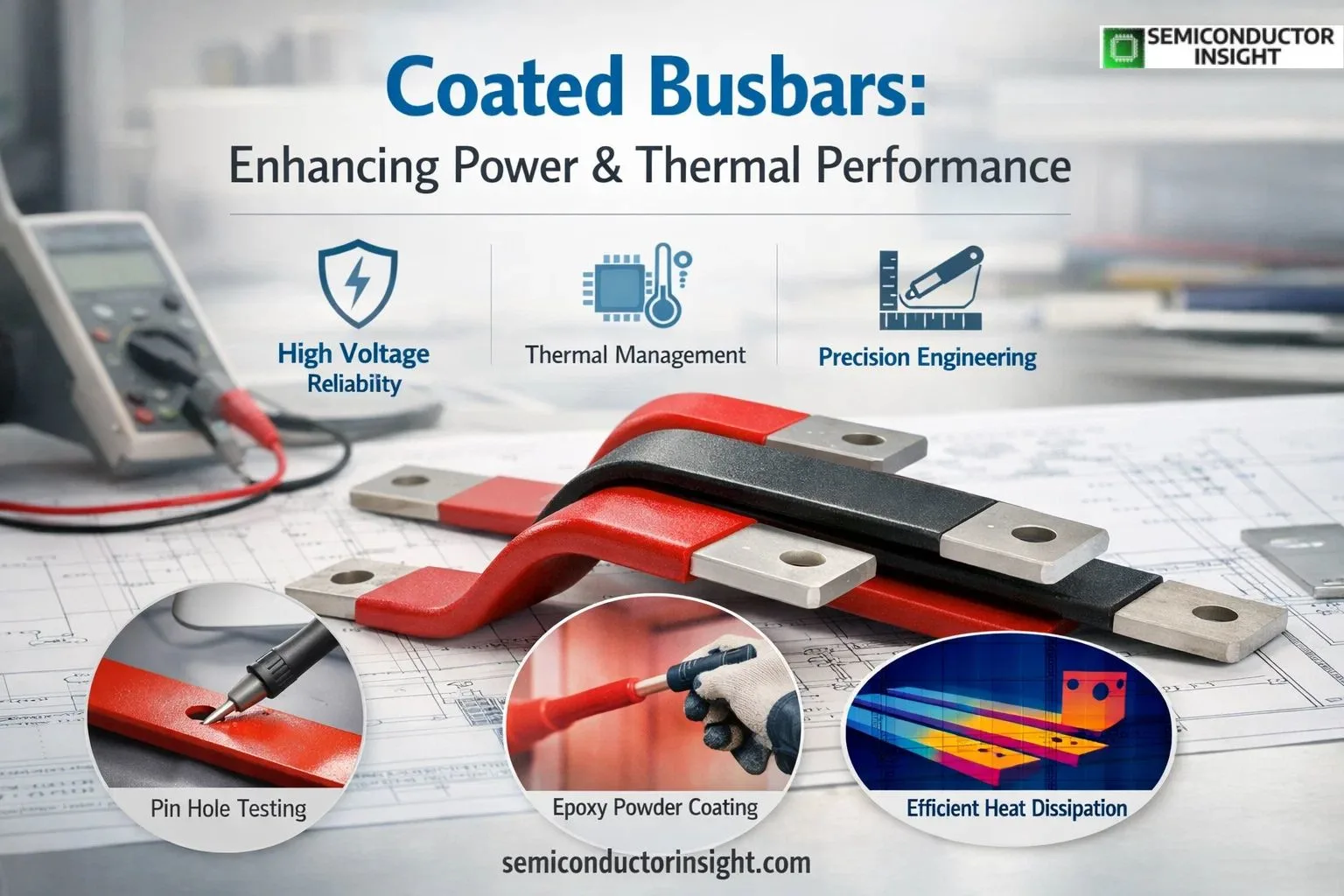
The Quiet Revolution: Why Coated Busbars Are Becoming the Semiconductor Industry’s Best-Kept Secret?
When engineers talk about semiconductor performance, the conversation usually revolves around silicon wafers, lithography, and node sizes. Yet, the unsung hero enabling the power delivery for these sensitive chips is often a simple metal bar with a sophisticated coating.
In the world of power electronics, the coated busbar market is experiencing a quiet revolution, driven not just by the need for conductivity, but by the demand for high-voltage reliability in increasingly compact spaces.
To Stay Tuned with More meaningful and In-Depth Insights, Do Visit here: https://semiconductorinsight.com/report/coated-busbar-market/
Beyond the Bare Metal: The Shift to Epoxy and Powder Coatings
- For decades, busbars were simple pieces of copper or aluminum, often left bare or wrapped in cumbersome PVC tubing.
- Today, the industry standard is shifting decisively toward epoxy powder coating. This isn’t just about aesthetics; it’s about physics.
- As voltages in electric vehicles and industrial servers rise, the risk of partial discharge becomes a critical threat. A tiny pinhole in an insulation layer invisible to the naked eye can lead to catastrophic failure over time.
- This is where advanced coating processes come into play. Electrostatic spraying of epoxy powder produces a dense, smooth, and extremely sticky coating, in contrast to conventional wrapping.
- The process involves baking the coated bar at high temperatures to melt and cure the powder into a uniform layer. This isn’t merely an insulator; it’s a structural component that enhances dielectric strength and corrosion resistance, allowing engineers to place conductors closer together without fear of arcing.
HV Wooding and Nuclear AMRC Delivering Next-Gen Engineering Accuracy
One of the most compelling recent developments comes from a collaboration between HV Wooding and the Nuclear AMRC (Advanced Manufacturing Research Centre). Supported by Innovate UK through the Faraday Battery Challenge, this project sought to redefine the quality standards for busbars used in electric vehicles.
The focus was on the manufacturing details that define reliability. According to Simon, a representative from the firm, the challenge lies in moving from a perfect CAD model to a physical component. An inaccurate bend radius or a sharp corner isn’t just a mechanical flaw; it becomes a stress point for the coating. The project emphasized holiday testing a non-destructive method that applies a controlled voltage to the busbar to detect pinholes before the part ever leaves the factory. In the high-stakes world of semiconductor-powered EVs, where battery packs cost thousands to replace, this level of quality assurance is non-negotiable.
The Semiconductor Connection: Thermal Management and Power Density
The connection to the semiconductor industry is most visible in the realm of thermal management. As wide-bandgap semiconductors like Silicon Carbide (SiC) and Gallium Nitride (GaN) gain traction, they operate at higher temperatures and switching frequencies than traditional silicon.
However, the passive parts that connect these sophisticated chips frequently impede their operation. An optimised busbar design is essential for reducing heat loss and guaranteeing uniform current distribution, according to a recent study published in the SAE International Journal.
If the busbar is unable to dissipate heat effectively, the semiconductor’s performance will be limited. In this case, epoxy coatings offer a clear benefit. Powder coatings provide better thermal conductivity than thick PVC sleeves, which trap heat. This keeps the conductor and, consequently, the connected semiconductor modules cooler under load.
Adapting to the New Energy Landscape: Flexibility and Form
- Perhaps the most significant shift is in how busbars are being designed for new energy applications like photovoltaics and energy storage. The market is moving away from rigid, high-volume stamping towards more agile manufacturing methods.
- Manufacturers are increasingly utilizing laser cutting and CNC machiningto produce busbars. This allows for rapid iteration without the cost and lead time of hard tooling a critical factor when designing battery packs for niche vehicles or compact data centers where space is at a premium.
- Furthermore, we are seeing a rise in plastic-impregnated flexible connections. These are not rigid bars but flexible braided copper strips encapsulated in PVC or epoxy, solving the installation challenges posed by tight, irregular spaces in modern power equipment.
The Innovation Imperative
As the MTI Magazine coverage of the HV Wooding project noted, quality isn’t the inspection report at the end of the line; it’s the repeatable process that makes the report predictable. For semiconductor designers and system integrators, the coated busbar is no longer just a commodity.
It is a critical enabler of the energy transition. Whether it’s facilitating the high-voltage architecture of an 800V EV platform or ensuring the reliability of a grid-tied solar inverter, the humble coated busbar has stepped into the spotlight. As voltages climb and footprints shrink, the integrity of that thin layer of epoxy will continue to define the durability of the electronics we rely on.

Comments (0)