

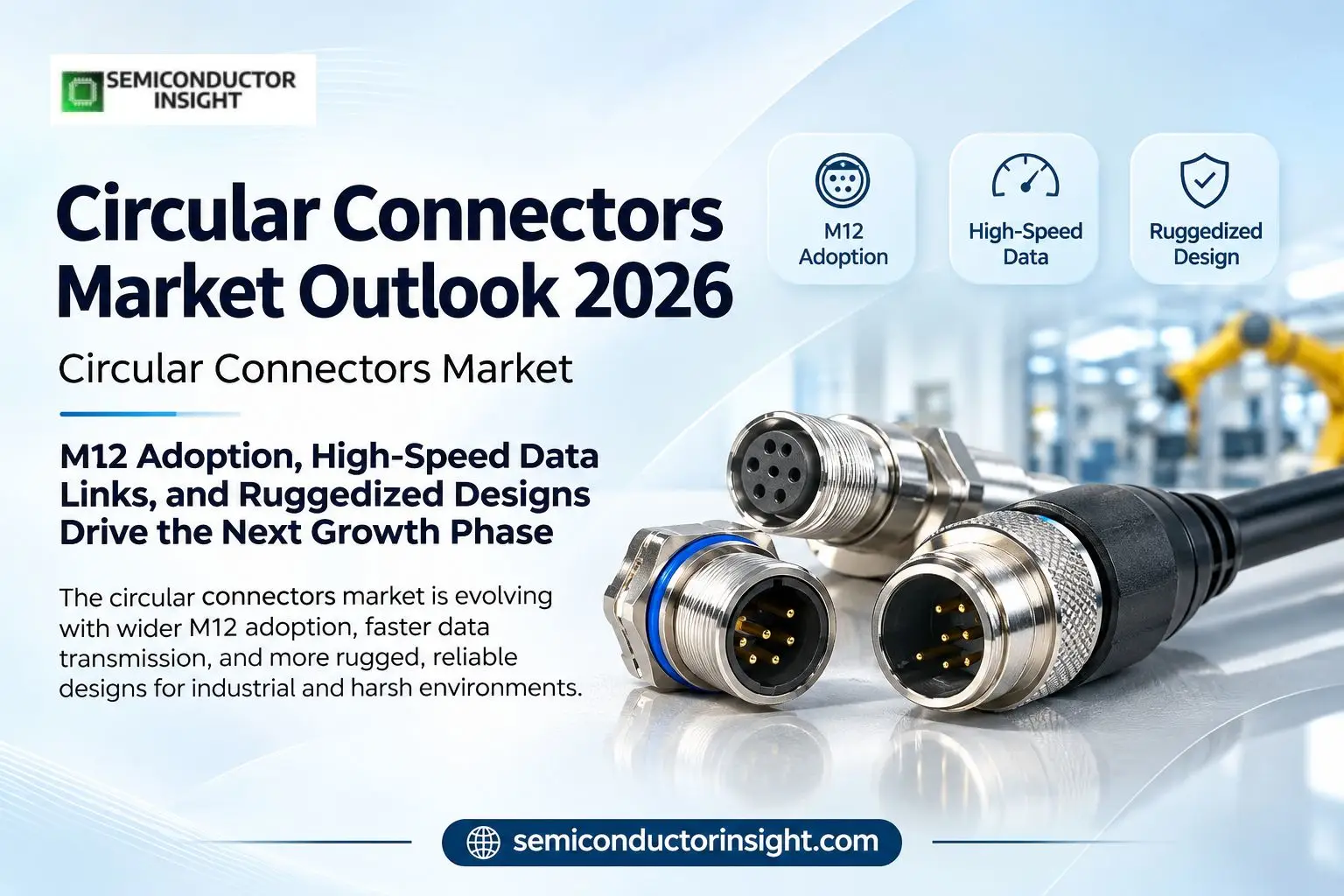
Circular Connectors Market Outlook 2026 with M12 Adoption, High-Speed Data Links, and Ruggedized Designs
Circular Connectors Market is gaining relevance as industrial equipment becomes more connected, compact, and data-intensive. Circular connectors provide secure electrical and signal interfaces between sensors, actuators, control units, motors, and external systems. Their round housing, locking mechanisms, and sealed construction make them suitable for installations exposed to vibration, dust, moisture, and repeated connection cycles.
The product category now extends well beyond conventional industrial wiring. Semiconductor production tools, robotic arms, electric vehicle systems, medical equipment, aerospace platforms, and automated inspection lines all require reliable connections. As equipment manufacturers combine power, control signals, and data transmission in smaller spaces, connector design is becoming an important part of system architecture.
M12 Is Moving from Sensor Wiring to Network Infrastructure
M12 connectors have become a familiar interface in factory automation, but their role is expanding with industrial Ethernet and higher-speed communication. The IEC 61076-2-101:2024 specification covers screw-locking M12 circular connectors from 2-way to 17-way. It includes data transmission up to 100 MHz and power and signal ratings of up to 250 V and 4 A per contact.
The standard’s 2024 revision, followed by European adoption in 2025, reflects the continuing need for consistent dimensions, coding, and performance across industrial installations. Different M12 coding arrangements help prevent incompatible connections, while newer configurations support increasingly varied combinations of data and power requirements.
Semiconductor Equipment Is Raising the Bar for Connector Reliability
- Semiconductor manufacturing provides a demanding application for circular connectors.
- Wafer-processing equipment, vacuum systems, motion-control platforms, inspection machines, and automated material-handling systems depend on stable electrical connections. Unplanned connector failure can interrupt a tightly coordinated production sequence, making mechanical durability and dependable signal transmission important purchasing considerations.
- Equipment designers also need connectors that fit into restricted spaces without compromising shielding, temperature tolerance, or service access.
- This is encouraging interest in compact circular formats, ruggedized housings, and connector assemblies designed for specific machine environments. In cleanroom and precision-production settings, material selection and resistance to process-related contamination are also relevant design considerations.
Hybrid Interfaces Are Reducing the Number of Separate Connections
A notable product-development direction is the integration of power and data contacts within a single connector interface. Hybrid circular connectors can reduce cable congestion and simplify equipment layouts by combining functions that would otherwise require separate connection points.
This approach is relevant to robotics, automated production cells, and modular machinery, where multiple cables can complicate installation and maintenance. Push-pull locking mechanisms are another area of development, allowing faster mating and unmating than traditional threaded arrangements in applications where frequent servicing is required. The design priority is shifting towards faster installation without sacrificing secure retention.
Don’t Forget to Browse Our Recent Exclusive Report for Detailed Insights: https://semiconductorinsight.com/report/metric-circular-connectors-market/
Does Tesla Use Silicon Carbide?
- Tesla’s Model 3 became a widely documented early example of silicon carbide technology in an electric vehicle traction inverter. A 2018 teardown of the Model 3 inverter identified STMicroelectronics SiC MOSFET power modules, with the reported inverter architecture using 24 single-switch modules mounted on a pin-fin heatsink. SiC devices support high-voltage switching with lower switching losses than conventional silicon alternatives in suitable operating conditions.
- This example is relevant to the broader connector ecosystem because EV powertrains also require robust circular and sealed electrical interfaces for sensors, motors, cooling systems, and auxiliary equipment. However, silicon carbide is a semiconductor material used in power devices; it is not a circular connector technology. The two components serve different functions within the vehicle’s electrical architecture.
EV Platforms and Charging Systems Are Expanding the Application Mix
Electric vehicles bring together battery systems, traction inverters, electric motors, thermal management, and charging electronics. These subsystems require dependable connections that can withstand vibration, temperature variation, and exposure to automotive fluids. Circular connector designs are used in selected low-voltage signal, sensor, and auxiliary-power applications, while high-voltage battery connections often use specialised connector formats.
Beyond passenger vehicles, electric buses, construction machinery, and industrial transport equipment are creating additional requirements for rugged electrical interfaces. Manufacturers are therefore developing application-specific solutions around sealing, current capacity, mechanical locking, and compact installation.

Comments (0)