
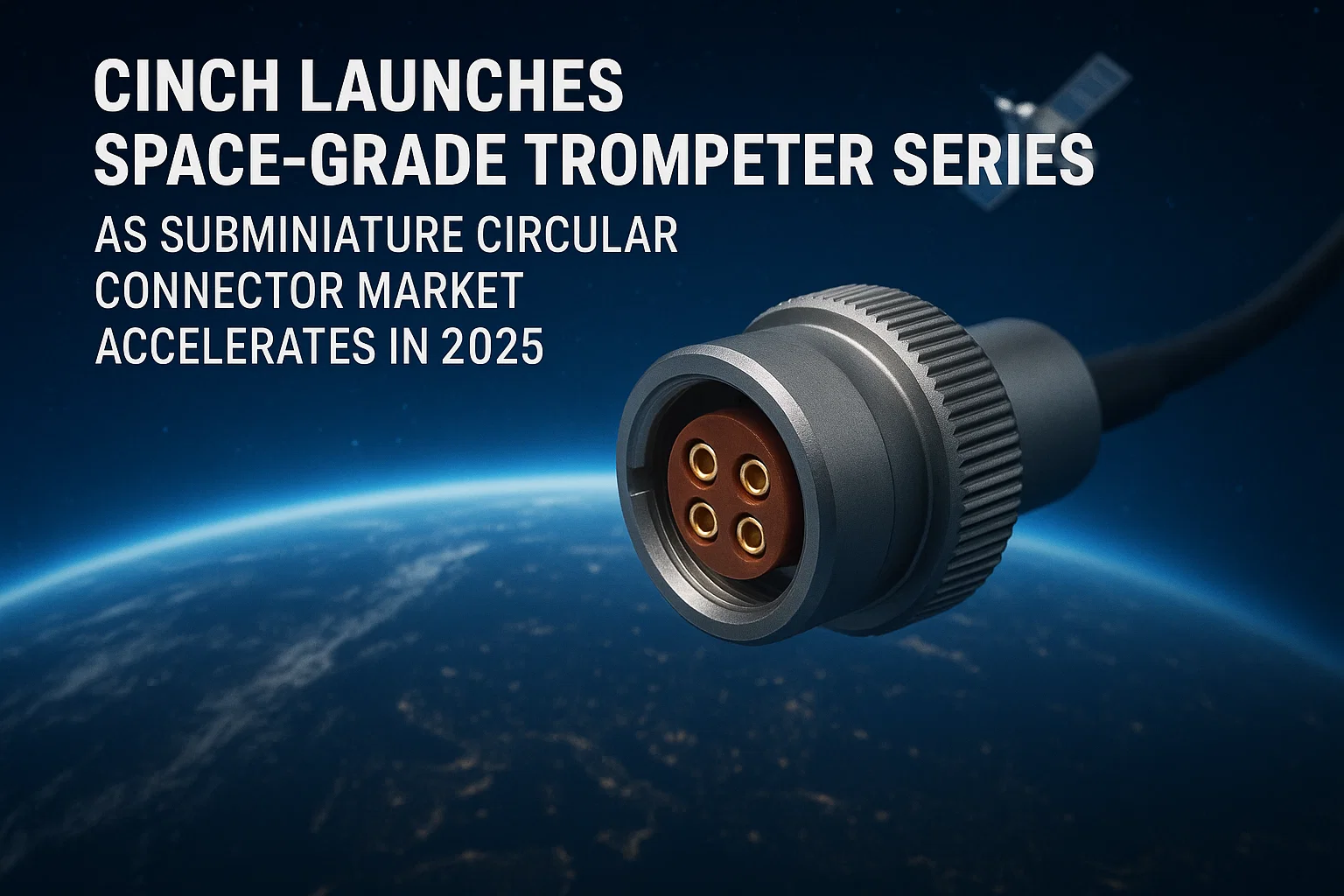
Cinch Launches Space-Grade Trompeter Series as Subminiature Circular Connector Market Accelerates in 2025
In an increasingly interconnected world, the role of connectors particularly subminiature circular connectors (SMCCs) is often underestimated. These small but robust components power critical systems across aerospace, defense, medical devices, industrial automation, and emerging space technologies. While they may be hidden beneath circuit boards, inside satellites, or in medical imaging machines, SMCCs form the nervous system of modern electronics, enabling high-speed, secure, and reliable transmission of signals and power.
The subminiature circular connector market was valued at USD 456 million in 2024 and is projected to grow steadily to USD 717 million by 2032, representing a compound annual growth rate (CAGR) of 6.8% during the forecast period. This growth is not just driven by traditional demand in aerospace and military sectors but also by new industrial automation, commercial space exploration, and medical technology trends.
Access Your Free Sample Report- Subminiature Circular Connector Market
1. Understanding Subminiature Circular Connectors
What are Subminiature Circular Connectors?
Subminiature circular connectors are a specialized class of electrical connectors designed for applications requiring:
- High reliability in compact designs.
- Ruggedness for extreme environments.
- Versatility in transmitting both signals and power.
Their circular geometry allows for efficient mating and resistance to vibration, making them highly favored in aerospace, medical devices, industrial machinery, robotics, and defense electronics.
Compared to larger circular connectors, subminiature versions reduce footprint and weight, critical in today’s push for miniaturization of electronics.
Key Features That Drive Adoption
- High-density contact arrangements: multiple signal paths in minimal space.
- Environmental sealing: resistant to dust, water, and extreme temperatures.
- Shielding: EMI/RFI protection ensures signal integrity.
- Durability: designed for thousands of mating cycles.
2. Market Dynamics (2024–2032)
The subminiature circular connector market’s projected growth to USD 717 million by 2032 is underpinned by several factors:
2.1 Market Drivers
- Aerospace and Defense Demand: Military aircraft, satellites, and drones require lightweight but durable interconnects.
- Medical Equipment Miniaturization: From surgical robots to portable imaging devices, compact connectors are essential.
- Industrial Automation: Growth in Industry 4.0 and robotics boosts connector demand for rugged environments.
- Commercial Space Sector: Private spaceflight and satellite constellations need connectors built for radiation and vacuum conditions.
2.2 Regional Outlook
- North America: Dominated by aerospace and defense manufacturers.
- Europe: Strong industrial and automotive robotics demand.
- Asia-Pacific: Fastest-growing region due to electronics manufacturing and space investments (especially China).
2.3 Challenges
- High precision manufacturing costs.
- Customization requirements for different industries.
- Competition from other compact interconnect technologies.
3. Recent Industry Developments
The past year has seen a wave of important product launches and strategic movements that showcase the industry’s forward momentum.
3.1 Cinch Connectivity Solutions – Space-Grade Trompeter Series
In March 2025, Cinch Connectivity Solutions (part of Bel Group) unveiled its Trompeter Space-Grade connectors, including TRB, TRT, TTM, and TRS series. These connectors are:
- Compliant with MIL-STD-1553B, ensuring secure data bus performance in aerospace.
- Designed for low outgassing to meet NASA standards, critical in space where trapped gasses can damage spacecraft components.
- Ruggedized for rockets, satellites, and deep-space probes.
These products are already available through distributors such as Mouser Electronics, DigiKey, and Air Electro, ensuring broad accessibility for engineers in both military and commercial space programs.
This launch demonstrates how space exploration has become a core growth driver for subminiature circular connectors.
Download Sample Report PDF- Subminiature Circular Connector Market
3.2 Binder – M9 Compact Connector Portfolio
On July 1, 2025, Binder, a German connector manufacturer, introduced its M9 compact connector series, targeted for:
- Industrial automation
- Medical electronics, where sterility and durability matter.
- Precision robotics.
These connectors are engineered for demanding environments, offering miniaturization without compromising robustness. The Binder M9 series fits neatly into the ongoing industrial transformation toward smaller, high-performance electronics.
3.3 Connector Industry Growth Snapshot (Q1 2025)
The connector market as a whole began 2025 with strong momentum:
- Sales rose +5.5% in January–February 2025 compared to the previous year.
- Orders increased +6.4%, signaling robust future demand.
- Analysts project global connector sales to grow by +7.9% in 2025, with the range of expectations stretching from +2.6% to +14.0% depending on regional dynamics.
- Asia-Pacific and China are anticipated to lead with double-digit growth, reflecting surging demand in consumer electronics and aerospace investments.
This positive macro-industry performance supports the long-term growth trajectory of the subminiature circular connector segment.
3.4 Cinch at Satellite 2025 (Washington, D.C.)
Cinch also showcased its micro-miniature circulars and RF/Microwave solutions at Satellite 2025, one of the world’s leading conferences for space and satellite technology. Exhibiting at such trade shows emphasizes the strategic importance of connectors in global communication networks, satellites, and space exploration.
4. Space-Grade Connectors as a Growth Catalyst
The demand for space-grade connectors is exploding due to commercial satellite projects and new government missions.
- The space-grade circular connector market was valued at USD 1.2 billion in 2023, projected to reach USD 1.8 billion by 2028, with a CAGR of ~6%.
- Major innovations include radiation-resistant materials, rugged microwave interconnects (e.g., HUBER+SUHNER), and micro-D space connectors (e.g., Sunkye).
- Private space firms like SpaceX, Blue Origin, and OneWeb are pushing for reliable, miniaturized interconnects to deploy mega-constellations.
For SMCC manufacturers, space represents both a challenge and an opportunity. Designing for vacuum, radiation, and thermal extremes requires specialized expertise, creating barriers to entry but also offering high-margin opportunities.
5. Applications Driving Adoption
5.1 Aerospace & Defense
Aircraft avionics, drones, satellites, and missiles all rely on lightweight, vibration-resistant SMCCs. Defense budgets continue to allocate heavily toward electronics modernization, sustaining demand.
5.2 Medical Technology
Portable diagnostic devices, surgical robots, and imaging systems require miniaturized yet sterilizable connectors. With global healthcare innovation surging, this sector is a significant contributor to the market CAGR.
5.3 Industrial Automation & Robotics
Industry 4.0 adoption factories integrating robots, sensors, and control systems is fueling industrial use of SMCCs. Ruggedness and compact size are critical in harsh production environments.
5.4 Space Exploration
Every satellite, spacecraft, or rover requires hundreds of connectors. As commercial players expand satellite constellations for internet and imaging services, connector demand multiplies.
Click Here To Download Full Sample Report- Subminiature Circular Connector Market
6. Future Outlook and Opportunities
6.1 Forecast Summary
- Market size: USD 456 million (2024) → USD 717 million (2032).
- CAGR: 8% (2024–2032).
- Growth segments: space, medical devices, robotics, industrial IoT.
6.2 Key Opportunities
- Miniaturization & High-Speed Data: Demand for connectors that support faster, denser data transfer.
- Hybrid Connectors: Integrating power + signal in compact packages.
- Sustainability: Development of eco-friendly materials and recyclable connectors.
- Custom Engineering: Offering tailored solutions for space and defense primes.
6.3 Potential Risks
- Supply chain disruptions (raw materials, precision machining).
- Technological substitution by wireless solutions (though connectors remain essential for power).
- Regulatory hurdles in defense and aerospace contracts.
The subminiature circular connector industry is experiencing a renaissance, fueled by the intersection of miniaturization, reliability, and high-performance demand across multiple industries. With a projected market value of USD 717 million by 2032, these compact interconnects are positioned at the heart of future innovations in aerospace, space exploration, medical technology, and industrial automation.
Recent launches such as Cinch’s Trompeter Space-Grade series and Binder’s M9 compact connectors exemplify how manufacturers are adapting to specialized needs, while overall connector sales growth signals strong industry health.

Comments (0)