MARKET INSIGHTS
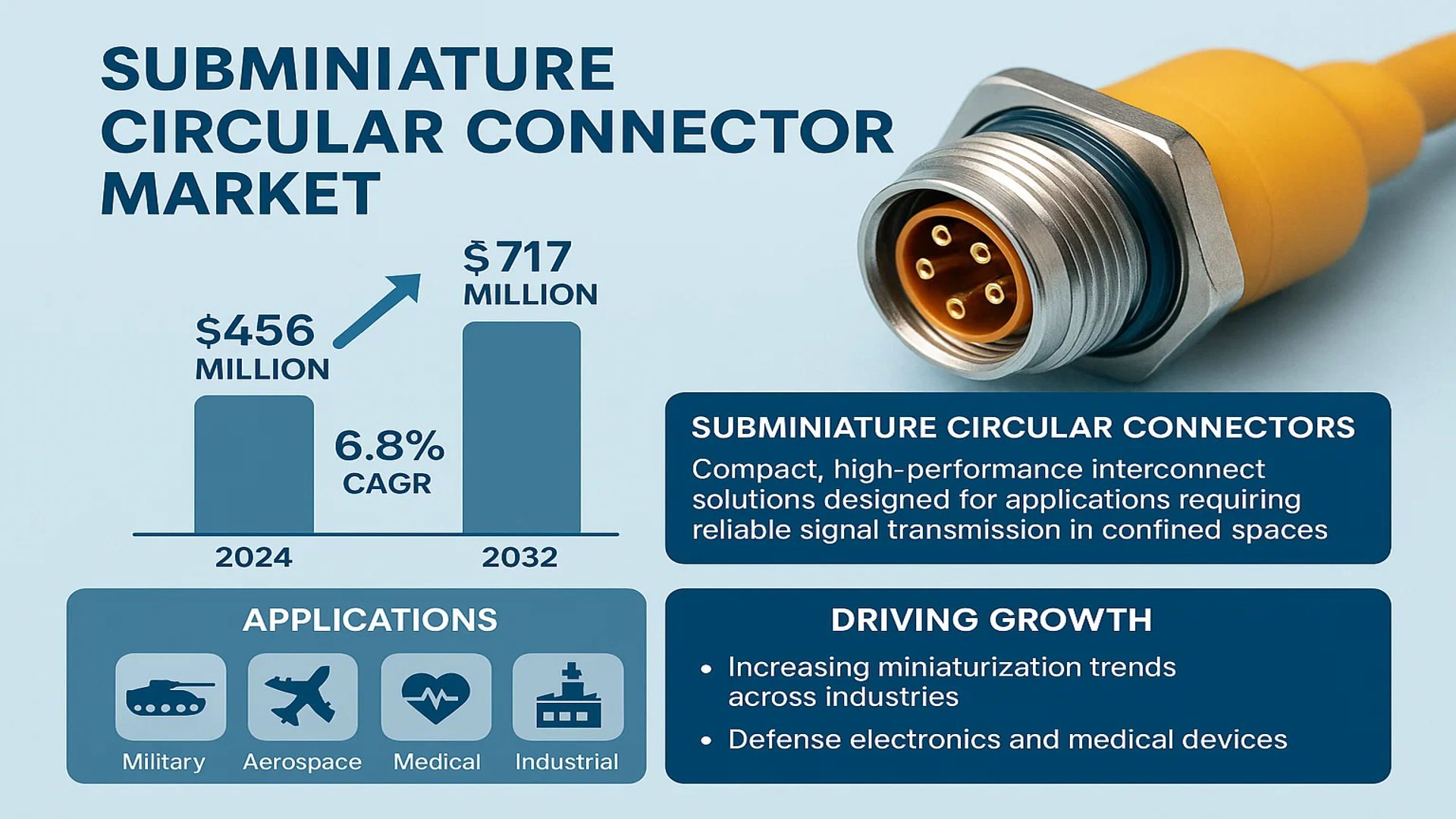
The global Subminiature Circular Connector Market was valued at 456 million in 2024 and is projected to reach US$ 717 million by 2032, at a CAGR of 6.8% during the forecast period.
Subminiature circular connectors are compact, high-performance interconnect solutions designed for applications requiring reliable signal transmission in confined spaces. These connectors feature a threaded coupling mechanism with either metal or plastic shells, supporting frequencies up to 6 GHz while maintaining robust EMI/RFI shielding. Their applications span military, aerospace, medical, and industrial sectors where space constraints and signal integrity are critical.
The market growth is driven by increasing miniaturization trends across industries, particularly in defense electronics and medical devices. While military applications accounted for 32% of 2024 revenue due to harsh-environment requirements, the fastest growth is expected in UAV systems, projected to grow at 8.1% CAGR through 2032. Recent innovations include TE Connectivity’s release of nano-D connectors with 30% smaller footprints than standard models, addressing the need for high-density interconnects in portable electronics.
MARKET DYNAMICS
MARKET DRIVERS
Expanding Demand for Miniaturized Components in Consumer Electronics to Fuel Market Growth
The global consumer electronics industry continues to shrink device sizes while increasing functionality, driving unprecedented demand for subminiature circular connectors. With smartphones now averaging under 8mm thickness and wearable devices becoming increasingly compact, manufacturers require high-performance connectors that occupy minimal space while maintaining signal integrity. The market for wearable devices alone is projected to exceed 1 billion units annually by 2028, creating massive opportunities for connector suppliers who can deliver reliable miniaturized solutions.
Accelerated Electrification in Automotive Sector to Drive Adoption
Automotive electrification represents one of the strongest growth drivers for subminiature circular connectors, with electric vehicles requiring approximately 3,000 individual connectors per vehicle – nearly twice as many as traditional combustion engine vehicles. The transition towards advanced driver assistance systems (ADAS), in-vehicle networking, and battery management systems creates critical needs for compact, high-voltage connectors capable of withstanding automotive environmental stresses. By 2030, EVs are expected to account for over 30% of global vehicle sales, ensuring sustained demand for specialized circular connectors throughout the automotive supply chain.
Beyond passenger vehicles, the commercial vehicle sector is undergoing similar electrification trends, with major OEMs committing to fully electric medium- and heavy-duty truck lineups by 2040. These larger vehicles require even more robust connector solutions capable of handling higher power loads while maintaining compact form factors.
MARKET RESTRAINTS
High Development Costs and Technical Complexity to Limit Market Penetration
While demand grows across multiple sectors, the subminiature circular connector market faces significant technical and economic barriers. Developing connectors that maintain performance at reduced sizes requires specialized materials and manufacturing processes, often increasing production costs by 40-60% compared to standard connectors. The precision engineering needed for contacts with diameters under 1mm drives up both development timelines and unit costs, making these components prohibitively expensive for some price-sensitive applications.
The industry also faces material science challenges as miniaturization pushes physical limits. Achieving reliable conductive paths and mechanical stability in ever-smaller packages requires advanced metallurgies and composite materials that can withstand hundreds or thousands of mating cycles without degradation.
MARKET CHALLENGES
Standardization and Interoperability Issues to Hinder Market Expansion
The lack of universal standards for subminiature circular connectors creates significant integration challenges across industries. With multiple manufacturers developing proprietary form factors and connection protocols, system designers often face compatibility issues that limit component interchangeability. This fragmentation increases inventory costs for OEMs and creates supply chain vulnerabilities, particularly in defense and aerospace applications where long product lifecycles require decades of parts availability.
Environmental and Reliability Challenges
Meeting stringent environmental requirements while maintaining miniaturized form factors presents ongoing design obstacles. Connectors must simultaneously withstand extreme temperatures (-55°C to 200°C), vibration (up to 20G), and corrosion while occupying ever-smaller footprints. These conflicting demands force manufacturers to make difficult trade-offs between size, performance, and ruggedness.
MARKET OPPORTUNITIES
Emerging UAV and Robotics Applications to Create New Market Potential
The rapid expansion of commercial drone and robotics applications opens significant growth avenues for subminiature circular connectors. Modern UAV systems require lightweight, high-density interconnects that can survive harsh operating conditions while adding minimal weight. The commercial drone market alone is projected to grow at nearly 15% CAGR through 2030, with industrial inspection, agricultural monitoring, and delivery applications driving much of this expansion.
Similarly, the service robotics sector increasingly demands compact connectors capable of supporting high-speed data transfer and power delivery in confined spaces. Medical robotics presents particularly promising opportunities, with surgical robots requiring ultra-reliable miniature connectors that meet strict sterilization and biocompatibility standards.
Advancements in connector materials and manufacturing techniques are enabling solutions specifically tailored to these emerging applications. Hybrid connectors combining power, signal, and fiber optic channels in single compact packages are gaining traction across these verticals, allowing system designers to reduce size and weight while improving reliability.
SUBMINIATURE CIRCULAR CONNECTOR MARKET TRENDS
Miniaturization and High-Frequency Performance Drive Market Expansion
The global subminiature circular connector market is experiencing significant growth, primarily due to increasing demand for compact, high-performance connectivity solutions across multiple industries. Valued at 456 million in 2024, the market is projected to reach 717 million by 2032, growing at a CAGR of 6.8%. Miniaturization remains a dominant trend, particularly in consumer electronics and aerospace applications, where space constraints and weight reduction are critical factors. Innovations in material science have led to connectors that maintain robust performance while reducing size, with gold-plated brass and stainless steel variants being increasingly preferred for their durability and conductivity.
Other Trends
Electrification in Automotive and Aerospace Sectors
The automotive industry’s push toward electric vehicles (EVs) and autonomous driving systems has heightened demand for subminiature circular connectors capable of handling high power and signal integrity. Similarly, the aerospace and UAV sectors require connectors that can withstand extreme environmental conditions while ensuring reliable data transmission. Connectors designed for high-temperature resistance, vibration tolerance, and EMI shielding are seeing accelerated adoption, with the military & defense segment alone accounting for over 28% of global demand in 2024.
Technological Advancements in Industrial and Medical Applications
Industries such as medical technology and industrial automation are increasingly relying on subminiature circular connectors for precision and reliability. The shift toward Industry 4.0 and IoT-enabled devices has resulted in greater integration of these connectors in robotics, sensors, and diagnostic equipment. Medical device manufacturers emphasize connectors that meet stringent sterilization and biocompatibility standards, while industrial applications favor ruggedized solutions for harsh operating environments. Recent product innovations include waterproof and dustproof variants, addressing the growing need for durability in outdoor and extreme-condition deployments.
COMPETITIVE LANDSCAPE
Key Industry Players
Innovation and Miniaturization Drive Intensified Market Competition
The global subminiature circular connector market features a dynamic competitive landscape dominated by established players with strong technological expertise in RF and high-frequency applications. Amphenol Corporation leads the market, holding approximately 18% revenue share in 2024, owing to its extensive product portfolio and strategic acquisitions in the aerospace and defense sectors. The company’s patented Positronic subminiature connectors have become industry benchmarks for reliability in harsh environments.
TE Connectivity and Hirose Electric follow closely, jointly accounting for nearly 25% of the global market. Their growth stems from successful penetration into automotive electrification and medical device applications, where precision and durability are paramount. TE Connectivity’s recent launch of its DEUTSCH DT Series has particularly strengthened its position in military aerospace applications.
While these major players dominate, niche specialists like Omnetics Connector and Ulti-Mate Connector are gaining traction through ultra-miniature solutions for wearable technologies and IoT devices. The market has witnessed increased R&D investments targeting waterproof and EMI-shielded variants, with Glenair recently introducing its Micro-D connectors rated for submarine applications.
Strategic partnerships are reshaping the competitive dynamics, exemplified by ITT Cannon‘s collaboration with major EV manufacturers to develop high-voltage circular connectors. Meanwhile, European players like HUBER+SUHNER and Souriau are expanding their Asian manufacturing footprint to capitalize on growing demand from 5G infrastructure projects.
List of Key Subminiature Circular Connector Manufacturers
- Amphenol Corporation (U.S.)
- TE Connectivity (Switzerland)
- Hirose Electric (Japan)
- Omnetics Connector (U.S.)
- Ulti-Mate Connector (U.S.)
- Glenair (U.S.)
- ITT Cannon (U.S.)
- Souriau (France)
- HUBER+SUHNER (Switzerland)
- Eaton (Ireland)
- Binder (Germany)
- Axon’ Cable (France)
Segment Analysis:
By Type
Metal Shell Segment Dominates Due to High Durability in Harsh Environments
The market is segmented based on type into:
- Metal Shell
- Subtypes: Stainless steel, Brass, Aluminum, and others
- Plastic Shell
- Subtypes: Nylon, Polycarbonate, and others
By Application
Aerospace & UAV Segment Leads Owing to Increasing Demand for Miniaturized Components
The market is segmented based on application into:
- Military & Defense
- Aerospace & UAV
- Industrial Application
- Medical
- Others
By End-User
Automotive Sector Shows Strong Growth Potential Due to Rising EV Adoption
The market is segmented based on end-user into:
- Automotive
- Consumer Electronics
- Telecommunications
- Oil & Gas
Regional Analysis: Subminiature Circular Connector Market
Asia-Pacific
The Asia-Pacific region dominates the global subminiature circular connector market, accounting for over 40% of global demand in 2024. This leadership position stems from concentrated electronics manufacturing hubs in China, Japan, and South Korea, coupled with rapid growth in India’s automotive and telecom sectors. China’s semiconductor and consumer electronics boom is driving connector innovation, particularly in miniaturized applications requiring high-frequency performance. The region’s competitive manufacturing ecosystem enables cost-effective production while meeting international quality standards. However, intellectual property protection remains a challenge as local manufacturers increasingly compete with established global players.
North America
North America’s market is characterized by technological sophistication and stringent military/aerospace specifications. The U.S. defense sector’s focus on miniaturized avionics and unmanned systems has created strong demand for ruggedized subminiature connectors meeting MIL-DTL-38999 standards. Meanwhile, medical device innovations and next-generation telecommunications infrastructure (including 5G deployments) are driving adoption of specialized connector solutions. While labor costs are higher than Asia, the region maintains competitive advantage through R&D investments and specialized manufacturing capabilities. Recent U.S. CHIPS Act funding allocations may further strengthen domestic connector supply chains.
Europe
European demand centers on industrial automation, medical technology, and transportation applications. Germany’s Industry 4.0 initiatives and stringent EU product regulations have accelerated adoption of high-reliability connector solutions with enhanced environmental resistance. The region shows growing preference for modular connector systems that simplify maintenance in manufacturing environments. While labor costs and regulatory burdens pose challenges, European manufacturers differentiate through precision engineering and materials science expertise. Brexit has introduced some supply chain complexities, but the region remains a key innovation hub for specialized connector applications.
South America
This emerging market shows promising growth in Brazil’s aerospace sector and Argentina’s renewable energy projects. However, economic volatility has constrained capital investments in connector-intensive industries. Most demand is met through imports, though local assembly operations are expanding to serve automotive and industrial sectors. Infrastructure limitations and currency fluctuations continue to hinder market expansion, but strategic partnerships between global suppliers and regional distributors are improving market access. The medical device sector shows particular potential as healthcare modernization drives demand for compact, reliable connectors.
Middle East & Africa
The region exhibits selective growth in defense and oil/gas applications requiring rugged connector solutions. UAE’s aerospace investments and Saudi Arabia’s industrial diversification programs are creating specialized demand. However, market development is uneven, with most sophisticated applications still served through imports. Local assembly is limited, though some global manufacturers are establishing regional service centers to support critical infrastructure projects. Long-term growth will depend on technology transfer initiatives and workforce development in electronics manufacturing capabilities.
Report Scope
This market research report provides a comprehensive analysis of the Global Subminiature Circular Connector Market, covering the forecast period 2024–2032. It offers detailed insights into market dynamics, technological advancements, competitive landscape, and key trends shaping the industry.
Key focus areas of the report include:
- Market Size & Forecast: Historical data and future projections for revenue, unit shipments, and market value across major regions and segments. The market was valued at USD 456 million in 2024 and is projected to reach USD 717 million by 2032 at a CAGR of 6.8%.
- Segmentation Analysis: Detailed breakdown by product type (Metal Shell, Plastic Shell), application (Military & Defense, Aerospace & UAV, Industrial, Medical, Others), and end-user industry to identify high-growth segments.
- Regional Outlook: Insights into market performance across North America, Europe, Asia-Pacific, Latin America, and the Middle East & Africa, with country-level analysis for key markets.
- Competitive Landscape: Profiles of 14 leading market participants including Amphenol, TE Connectivity, Hirose Electric, and ITT Cannon, covering their product portfolios, market share, and strategic developments.
- Technology Trends: Analysis of miniaturization trends, high-frequency applications, and material innovations in connector design.
- Market Drivers & Restraints: Evaluation of growth factors including increasing electronics in automotive sector and demand from defense applications, along with challenges like supply chain complexities.
- Stakeholder Analysis: Strategic insights for component manufacturers, OEMs, and investors regarding emerging opportunities in high-growth segments and regions.
The report employs both primary and secondary research methodologies, including interviews with industry experts and analysis of verified market data, to ensure accuracy and reliability.
FREQUENTLY ASKED QUESTIONS:
What is the current market size of Global Subminiature Circular Connector Market?
-> Subminiature Circular Connector Market was valued at 456 million in 2024 and is projected to reach US$ 717 million by 2032, at a CAGR of 6.8% during the forecast period.
Which key companies operate in this market?
-> Major players include Amphenol, TE Connectivity, Hirose Electric, ITT Cannon, Glenair, and HUBER+SUHNER, among others.
What are the key growth drivers?
-> Primary growth drivers include increasing electronics in automotive sector, defense modernization programs, and demand for miniaturized connectors in consumer electronics.
Which region dominates the market?
-> North America currently leads in market share, while Asia-Pacific is expected to witness the highest growth rate during the forecast period.
What are the emerging trends?
-> Emerging trends include development of high-frequency connectors, increased use in UAV applications, and innovations in connector materials for harsh environments.

Get Sample Report PDF for Exclusive Insights
Report Sample Includes
- Table of Contents
- List of Tables & Figures
- Charts, Research Methodology, and more...
 Download Sample Report PDF