
Channel Coil Drives Market Redefining Motion Control in Chip Fabrication
Channel coil drive systems are emerging as a critical component in semiconductor manufacturing equipment, where precision, cleanliness, and repeatability define success. These drives operate using electromagnetic principles to generate controlled linear or rotary motion, making them highly suitable for wafer handling, lithography stages, and inspection systems.
Channel coil systems, in contrast to conventional mechanical drives, reduce wear and particle creation by minimising physical contact. This is crucial in cleanroom settings where even a single micron-sized contaminant can interfere with chip manufacture.
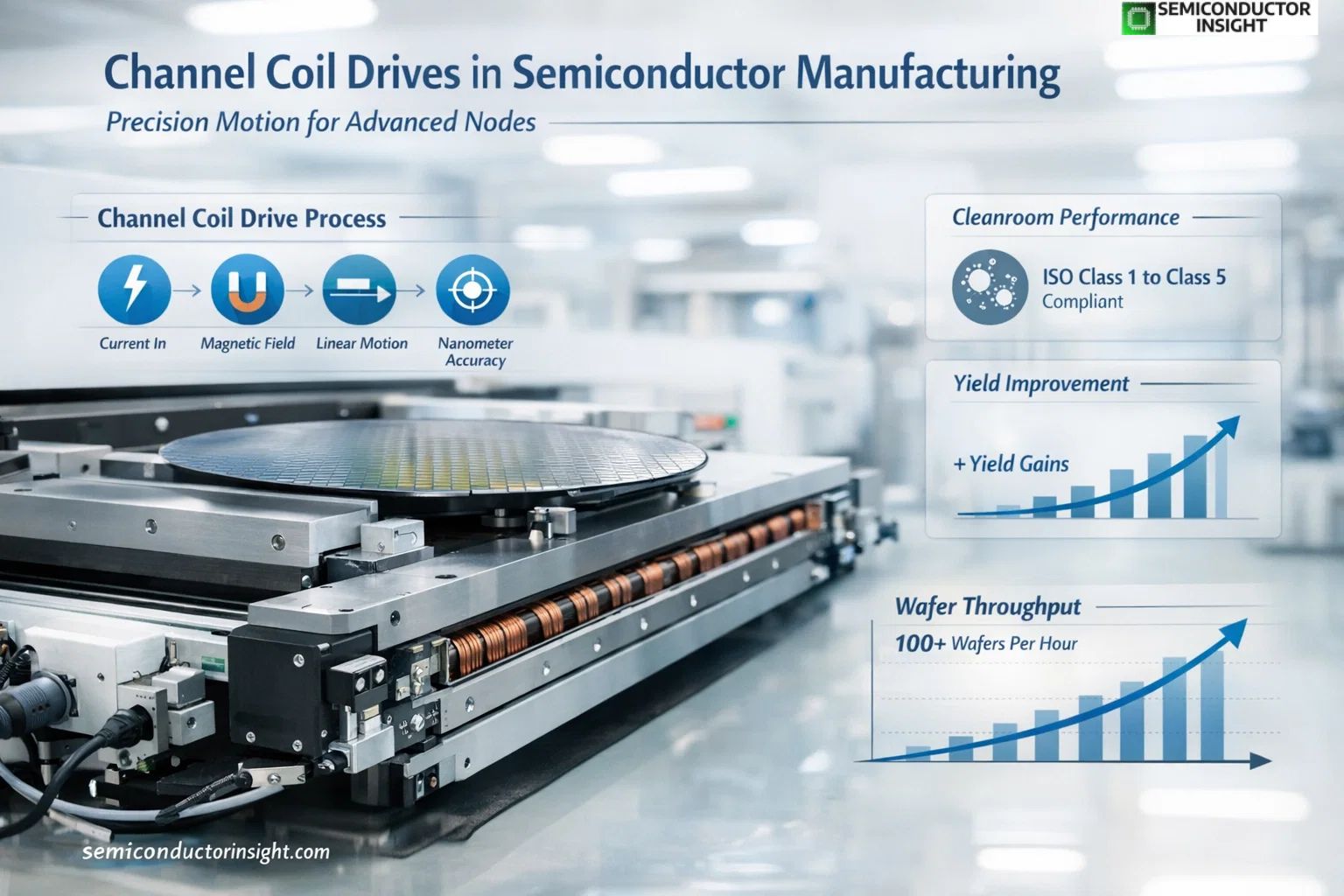
Modern semiconductor fabs process wafers at speeds exceeding 100 wafers per hour in advanced nodes, requiring motion systems that can deliver positioning accuracy within nanometer ranges. Channel coil drives meet this demand by enabling smooth, vibration-free movement, which is particularly crucial in extreme ultraviolet lithography systems where alignment precision directly impacts circuit integrity.
Working Principle of a Channel Coil Drive
- A channel coil drive is built around a precisely designed combination of coils and magnetic tracks.
- When electric current passes through the coils, it creates a magnetic field that interacts with permanent magnets or conductive paths to generate motion, all without relying on mechanical parts such as gears or belts.
- This makes the system highly efficient and well suited for precise motion control.
The motion process follows a simple sequence: electric current input, magnetic field generation, electromagnetic interaction, controlled linear motion, and feedback correction.
- With the help of sensors and encoders, the drive can make real-time adjustments to maintain accuracy.
- In semiconductor equipment, this level of control can achieve positioning precision within ±5 nanometres, supporting consistent wafer alignment across repeated cycles.
See the full report analysis by clicking the link below: https://semiconductorinsight.com/report/channel-coil-drive-market/
Cleanroom Compatibility and Contamination Control
One of the most critical requirements in semiconductor manufacturing is maintaining ultra-clean environments. According to cleanroom standards referenced in technical documentation from organizations like International Organization for Standardization, particle contamination must be tightly controlled, especially in ISO Class 1 to Class 5 environments used in advanced fabs.
Channel coil drives offer a significant advantage here. Since they operate with minimal friction and fewer moving parts, they generate far fewer particles compared to conventional mechanical systems. This makes them ideal for front-end processes such as wafer fabrication, where contamination can lead to yield losses worth millions of dollars annually.
In practical terms, fabs using advanced motion systems have reported yield improvements of several percentage points, which can translate into thousands of additional functional chips per production batch.
Building Cohesion in Semiconductor Operations
Channel coil drives are not standalone components; they are deeply integrated into various semiconductor manufacturing systems. In lithography machines, they control wafer stage positioning with extreme precision. In inspection systems, they enable smooth scanning across wafer surfaces, ensuring defect detection at sub-micron levels.
For example, modern inspection tools can scan wafers at speeds exceeding 1 meter per second while maintaining positional accuracy. This level of performance is only achievable through advanced electromagnetic drive systems that eliminate mechanical backlash.
Additionally, in semiconductor packaging and testing, these drives are used in pick-and-place systems handling delicate components at rates of over 10,000 units per hour, ensuring both speed and precision without damaging sensitive microstructures.
Leading Brands and Product Portfolios
Several global companies are actively advancing channel coil drive technologies as part of their motion control and semiconductor equipment offerings
- Bosch Rexroth offers linear motor systems designed for high-precision industrial and semiconductor applications, focusing on energy efficiency and modular integration
- Siemens provides advanced motion control solutions integrated with digital automation platforms, enabling real-time monitoring and optimization
- Rockwell Automation delivers electromagnetic drive systems tailored for high-speed manufacturing environments
- Parker Hannifin specializes in precision linear actuators and drives used in semiconductor and cleanroom applications
- Yaskawa Electric Corporation focuses on servo and motion control technologies supporting semiconductor fabrication systems
These companies are continuously refining their portfolios to support the semiconductor industry’s push toward smaller nodes, higher throughput, and improved efficiency.
Recent Shifts toward Smart Motion Systems
The integration of digital technologies is reshaping how channel coil drives are deployed. Smart sensors and embedded control systems now allow real-time monitoring of parameters such as temperature, vibration, and positional accuracy. This data-driven approach supports predictive maintenance, reducing unexpected downtime in fabs where equipment availability is critical.
Recent industry developments highlighted in engineering journals and semiconductor-focused publications show that fabs implementing smart motion systems have reduced maintenance-related interruptions by up to 20%, improving overall equipment effectiveness.
Moreover, as semiconductor manufacturing moves toward advanced nodes below 5 nanometers, the demand for ultra-precise and reliable motion systems continues to grow. Channel coil drives, with their ability to deliver consistent performance under stringent conditions, are becoming an integral part of this evolution.

Comments (0)