

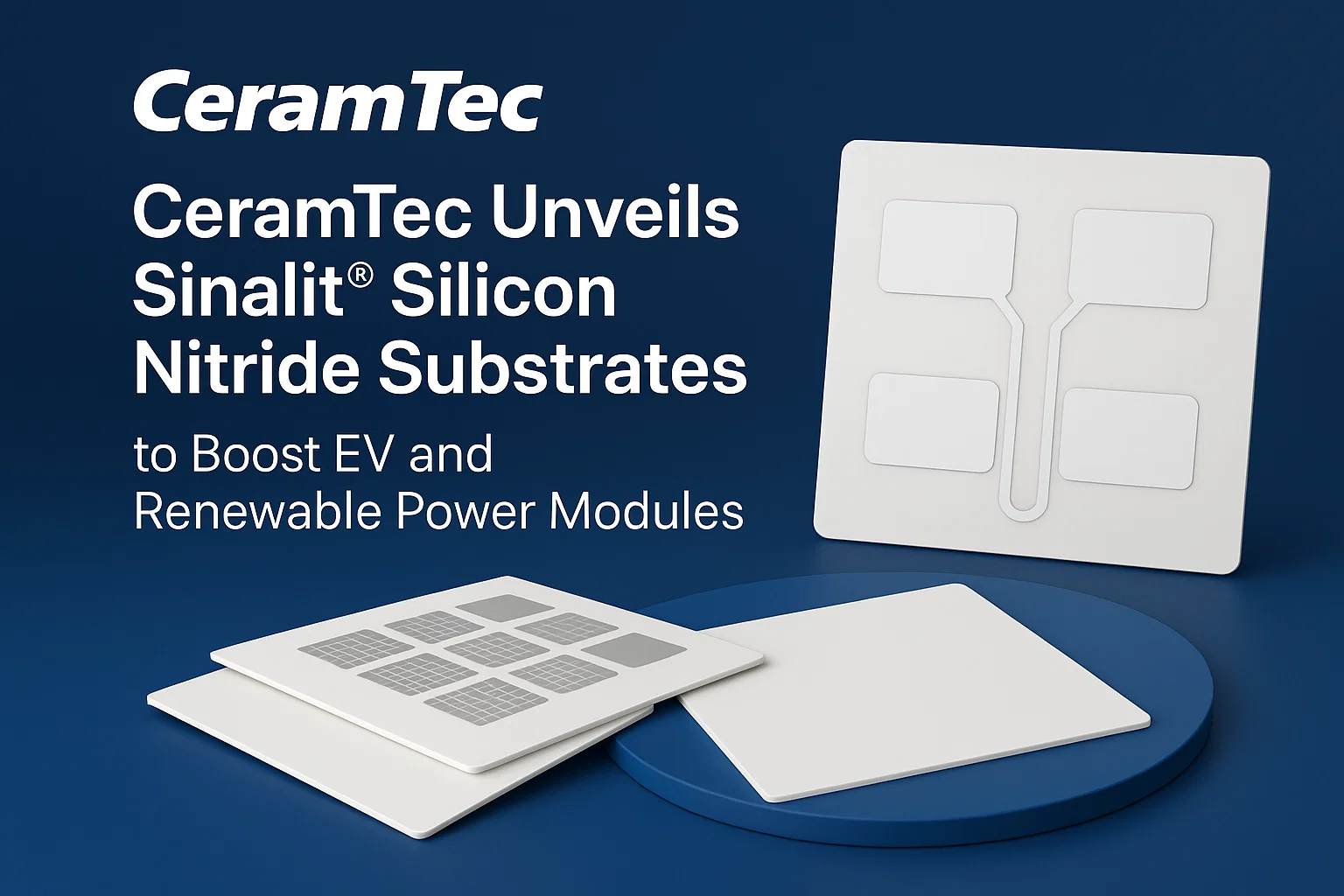
CeramTec Unveils Sinalit® Silicon Nitride Substrates to Boost EV and Renewable Power Modules
The rapid evolution of power electronics has transformed industries ranging from automotive and renewable energy to industrial automation and aerospace. At the core of these advances are metal ceramic substrates for power modules—critical components that enable efficient thermal management, electrical insulation, and robust performance in demanding environments. As silicon carbide (SiC) and gallium nitride (GaN) devices gain prominence, substrates must keep pace by offering high thermal conductivity, mechanical strength, and compatibility with advanced packaging methods.
The global Metal Ceramic Substrates for Power Modules market was valued at USD 1,329 million in 2024. Forecasts suggest exponential growth to USD 4,105 million by 2032, representing a striking CAGR of 17.9%. This growth is propelled by increasing electrification in vehicles, rising demand for renewable energy, and the transition to wide-bandgap semiconductors.
Access Your Free Sample Report- Metal Ceramic Substrates for Power Modules Market
Understanding Metal Ceramic Substrates for Power Modules
Before diving into recent developments, it’s useful to understand what makes metal ceramic substrates so critical.
-
What They Are
- A ceramic substrate serves as a mechanical base and electrical insulator.
- A metal layer—typically copper—is bonded to the ceramic using technologies such as Direct Copper Bonding (DCB), Active Metal Brazing (AMB), or Sputter Metal Bonding (SMB).
- This hybrid structure combines the thermal conductivity and mechanical resilience of ceramics with the electrical performance of metals.
-
Why They Matter
- Thermal management: Efficiently dissipating heat is vital for power module reliability.
- Electrical insulation: High dielectric strength ensures safe operation under high voltages.
- Mechanical stability: Resistance to thermal cycling and mechanical stress extends device lifespan.
-
Applications
- Automotive power electronics (inverters, converters, on-board chargers).
- Renewable energy systems (solar inverters, wind turbine drives).
- Industrial automation and robotics (motor drives, power supplies).
- Aerospace and defense (radar, satellite systems).
Market Growth Trajectory
The market’s rapid expansion reflects megatrends shaping global energy and mobility.
- 2024 Valuation: USD 1,329 million.
- 2032 Projection: USD 4,105 million.
- CAGR (2024–2032): 17.9%.
Key Growth Drivers
- Electrification of Mobility
Electric vehicles (EVs) require compact, lightweight, and highly efficient power modules. Substrates like silicon nitride are gaining traction for their superior thermal and mechanical properties, ensuring safety and reliability in traction inverters and on-board chargers. - Transition to Wide-Bandgap Semiconductors
SiC and GaN devices operate at higher voltages, frequencies, and temperatures. To unlock their full potential, substrates must offer excellent thermal conductivity and withstand thermal cycling without cracking or delamination. - Renewable Energy Expansion
Solar and wind power installations continue to rise globally. Power inverters in these systems rely heavily on durable ceramic substrates for long-term, maintenance-free operation. - Miniaturization and Integration
Consumer and industrial devices demand smaller form factors without sacrificing power. This requires substrates that support thinner, stronger designs with embedded functionality. - Reliability in Harsh Environments
Aerospace, defense, and industrial sectors need power modules that perform reliably in high-stress environments—further boosting demand for advanced ceramic substrates.
Recent Industry Developments
-
CeramTec’s Launch of Sinalit® Silicon Nitride Substrates
In June 2024, CeramTec, a global leader in advanced ceramics, unveiled Sinalit®, a new generation of silicon nitride (Si₃N₄) substrates at PCIM Europe.
Key Features
- High Strength: Flexural strength ≥ 700 MPa, fracture toughness ≥ 6 MPa√m.
- Thin Profiles: Available in 0.25–0.32 mm thickness—ideal for compact designs.
- Thermal Conductivity: ~80 W/mK, ensuring effective heat dissipation.
- Copper Metallization: Supports up to 1 mm thick copper, compatible with AMB and SMB processes.
Implications
- Targets automotive e-mobility applications (EV traction inverters, chargers).
- Enhances reliability in renewable energy systems and industrial automation.
- Its combination of thinness, strength, and thermal conductivity positions it as a substrate of choice for next-generation power modules.
Download Sample Report PDF- Metal Ceramic Substrates for Power Modules Market
-
Remtec’s Metallized Ceramic Circuits for High-Power Applications
At APEC 2025, Remtec highlighted its advances in metallized ceramic circuits for power electronics.
Key Features
- Compatible with multiple ceramics: alumina, aluminum nitride, and silicon nitride.
- Offers single-layer and multilayer dielectric circuits with precise tolerances.
- Supports copper thickness of 5–12 mm, enabling high current handling.
- Customized interconnects and interposers for diverse power module configurations.
Implications
- Ideal for high-power automotive systems such as braking and radar converters.
- Enhances design flexibility, allowing tailored solutions for diverse industries.
- Demonstrates the industry’s shift toward application-specific substrates with multilayer structures and thicker metallization.
-
NGK & PanelSemi’s Hybrid Substrate (HBS) Development
In July 2024, NGK Insulators announced a collaboration with PanelSemi, a Taiwanese startup, to develop Hybrid Ceramic Substrates (HBS).
Key Features
- Combines ceramic base materials with polyimide-based circuit wiring.
- Functions as both interposer and packaging substrate.
- Enables high-density integration in ultra-thin formats.
Implications
- Potentially transformative for RF and optoelectronic semiconductor applications.
- Supports the broader industry trend of integration and miniaturization.
- Aligns with NGK’s “Road to 2050” strategy for sustainable innovation.
Comparative Analysis of Recent Innovations
| Company | Development | Core Innovation | Target Applications | Industry Impact |
| CeramTec | Sinalit® Si₃N₄ substrates | High strength, thin profile, 80 W/mK thermal conductivity, 1 mm Cu support | EV power electronics, renewable energy | Sets new benchmark for thermal + mechanical performance |
| Remtec | Metallized ceramic circuits | Multilayer ceramics, thick Cu layers (5–12 mm), custom interposers | Automotive, radar, industrial power systems | Enhances design flexibility, high-power handling |
| NGK + PanelSemi | Hybrid Substrate (HBS) | Embedded polyimide circuits + ceramics, ultra-thin, high density | RF, optoelectronics, advanced packaging | Pushes integration, enables miniaturization |
Challenges and Opportunities
Challenges
- Cost Pressures: Advanced substrates such as Si₃N₄ are costlier to manufacture compared to alumina.
- Manufacturing Complexity: Maintaining uniformity in ultra-thin, high-strength substrates is technically demanding.
- Supply Chain Dependencies: Raw materials like high-purity ceramics and copper foils face supply risks.
Opportunities
- E-Mobility Boom: With EV adoption accelerating, demand for reliable substrates will skyrocket.
- Renewable Energy Transition: Global decarbonization targets will drive sustained investments in solar and wind, directly boosting substrate demand.
- Wide-Bandgap Device Synergy: The growth of SiC and GaN semiconductors creates opportunities for next-gen substrates tailored to their needs.
- Integrated Substrates: Hybrid solutions (like NGK’s HBS) could open new markets in RF and 5G infrastructure.
Regional Outlook
- Asia-Pacific: Dominates the market, led by China, Japan, and South Korea. Strong EV manufacturing ecosystems and semiconductor supply chains fuel growth.
- Europe: Focus on automotive electrification and renewable energy makes it a key hub. Germany and France are central markets.
- North America: Growth driven by EV adoption (Tesla, GM, Ford), renewable projects, and defense applications.
- Rest of the World: Emerging markets in Southeast Asia, the Middle East, and Latin America are gradually adopting advanced power modules.
Click Here To Download Full Sample Report- Metal Ceramic Substrates for Power Modules Market
Future Outlook
By 2032, the metal ceramic substrates industry will exceed USD 4.1 billion, underpinned by:
- Mass electrification of vehicles.
- Renewable integration into global grids.
- Advances in wide-bandgap semiconductors requiring matching substrates.
- Hybridization and integration trends, reducing module footprint while improving performance.
Companies that innovate in substrate materials (Si₃N₄, AlN, hybrid composites) and metallization technologies (AMB, SMB, multilayer copper) will lead the market.
The metal ceramic substrates for power modules industry is undergoing a profound transformation. With the market set to triple in size by 2032, recent developments by CeramTec, Remtec, and NGK showcase the industry’s trajectory toward thinner, stronger, and more integrated solutions.
From CeramTec’s ultra-robust Sinalit® silicon nitride substrates, to Remtec’s metallized multilayer circuits, to NGK’s hybrid substrate innovation, the common thread is pushing performance limits while enabling compact, high-power, and reliable systems.

Comments (0)