
Catalytic Bead Sensors Redefining Gas Detection in Modern Industries
The faint hiss of gas escaping into an industrial environment is a sound that safety managers dread. In the milliseconds between a leak and a potential disaster, a small, unassuming piece of technology the catalytic bead sensor stands as the last line of defense.
But as industries push into more challenging environments, from inerted tanks to complex petrochemical facilities, the role of this century-old technology is being redefined.
The Regulatory Hammer: Why Compliance is Driving Demand
- If there is a single engine propelling catalytic bead sensor market forward, it is the tightening vice of global safety regulations. Recent legislative actions highlight this trend with remarkable clarity.
For instance, the Government of Canada introduced the Reduction in the Release of Volatile Organic Compounds Regulations (SOR/2025-88), which explicitly mandates specific performance criteria for catalytic bead sensors used in combustible gas detection.
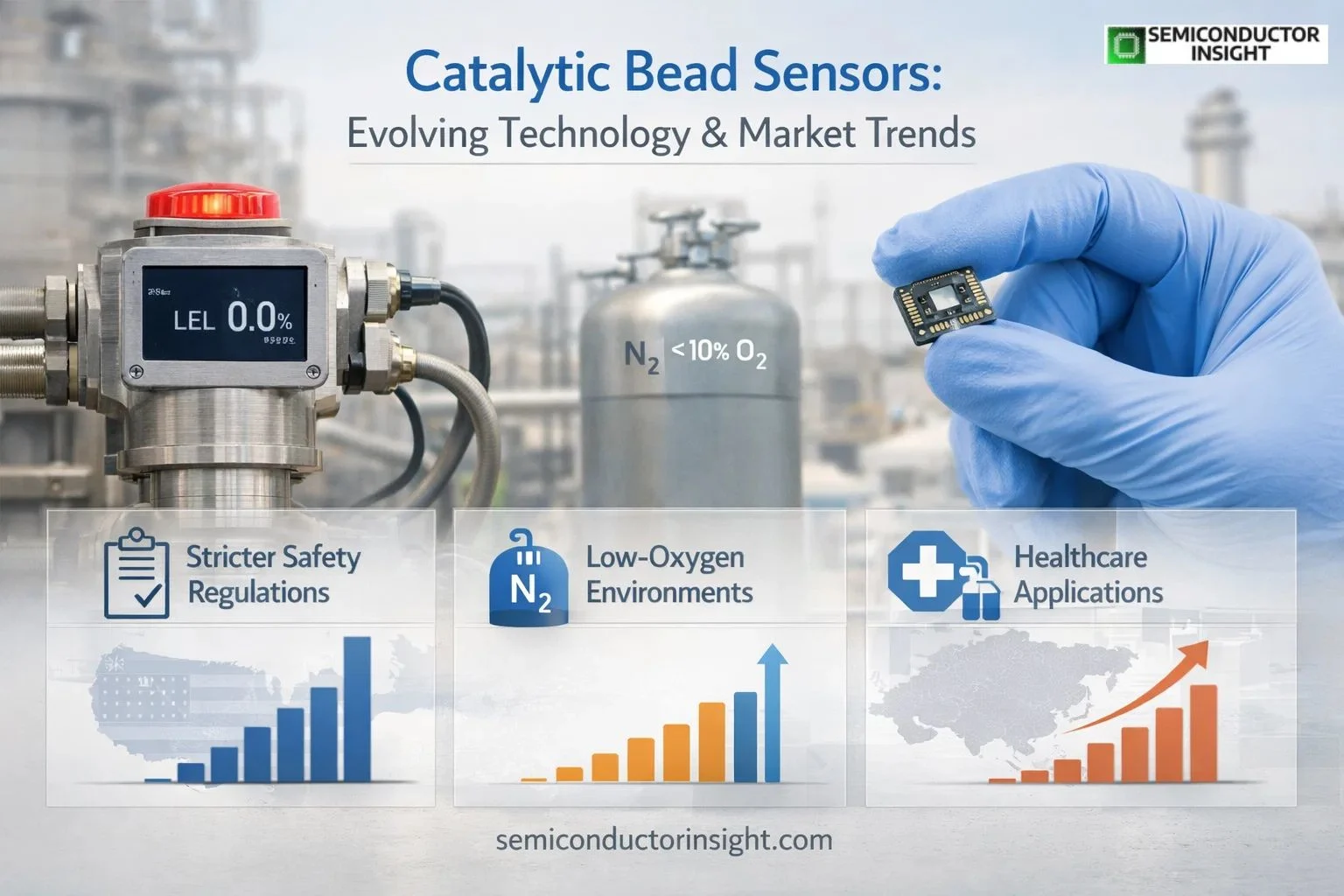
- The regulation is notably strict, prohibiting the use of these sensors in atmospheres containing less than 10% oxygen by volume or in environments where substances are likely to poison the catalyst.
- This legal framework does more than just set rules; it forces industries to upgrade legacy systems. The U.S. Occupational Safety and Health Administration (OSHA) further underscores the stakes, reporting that approximately 4,500 workers die annually from workplace accidents, with a significant portion involving gas exposure incidents. Such statistics transform safety equipment from a cost center into a non-negotiable operational necessity.
Beyond the Bead: Innovation in Miniaturization
While the basic principle of catalytic oxidation remains, the technology is undergoing a quiet revolution. Researchers at the Technion Israel Institute of Technology have developed a novel miniature combustion-type CMOS gas sensor (GMOS) using Pt nanoparticle catalysts. This advancement allows for a sensitivity nearly twice that of traditional sputtered catalysts, enabling the detection of specific gases like ethanol and acetone in mixtures a level of selectivity previously difficult for bead sensors.
Similarly, Nissha FIS has tackled the persistent issue of sensor poisoning. By forming a three-dimensional catalyst structure directly on the surface of a platinum coil, their new designs improve resistance to siloxane poisoning while drastically reducing startup time and response speed. This is a critical development for facilities worried about “sensor death” from silicone-based compounds.
The Low-Oxygen Dilemma: Choosing the Right Tool
Despite these innovations, the market faces a hard truth about operational limits. In low-oxygen or inerted spaces common in nitrogen-purged chemical reactors or storage tanks catalytic bead sensors struggle to provide accurate readings because they require oxygen to oxidize the combustible gas on the bead.
This limitation is not just a technical nuance; it is a safety liability. The Canadian regulations explicitly ban their use in sub-10% oxygen environments. Consequently, the market is seeing a bifurcation. For standard atmospheric conditions, catalytic bead sensors remain the economical and familiar choice. However, for high-risk or low-oxygen scenarios, they are often supplemented or replaced by infrared (IR) sensors. This dynamic is pushing manufacturers to integrate both technologies into hybrid monitoring systems.
Healthcare and Clinical Diagnostics: A Surprising Frontier
- Healthcare, rather than heavy industry, may be the catalytic bead technology’s most surprising growth vector. In a recent work published in Biosensors and Bioelectronics, researchers at Jilin University demonstrated a catalytic platform boosted by near-infrared light for the detection of volatile sulphur compounds (VSCs) linked to periodontitis.
- In the meantime, surface-engineered nanobeads with a palladium catalyst that maintains catalytic activity for more than 140 days at room temperature have been created by the Korea Institute of Science and Technology (KIST). With lower detection limits than conventional ELISA techniques, this platform showed improved performance in identifying clinically significant biomarkers including C-reactive protein and SARS-CoV-2 antigens. This crossover implies that the bead sensor of the future will be used in both oil refineries and diagnostic labs.
North America Leads, Asia Surges
From a market perspective, the numbers reflect the industrial demand. According to data tracking the sector, North America currently dominates catalytic bead sensor market, holding a significant revenue share due to stringent industrial safety protocols in the U.S. and Canada.
However, the Asia-Pacific region is projected to exhibit the highest growth rate. This surge is driven by rapid industrialization, increased government initiatives for workplace safety, and a booming manufacturing sector.
Feel Free to Reach Our Most Recent Updates of the Report: https://semiconductorinsight.com/report/catalytic-bead-sensors-market/
Catalytic bead sensor market is at a fascinating intersection. On one hand, it is anchored by mature, compliance-driven demand in traditional sectors like oil and gas. On the other, it is being revitalized by nanotechnology, IoT integration, and even medical diagnostics.
For safety managers and procurement specialists, the future involves understanding that one size does not fit all. The decision to choose a catalytic bead sensor over an IR alternative hinges on a clear-eyed assessment of the environment: Is there oxygen? Are there poisons? In answering those questions correctly, we ensure that these silent guardians continue to protect life and infrastructure for the next generation.

Comments (0)