
Catalytic Bead Sensors Market Insights
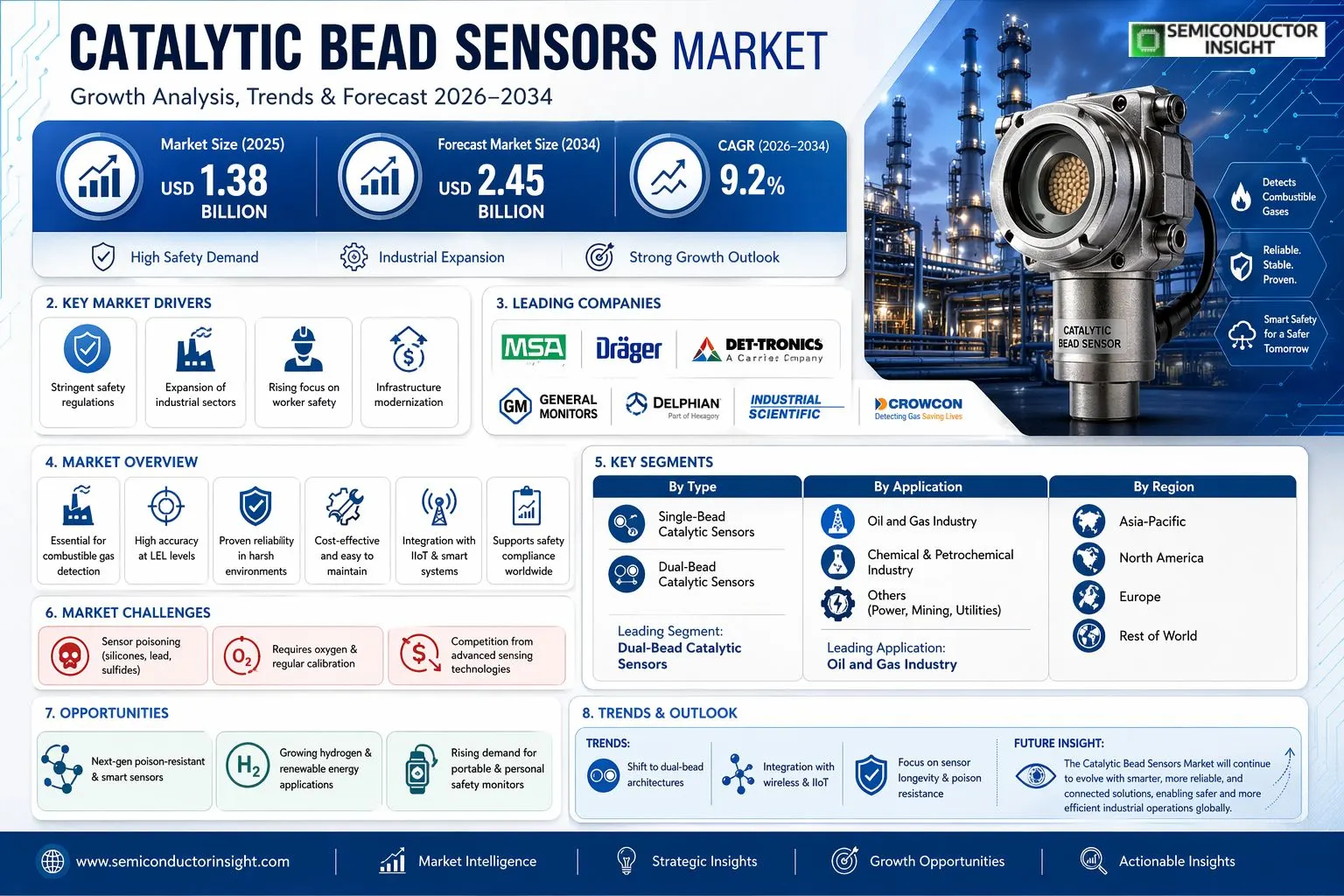
Global Catalytic Bead Sensors Market size was valued at USD 1.38 billion in 2025. The market is projected to grow from USD 1.51 billion in 2026 to USD 2.45 billion by 2034, exhibiting a CAGR of 9.2% during the forecast period.
Catalytic bead sensors are a foundational type of gas detection sensor primarily used for monitoring combustible gases and vapors in industrial environments. These sensors operate on the principle of catalytic combustion, where a target gas oxidizes on a heated catalyst bead, typically platinum or palladium; the resulting heat change is measured to indicate gas concentration with high reliability.
The market growth is driven by stringent industrial safety regulations globally and the persistent expansion of key end-use sectors like oil & gas and chemicals. However, these sensors face challenges from poisoning by silicone vapors or lead compounds, which can degrade performance. To counter this, manufacturers are innovating with poison-resistant designs and advanced compensation algorithms. For instance, industry leaders such as MSA Safety and Drager continuously enhance their sensor portfolios to improve longevity and accuracy in harsh conditions, ensuring their critical role in fixed and portable gas detection systems remains secure despite competitive pressure from alternative technologies like infrared sensors.
MARKET DRIVERS
Stringent Global Safety Regulations Mandating Gas Detection
The expansion of Catalytic bead sensors market is primarily propelled by increasingly stringent occupational health and safety regulations worldwide. Governments and agencies mandate the continuous monitoring of combustible gases in industries like oil & gas, mining, chemicals, and manufacturing. The intrinsic safety and proven reliability of catalytic bead sensors in detecting LEL (Lower Explosive Limit) levels make them a compliant and often specified solution. This regulatory push creates sustained demand for sensor installation, maintenance, and replacement in both new and existing facilities.
Expansion of Industrial Infrastructure in Emerging Economies
Rapid industrialization in Asia-Pacific, the Middle East, and Latin America is a significant catalyst for market growth. The commissioning of new petrochemical plants, refineries, and power generation facilities requires comprehensive safety systems from the outset. Catalytic bead sensors are a foundational component of these fixed gas detection systems due to their cost-effectiveness for wide-area monitoring of combustible gas leaks, driving volume sales in these high-growth regions.
➤ The core technology’s robustness and long-term cost-benefit for monitoring combustible gases remain unmatched for many applications, ensuring its continued relevance.
Furthermore, the ongoing need to upgrade aging industrial infrastructure in developed economies presents a steady driver. Plant modernization projects often replace older detection units with newer, more stable catalytic bead sensors that offer improved poison resistance and longer operational lifespans, bolstering the aftermarket and replacement segment.
MARKET CHALLENGES
Competition from Advanced Sensing Technologies
A primary challenge for Catalytic bead sensors market is the competitive pressure from alternative technologies, particularly infrared (IR) and laser-based sensors. These technologies offer advantages like immunity to sensor poisoning, require less frequent calibration, and can operate in oxygen-deficient environments. For high-value, critical applications where cost is secondary to performance and reduced maintenance, end-users are gradually adopting these alternatives, potentially limiting market share growth for catalytic bead sensors in premium segments.
Other Challenges
Sensor Poisoning and Inhibition Vulnerability
The performance of catalytic bead sensors can be degraded or permanently damaged by exposure to silicons, leaded compounds, and sulfide gases common in certain industrial processes. This necessitates the use of protective filters, more complex maintenance schedules, or sensor replacement, increasing the total cost of ownership and presenting an operational hurdle.
Requirement for Oxygen and Routine Calibration
Unlike some alternatives, catalytic bead sensors require a minimum oxygen concentration to function accurately. Additionally, they demand regular calibration and bump testing to ensure reliability, which incurs ongoing labor and operational costs. This maintenance burden is a notable challenge compared to “maintenance-free” promotional claims of newer technologies.
MARKET RESTRAINTS
High Cost Sensitivity in Mature and Commoditized Segments
The market faces significant restraint from intense price competition, especially in mature industrial sectors and for standardized sensor models. The perceived commoditization of basic catalytic bead sensors pushes manufacturers toward cost-cutting, which can pressure margins and potentially impact quality. This cost sensitivity can slow the adoption of newer, more advanced (and expensive) catalytic bead sensor variants with enhanced features, as end-users may opt for the minimum compliant, lowest-cost solution.
Technical Limitations in Specific Extreme Environments
Inherent technical limitations restrain the use of catalytic bead sensors in certain niche but growing applications. Their performance can be less reliable in environments with rapidly changing humidity and temperature or in the presence of background gases that cause false readings. For applications in extreme conditions, such as deep-sea operations or certain high-purity chemical processes, other sensor technologies are often selected, limiting the addressable market for catalytic bead sensors.
MARKET OPPORTUNITIES
Innovation in Poison-Resistant and Smart Sensor Designs
There is a substantial opportunity for growth through technological innovation. Developing next-generation catalytic bead sensors with advanced, more poison-resistant catalytic beads or innovative filter systems directly addresses a key market weakness. Furthermore, integrating digital capabilities, such as onboard diagnostics, predictive maintenance alerts, and wireless communication for Industry 4.0 networks, can transform these traditional sensors into smart, data-point devices, enhancing their value proposition.
Expansion into Renewable Energy and Hydrogen Economy
Global shift toward renewable energy and the emerging hydrogen economy presents a new frontier. Catalytic bead sensors are crucial for monitoring hydrogen leaks in production, storage, and fuelling stations. As investments in green hydrogen infrastructure accelerate, the demand for reliable, cost-effective combustible gas detection will surge, creating a high-growth application segment for Catalytic bead sensors market.
Growth in Portable and Personal Safety Monitoring
The market for portable gas detectors and wearable personal safety monitors continues to expand, driven by stricter enforcement of worker safety protocols. The miniaturization and power efficiency improvements in catalytic bead sensor technology enable their integration into these compact, battery-operated devices. This trend opens significant volume opportunities in the safety equipment sector beyond traditional fixed systems.
Catalytic Bead Sensors Market Trends
Transition Towards Dual-Bead Sensor Architectures
A primary trend is the increasing preference for dual-bead catalytic sensors over traditional single-bead designs. This shift is driven by the need for higher stability and accuracy in critical monitoring applications. Dual-bead sensors, featuring active and reference beads, offer effective compensation for environmental variables like humidity and temperature, reducing false alarms. Manufacturers are responding to this demand, focusing R&D on enhancing the selectivity and longevity of these sensor types for deployments in demanding industrial environments.
Other Trends
Emphasis on Sensor Longevity and Poison Resistance
Industrial users are prioritizing sensors with enhanced resistance to chemical poisoning and prolonged operational life. Exposure to substances like silicones or lead can degrade the catalyst, leading to sensor failure. Market leaders are actively developing new catalyst formulations and protective coatings to mitigate these effects. This trend is crucial for reducing maintenance costs and ensuring safety in facilities where sensor replacement is logistically challenging or hazardous.
Integration with Wireless and IIoT Networks
The integration of catalytic bead sensors into wireless networks and broader Industrial Internet of Things (IIoT) ecosystems represents a significant technological evolution. This connectivity enables real-time data transmission, remote calibration monitoring, and predictive maintenance, moving beyond simple alarm functions. It allows for centralized monitoring of gas detection points across large facilities like refineries, enhancing overall safety management efficiency and providing valuable operational intelligence.
Market Consolidation and Specialized Offerings
The competitive landscape of Catalytic Bead Sensors Market is characterized by established safety solution providers. These key players are focusing on offering integrated safety systems rather than standalone sensors. Concurrently, a trend towards specialization is emerging, with manufacturers tailoring sensor specifications for niche applications within the chemical, petrochemical, and oil and gas sectors. This dual approach of broad system integration and application-specific design is shaping product development strategies across the industry.
COMPETITIVE LANDSCAPE
Key Industry Players
A Mature Market Dominated by Safety and Industrial Automation Giants
Catalytic Bead Sensors market features a consolidated landscape dominated by a handful of established global leaders in safety and industrial instrumentation. The top five players, including MSA Safety, Drägerwerk AG & Co. KGaA, and General Monitors, collectively command a significant revenue share. These companies leverage their extensive distribution networks, comprehensive product portfolios for gas detection systems, and deep-rooted relationships in high-consequence industries like oil & gas, petrochemicals, and mining. Their focus is on offering robust, reliable sensors for plant-wide combustible gas safety, often integrated into larger life-safety monitoring systems. Recent strategic moves have included portfolio diversification towards infrared/IR technologies and the development of more robust, poison-resistant catalytic beads, alongside targeted mergers and acquisitions to strengthen regional market presence and application expertise.
Beyond these leaders, the competitive field includes several significant niche and specialized players such as Carrier Global Corporation, through its Det-Tronics brand, which holds a strong position in flame and gas detection. Notable regional manufacturers and companies specializing in specific sensor technologies or application segments contribute to the competitive dynamics. Competitors like RKI Instruments and Crowcon have cultivated strong brand recognition, particularly in portable and area monitoring solutions, while companies such as Industrial Scientific and Hanwei Electronics Group are expanding their global footprint. The competitive intensity is further driven by continuous investments in R&D to improve sensor longevity, reduce false alarms, and incorporate digital features like predictive diagnostics and Industrial Internet of Things (IIoT) connectivity, offering enhanced value propositions to end-users.
List of Key Catalytic Bead Sensors Companies Profiled
- MSA Safety Inc.
- Drägerwerk AG & Co. KGaA
- Det-Tronics (Carrier Global Corporation)
- General Monitors (Fortive Corporation)
- Delphian Corporation
- Industrial Scientific Corporation
- Crowcon Detection Instruments Ltd. (Halma plc)
- RKI Instruments, Inc. (Riken Keiki Co., Ltd.)
- Hanwei Electronics Group Corp.
- Sierra Monitor Corporation
- Gastech Australia Pty Ltd.
- New Cosmos Electric Co., Ltd.
- Sensidyne, LP
- Teledyne Gas and Flame Detection
- Mil-Ram Technology, Inc.
Segment Analysis:
| Segment Category | Sub-Segments | Key Insights |
| By Type |
|
Dual-Bead Catalytic Sensors are widely regarded as the leading segment due to their inherent superiority in providing stable and accurate readings. This is primarily achieved through a compensated design that uses a second inert bead to actively counter environmental variables and background changes, such as fluctuations in temperature or humidity, which significantly enhances measurement reliability. Operators favor this design for critical safety applications where long-term stability and reduced false alarms are paramount. Continuous innovation is also focused on extending the operational lifespan of these sensors, making them a preferred choice for fixed, permanent installations in industrial settings where consistent performance is non-negotiable. |
| By Application |
|
The Oil and Gas Industry stands as the dominant and most critical application segment. This leadership is driven by the pervasive presence of combustible hydrocarbon gases across the entire upstream, midstream, and downstream value chain, creating a vast, non-negotiable demand for reliable detection. Sensor deployment is extensive in high-risk zones, including drilling platforms, refineries, and pipelines, to comply with stringent global safety regulations aimed at preventing catastrophic explosions and protecting personnel. Furthermore, the industry’s ongoing digitalization and remote monitoring initiatives increasingly integrate catalytic bead sensors into broader plant safety and asset management systems, cementing their role as a foundational component of industrial safety infrastructure in this sector. |
| By End User |
|
Industrial Manufacturing represents the leading end-user base due to the widespread need for combustible gas detection across diverse factory environments. This segment includes chemical plants, pharmaceutical facilities, and other manufacturing sites that handle volatile solvents or generate combustible byproducts. Demand is fueled by robust regulatory frameworks mandating occupational safety, compelling facility managers to install permanent monitoring systems. A key trend is the retrofitting and upgrading of older detection systems with modern catalytic bead sensor modules to enhance safety without completely overhauling existing infrastructure. The critical role of these sensors in enabling continuous production processes while managing risk solidifies their prominence in this broad market category. |
| By Detection Principle |
|
Catalytic Combustion is the foundational and leading detection principle for broad-spectrum combustible gas monitoring, prized for its versatility and effectiveness. Its primary advantage is the ability to detect a wide range of flammable gases and vapors with excellent sensitivity, making it the universal first line of defense in many hazardous environments. The technology is mature and highly cost-effective for general-purpose monitoring, which encourages its adoption in applications requiring numerous detection points. While other technologies may excel in specific niches, the robust performance and proven reliability of catalytic combustion sensors in varied and demanding industrial atmospheres maintain their dominant position in the overall safety sensor landscape. |
| By Sales Channel |
|
Direct Sales to Original Equipment Manufacturers (OEMs) and System Integrators is the most influential channel, forming the backbone of market delivery. This channel’s leadership is anchored in the technical and integrated nature of catalytic bead sensors, which are typically sold as critical components to manufacturers of comprehensive gas detection systems, analyzers, and safety instrumentation. Sales through this route involve deep technical collaboration, customization, and long-term supply agreements, ensuring sensor specifications perfectly match end-system requirements. The channel’s strength drives innovation and quality, as sensor manufacturers work closely with OEMs to develop application-specific solutions for complex industrial safety challenges, fostering strong, strategic partnerships that define the market’s supply chain dynamics. |
Regional Analysis: Global Catalytic Bead Sensors Market
North America
A comprehensive framework of safety regulations, including Process Safety Management standards, mandates the deployment of fixed and portable gas detection systems. This legal imperative creates a non-negotiable demand for reliable catalytic bead sensors across high-risk industries.
The region hosts leading sensor OEMs and R&D centers focused on improving catalyst formulations and sensor housings to combat poisoning and extend operational life. This focus ensures product evolution meets the demanding needs of industrial clients.
Beyond oil and gas, strong demand stems from the chemicals, pharmaceuticals, and utilities sectors. The need for continuous monitoring in confined spaces and around process equipment underpins steady market growth for catalytic bead sensor solutions.
The market is characterized by a preference for integrated safety systems. Catalytic bead sensors are often sold as critical components within larger detection networks, requiring high levels of calibration, service support, and technical expertise from suppliers.
Europe
Europe maintains a robust market for catalytic bead sensors, shaped by the region’s ATEX directives and similarly stringent workplace safety regulations. The mature manufacturing and chemical processing industries across Germany, the UK, and France rely heavily on these sensors for explosion protection. A strong emphasis on environmental monitoring and industrial emissions control also supports demand. European manufacturers are noted for their precision engineering and high-quality instrument manufacturing, which integrates catalytic bead technology into reliable fixed detection systems. The market trend leans towards the adoption of smart sensors with diagnostic capabilities and connectivity for Industry 4.0 applications, complementing traditional safety functions.
Asia-Pacific
The Asia-Pacific region is the fastest-growing market for catalytic bead sensors, fueled by rapid industrialization, infrastructure development, and expanding oil & gas exploration activities. Countries like China, India, and Southeast Asian nations are major growth drivers, with increasing investments in industrial safety. While price sensitivity is higher, demand is burgeoning from sectors such as manufacturing, petrochemicals, and mining. Local manufacturing of sensors is increasing, though the market still relies on technological imports and partnerships. The primary growth dynamic is the transition from basic safety compliance to more systematic, technology-driven risk management solutions in emerging industrial economies.
South America
Market growth in South America is closely tied to the vitality of its natural resource sectors, particularly mining and oil & gas operations in countries like Brazil and Chile. The enforcement of industrial safety standards is strengthening, driving demand for essential gas detection equipment like catalytic bead sensors. The market is developing, with growth often reliant on large-scale industrial projects and foreign investment in infrastructure. Challenges include economic volatility and varying levels of regulatory enforcement across different countries, which can affect the pace of safety technology adoption compared to more mature markets.
Middle East & Africa
The Middle East, especially the GCC countries, represents a critical market due to its concentrated petrochemical and oil refining capacities, where catalytic bead sensors are essential for plant safety. Africa’s market is more nascent but shows potential growth linked to mining operations and gradual industrial development. The regional dynamic is bifurcated: the Middle East has a well-established, high-specification demand aligned with major energy projects, while Africa’s growth is more emergent and project-dependent. Across both areas, the need for durable sensors that can perform reliably in harsh environmental conditions is a key consideration.
Report Scope
This market research report provides a comprehensive analysis of the Catalytic Bead Sensors Market , covering the forecast period 2026–2034. It offers detailed insights into market dynamics, technological advancements, competitive landscape, and key trends shaping the industry.
Key focus areas of the report include:
- Market Overview: The report begins with an overview outlining its current market scenario, key growth indicators, and industry transformation drivers. It discusses macroeconomic factors, demand–supply balance, regulatory landscape, and the strategic role of semiconductors in powering advancements across industries such as automotive, telecommunications, consumer electronics, and industrial automation.
- Market Size & Forecast: Historical data and future projections for revenue, unit shipments, and market value across major regions and segments.
- Segmentation Analysis: Detailed breakdown by product type, technology, application, and end-user industry to identify high-growth segments and investment opportunities.
- Regional Insights: Insights into market performance across North America, Europe, Asia-Pacific, Latin America, and the Middle East & Africa, including country-level analysis where relevant.
- Competitive Landscape: Profiles of leading market participants, including their product offerings, R&D focus, manufacturing capacity, pricing strategies, and recent developments such as mergers, acquisitions, and partnerships.
- Technology Trends & Innovation: Assessment of emerging technologies, integration of AI/IoT, semiconductor design trends, fabrication techniques, and evolving industry standards.
- Market Drivers & Restraints: Evaluation of factors driving market growth along with challenges, supply chain constraints, regulatory issues, and market-entry barriers.
- Stakeholder Insights: Insights for component suppliers, OEMs, system integrators, investors, and policymakers regarding the evolving ecosystem and strategic opportunities.
Primary and secondary research methods are employed, including interviews with industry experts, data from verified sources, and real-time market intelligence to ensure the accuracy and reliability of the insights presented.
FREQUENTLY ASKED QUESTIONS:
What is the current market size of Catalytic Bead Sensors Market?
-> Catalytic Bead Sensors Market was valued at USD 1377 million in 2025 and is projected to reach USD 2453 million by 2034, growing at a CAGR of 9.2% during the forecast period.
Which key companies operate Catalytic Bead Sensors Market?
-> Key players include MSA Safety, Drager, Det-Tronics, General Monitors, and Delphian, among others. Global top five players held a significant revenue share in 2025.
What are the key growth drivers?
-> Key growth drivers include increasing safety regulations, demand from the oil & gas and chemical industries, and the need for reliable combustible gas detection to prevent industrial accidents.
Which region dominates the market?
-> The report provides detailed regional analysis for North America, Europe, Asia, South America, and the Middle East & Africa. The market size for the US and China are key focal points within the regional segments.
What are the emerging trends?
-> Emerging trends include technological advancements in sensor design, integration of catalytic bead sensors into broader safety systems, and development of sensors for harsh industrial environments.

Get Sample Report PDF for Exclusive Insights
Report Sample Includes
- Table of Contents
- List of Tables & Figures
- Charts, Research Methodology, and more...
 Download Sample Report PDF


