
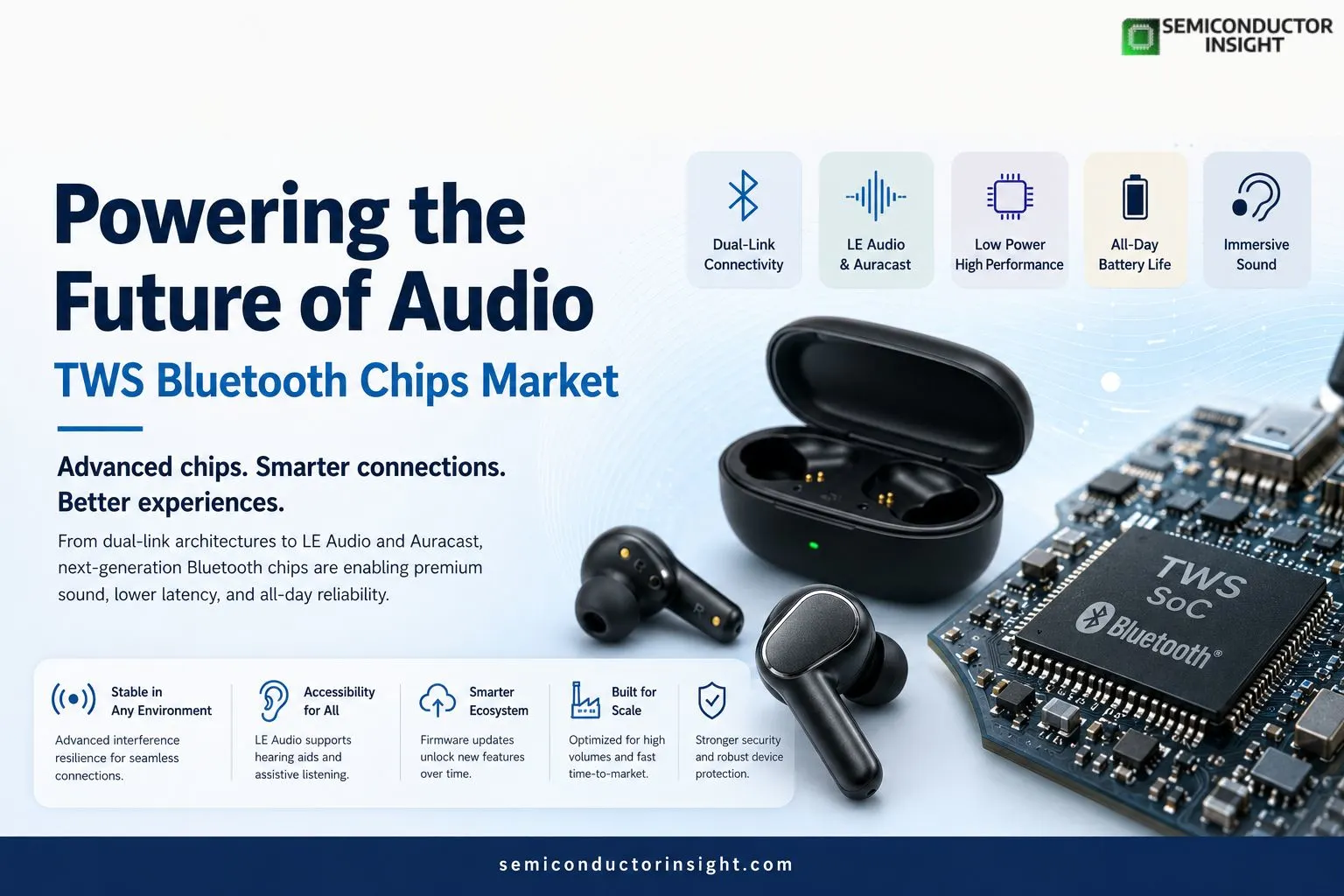
Bluetooth SIG Specification Updates 2026 Influence TWS Bluetooth Chips Market Design Choices
True wireless stereo earbuds have become the dominant form of personal audio, with each pair requiring specialized Bluetooth chips that handle stereo synchronization, low-latency streaming, and battery management in constrained form factors.
Bluetooth SIG data indicates 448 million Bluetooth earbuds were expected to ship in 2024, with projections climbing toward 712 million annual units by 2028. Every one of those devices depends on at least one primary audio SoC that manages the radio link, digital signal processing, and sensor fusion.
Chip Architectures Enabling Independent Earbud Links
- Early TWS designs relied on a master-slave relay system where one earbud received the full stream and forwarded audio to the other.
- Modern chips from Qualcomm and Airoha support dual-transmission architectures that allow both earbuds to maintain independent connections to the source device.
- This approach balances battery drain and improves resilience against interference, a practical necessity given the dense radio environments found in urban commuting and open-plan offices.
Qualcomm Platforms Powering Premium Listening Experiences
Qualcomm’s QCC series remains a frequent choice for higher-end models. Recent generations such as the S3 and S5 platforms incorporate aptX Lossless support, adaptive active noise cancellation processing, and LE Audio readiness.
Brands including Bose, Sennheiser, and Samsung have integrated these chips to deliver features like spatial audio with head tracking and game-mode latency under 50 milliseconds. Teardown analyses consistently identify these platforms in devices priced above the mid-tier range.
MediaTek Airoha Solutions Scaling Mid-Range Volume Production
Airoha, operating under MediaTek, supplies high-volume chipsets widely used by Chinese and Southeast Asian brands. Platforms such as the AB156x and MT2811 families combine Bluetooth 5.3 or 5.4 radios with hybrid noise-cancellation engines and multi-point connectivity.
These chips appear frequently in models sold through major online channels, supporting features that once belonged only to flagship products while keeping power consumption low enough for all-day wear.
- Chinese Design Houses Filling Cost-Sensitive Segments
- Domestic Chinese semiconductor firms including Bluetrum, JieLi Technology, and Bestechnic have developed competitive SoCs that dominate the entry and mid-tier segments.
- These chips often integrate Bluetooth radio, audio DSP, and power management on a single die, enabling complete TWS solutions at lower bill-of-materials cost.
- Reverse-engineering reports of budget earbuds frequently identify these platforms, illustrating how specialized audio silicon has proliferated beyond traditional Western suppliers.
- LE Audio and Auracast Changing Connection Expectations
- The formal introduction of Bluetooth LE Audio and the LC3 codec has begun reshaping chip requirements.
- LE Audio enables multi-stream audio to both ears with lower power draw and introduces Auracast broadcast capability, allowing a single transmitter to reach an unlimited number of receivers.
- Early public deployments have appeared at cultural venues such as the Sydney Opera House and selected airports, while smartphone makers including Samsung, Google, and Xiaomi have added native support in recent flagship handsets.
You Can Go Through Our Latest Updated Insights Here: https://semiconductorinsight.com/report/tws-bluetooth-chips-market-2/
- Firmware Ecosystems and Long-Term Device Support
- Chip vendors supply extensive software development kits and reference designs that allow brands to differentiate user experience through custom equalizers, ANC profiles, and companion applications.
- Regular over-the-air firmware updates extend the useful life of both the chip and the finished product, addressing security patches and adding new codec support years after initial launch.
Manufacturing Concentration and Supply Chain Realities
A significant portion of TWS Bluetooth chips are fabricated at foundries in Taiwan and mainland China, then packaged and tested near the major assembly hubs of the Pearl River Delta. This geographic concentration supports rapid iteration cycles between chip designers and earbud manufacturers, enabling new models to move from concept to mass production within months.
Taiwan-based suppliers such as Airoha (a MediaTek subsidiary) rely on advanced nodes including TSMC’s low-voltage 12-nanometer processes for AI-enhanced features like adaptive noise suppression. Meanwhile, Chinese design houses including Bluetrum, JieLi Technology, and Bestechnic maintain headquarters and production links in Shenzhen, Zhuhai, and Shanghai, feeding the dense ecosystem of casing, battery, driver, and PCB suppliers clustered within a few hours’ drive of one another. Industry observations note that China accounts for the overwhelming majority of global TWS earbud assembly, with Shenzhen alone serving as the primary design and manufacturing center for both branded and white-label production.
This proximity allows component changes to be validated in days rather than weeks, supporting the high annual volumes of Bluetooth earbuds that reached hundreds of millions of units in recent years and continue expanding toward the 700-million range by the later 2020s according to Bluetooth SIG projections.
Everyday Reliability in Dense Radio Environments
- Users expect seamless performance even when walking through crowded transit hubs or working near multiple Wi-Fi access points.
- Modern chips incorporate advanced interference mitigation, frequency-hopping improvements, and multipoint connection handling so that a single pair of earbuds can remain paired simultaneously to a phone and a laptop without audible dropouts.
- Bluetooth operates in the crowded 2.4 GHz band shared with Wi-Fi, microwave ovens, and countless other devices, yet contemporary TWS silicon employs adaptive frequency hopping across 79 channels and improved packet retransmission logic to maintain stable links.
- Dual-transmission architectures found in platforms from Qualcomm and Airoha allow each earbud to connect independently to the source, reducing the single-point-of-failure risk of older master-slave relay designs.
Accessibility Applications Opening New Use Cases
LE Audio’s standardized hearing-aid profile removes previous proprietary barriers, allowing compatible TWS-style devices and dedicated hearing aids to stream directly from mainstream smartphones. Combined with Auracast, this creates opportunities for assistive listening in classrooms, theaters, and public transport systems without requiring specialized receivers.
Bluetooth SIG materials highlight that LE Audio enables higher-quality audio at lower power while supporting multi-stream delivery to both ears and broadcast audio to an unlimited number of receivers.

Comments (0)