
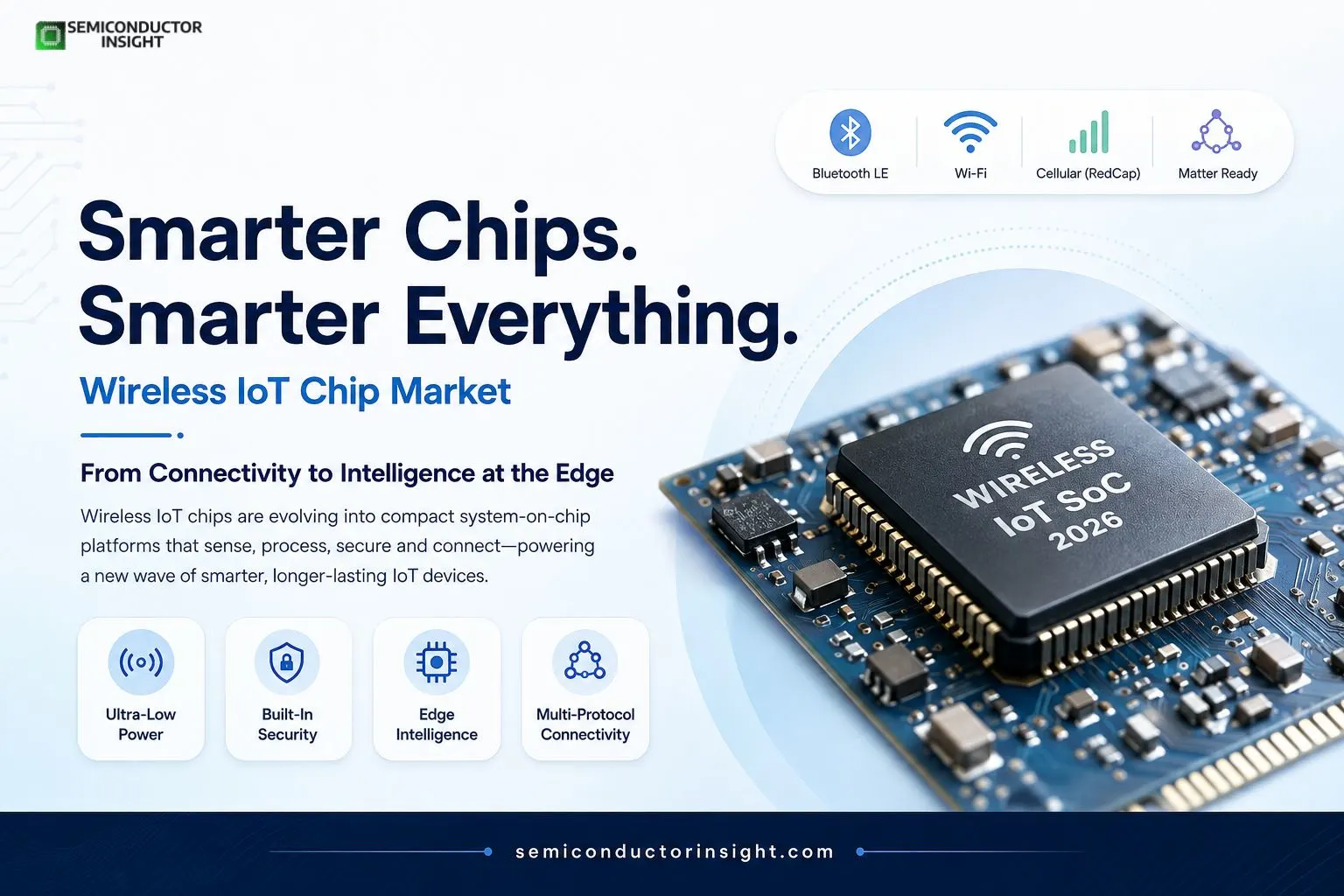
Bluetooth LE vs. Wi-Fi in Wireless IoT Chip Market 2026 for Low Power Connected Devices
The wireless IoT chip is becoming much more than a small radio inside a sensor. In 2026, connectivity silicon increasingly combines wireless communication, microcontrollers, security functions, power management and edge processing in compact system-on-chip designs.
That shift is opening new possibilities for smart meters, industrial sensors, asset trackers, wearables, appliances, logistics equipment and connected infrastructure.
The wireless chip is becoming the device’s nervous system
An IoT product often has only a small amount of information to transmit, but it may need to remain operational for months or years. That makes energy consumption, radio sensitivity, processing efficiency and security just as important as raw data throughput.
A connected sensor may therefore follow a very different architecture from a smartphone:
Sensor → Microcontroller → Wireless SoC → Antenna → Gateway or Network → Cloud / Edge Platform
The semiconductor opportunity is increasingly concentrated in making every stage smaller, more power efficient and easier for manufacturers to integrate.
Bluetooth LE is moving into surprisingly large device categories
· Bluetooth’s latest shipment outlook provides a useful indicator of the scale of wireless connectivity.
· Bluetooth-enabled device shipments are projected to exceed approx. 5.3 billion units in 2025 and approach 8 billion units by 2029. Bluetooth SIG also projects single-mode Bluetooth LE shipments to grow at a 22% CAGR, while Bluetooth Classic single-mode shipments are expected to decline.
· That transition matters for chip designers. Bluetooth LE is increasingly being used in electronic shelf labels, smart tags, wearables, sensors and location systems where continuous high-speed communication is unnecessary.
· The result is a design priority that sounds simple but is technically demanding: send the right amount of data while consuming as little energy as possible.
A new generation of cellular IoT silicon is arriving
Cellular connectivity is also being redesigned for devices that sit between ultra-low-data IoT and full 5G broadband. 5G RedCap, introduced through 3GPP Release 17, reduces device complexity by limiting bandwidth to as much as 20 MHz, removing carrier aggregation and dual connectivity, and supporting simpler antenna configurations. It can deliver peak rates of up to 226 Mbps downlink and 120 Mbps uplink.
By April 2025, the Global mobile Suppliers Association had identified 30 operators across 21 countries investing in RedCap, with commercial launches reported from operators including China Mobile, China Telecom, China Unicom, Dito, STC and T-Mobile US.
This gives wireless IoT chip manufacturers a new target between conventional LTE IoT modules and higher-performance 5G platforms.
The semiconductor is being designed around the battery
For many IoT products, changing a battery is expensive or physically impractical. A sensor installed on a factory machine, utility asset or warehouse package may need to operate for long periods without human intervention.
That is why low-power modes are becoming a defining feature of wireless chip architecture. 3GPP’s cellular IoT work includes technologies such as extended discontinuous reception, while newer RedCap developments continue to focus on reducing device complexity and energy consumption.
At the short-range end, Bluetooth LE is following the same philosophy. Its growth in single-mode applications demonstrates how connectivity is moving toward purpose-built radios rather than always-on high-performance communication.
For More Detailed Insights, You Can Surf Our Latest Report Here: https://semiconductorinsight.com/report/wireless-iot-chip-market/
Matter is changing what smart-home chips need to accomplish
The smart-home ecosystem adds another layer to wireless semiconductor design: interoperability.
Matter is designed as a common application-layer standard for connected-home products and is built on established networking technologies. The Connectivity Standards Alliance positions Matter around interoperability, reliability, security and simplified product development.
For chip suppliers, this encourages multiprotocol platforms capable of supporting combinations of technologies such as Wi-Fi, Thread and Bluetooth LE during commissioning and operation. The chip increasingly becomes the point where different connectivity standards converge.
Ambient IoT points toward an even smaller class of chips
ü One of the more intriguing developments is Ambient IoT, where extremely constrained devices can communicate through backscatter techniques rather than relying on conventional active radio transmission.
ü A 3GPP publication discussing the concept describes devices that modulate information onto an externally supplied carrier wave and reflect the signal back toward a reader.
ü This approach could eventually support applications where conventional batteries are undesirable, including identification, sensing and industrial tracking.
ü The semiconductor implication is substantial: future wireless IoT chips may not simply become faster. Some will become smaller, more selective, more energy efficient and increasingly dependent on the surrounding wireless environment.
Where the next chip designs are finding room
The most interesting applications are appearing where connectivity has traditionally been difficult, expensive or power hungry. Smart labels can communicate shelf information, industrial sensors can send machine-health data, trackers can monitor logistics assets, and wearable devices can combine sensing with local processing.
SIA notes that IoT semiconductors encompass microcontrollers, sensors and memory, alongside the infrastructure required to connect billions of devices across industrial, retail, healthcare and transportation applications.
The 2026 design race is about efficiency rather than maximum speed
Wireless IoT Chip Market is entering a phase where the winning architecture will depend heavily on the application. Bluetooth LE makes sense for short-range, low-energy devices; Wi-Fi remains valuable where higher throughput and local networking are needed; and cellular technologies such as RedCap are opening a middle ground for wide-area connected equipment.
The industry’s direction is therefore becoming clear: wireless chips are evolving from connectivity components into compact computing platforms that sense, process, secure and communicate data at the edge. As billions of connected devices move from simple monitoring toward autonomous decision-making, that architectural shift could become one of the most important semiconductor stories of 2026 and beyond.

Comments (0)