
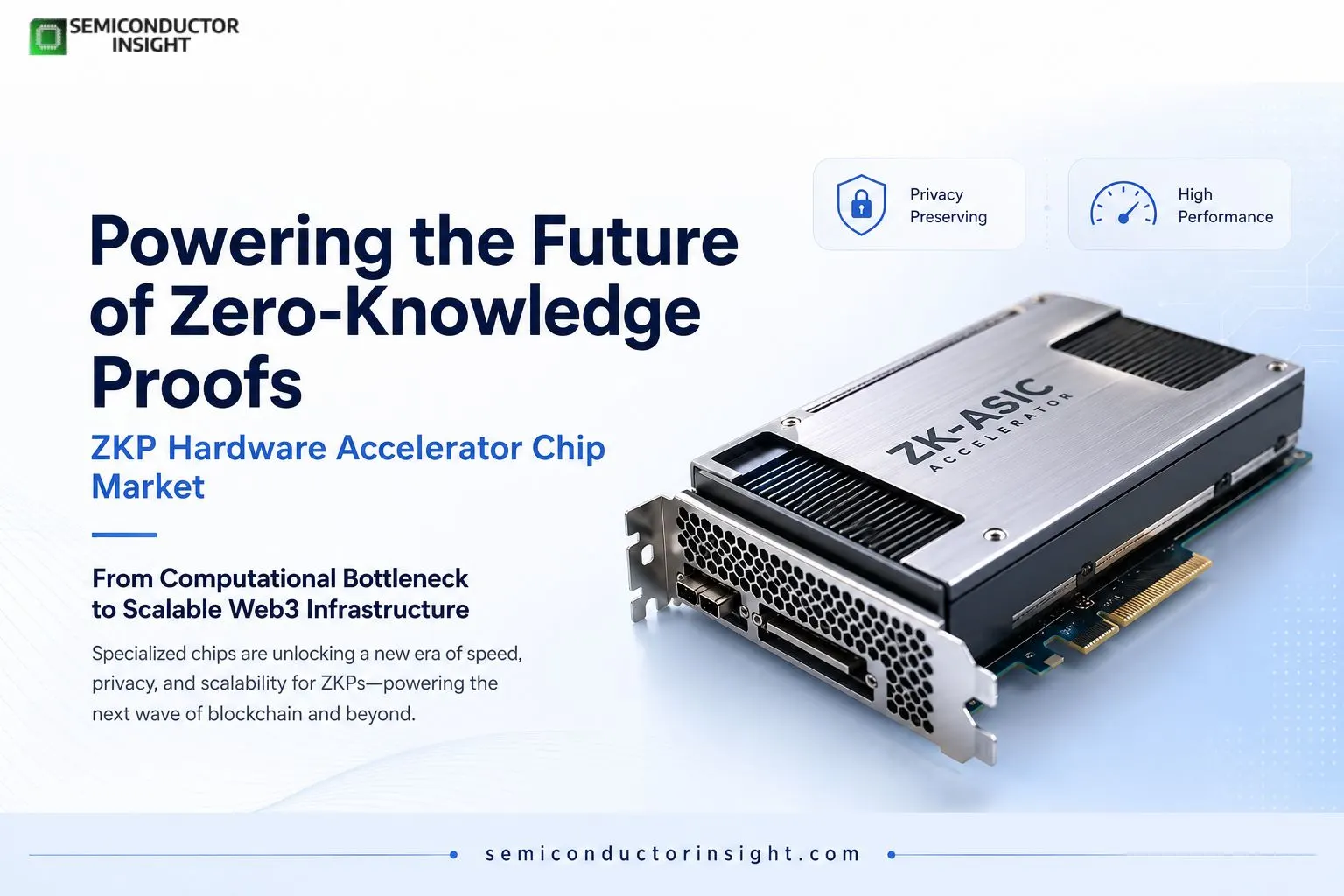
Blockchain Hardware Accelerator Chip for Zero-Knowledge Proofs Market 2026: The ASIC Revolution
The blockchain industry is standing at a critical inflection point, and at the heart of this transformation lies zero-knowledge proof technology. ZKPs, a cryptographic breakthrough first conceptualized nearly four decades ago, have become the backbone of modern blockchain applications ranging from privacy-preserving transactions to layer-two scaling solutions like zkRollups. However, the computational intensity of generating these proofs has emerged as a formidable bottleneck. Hardware acceleration has risen as the direct and necessary solution to this challenge, and specialized chips are now redefining the speed, cost, and feasibility of ZKP generation at scale.
The market for these accelerators is nascent but carries immense potential. Current industry analysis suggests that with mainstream adoption, the hardware required to meet ZKP computational demands could unlock a market valued in the billions of dollars, fundamentally reshaping the economics of the Web3 infrastructure layer.
Take a Quick Glance at Our In-Depth Analysis Report: https://semiconductorinsight.com/report/blockchain-hardware-accelerator-chip-for-zero-knowledge-proofs-market/
Understanding the Hardware Landscape: GPU, FPGA, and the ASIC Ascent
- To grasp the significance of specialized chips for ZKPs, one must first understand the existing hardware hierarchy. The industry currently relies on three main computing architectures to accelerate proof generation: GPUs, FPGAs, and ASICs.
- GPUs have become the de facto standard in the near term due to their general-purpose parallel architecture and the maturity of their software ecosystem. They are versatile and readily available, making them the most cost-effective and accessible option for rapid deployment and iteration in the current market. However, GPUs face significant bottlenecks in tasks like large integer modular operations, which are central to ZKP generation, leading to inefficiencies in energy consumption and scalability.
- FPGAs occupy a middle ground. These reconfigurable chips offer a ‘sweet spot’ between flexibility and efficiency. Their programmability at the logic-gate level makes them ideal for validating algorithmic changes and for deployment in low-latency scenarios like high-frequency trading. Yet, they struggle to compete with GPUs in raw performance per dollar and with ASICs in peak efficiency, positioning them as a tactical, rather than strategic, solution for long-term scalability.
- ASICs represent the pinnacle of performance and energy efficiency. These dedicated chips are custom-built to execute specific tasks, processing proofs orders of magnitude faster and with far greater energy efficiency than their more general-purpose counterparts. While historically considered the ‘Mount Everest’ of the industry due to their high design costs and market uncertainties, ASICs are now being actively developed, with the potential to provide the 10 to 100 times performance advantage necessary to bring ZKP technology to the masses.
Cysic’s ComputeFi and the Dawn of ZK-ASIC
Leading the charge in this ASIC frontier is Cysic, currently the most prominent team focused on developing dedicated ZK-ASIC chips. Their ambitious project is centered on a concept they call ComputeFi, which aims to transform high-performance computing capabilities from expensive, fixed assets into programmable and tradeable on-chain commodities.
Cysic’s competitive edge lies in its dual-track approach of combining ASIC innovation with GPU acceleration. Their self-developed C1 chip is based on a zkVM architecture designed for high bandwidth and flexible programmability. The company is preparing to launch two hardware products built on this technology: ZK Air, a portable, plug-and-play accelerator about the size of an iPad charger, and ZK Pro, a high-performance system designed for enterprise-level tasks like large-scale zkRollup and zkML applications.
Early performance benchmarks are promising; in testing, the C1 chip achieved approximately 1.31 million Keccak proofs per second, representing a 13-fold acceleration over other solutions. The company’s testnet has progressed to its second phase, with performance claims of being 5 to 10 times faster than GPU acceleration. Following its mainnet launch and Token Generation Event in December 2025, the market is closely watching the development and distribution of these physical ASIC products.
Interoperability and the Smart Lighting Ecosystem
While the cryptographic chips form the backbone, the principle of hardware integration extends to other connected technologies, such as the smart home.
For instance, Signify, the world leader in lighting, operates a fleet of over 156 million connected smart products, the majority of which utilize Zigbee and Matter protocols.
Their Philips Hue ecosystem has grown to over 1,000 products, all capable of receiving software updates and integrating with broader smart home systems.
This demonstrates the importance of reliable hardware and interoperability standards, much like the emerging need for standardized, high-performance ZKP hardware.
Beyond the Blockchain: The Impact on AI and Machine Learning
- The value proposition of ASIC acceleration extends beyond blockchain.
- Zero-knowledge machine learning (zkML) is an emerging field where proving the veracity of machine learning inferences without revealing the underlying data is becoming critically important.
- The computational demands for both generating ZK proofs and performing AI inference are staggering.
- ASICs, known for their dominance in cryptocurrency mining due to their extreme efficiency, are poised to bring the same disruptive advantages to AI.
In the long term, while GPUs will likely remain dominant for training AI models due to their flexibility, ASICs are projected to have irreplaceable value in large-scale inference and fixed-task execution. Cysic’s network aims to be a general proof layer, supporting ZK proofs, AI inference, and cryptographic mining all within a single decentralized infrastructure.

Comments (0)