FPGA based smartNIC chip with inline TLS offload Market Insights
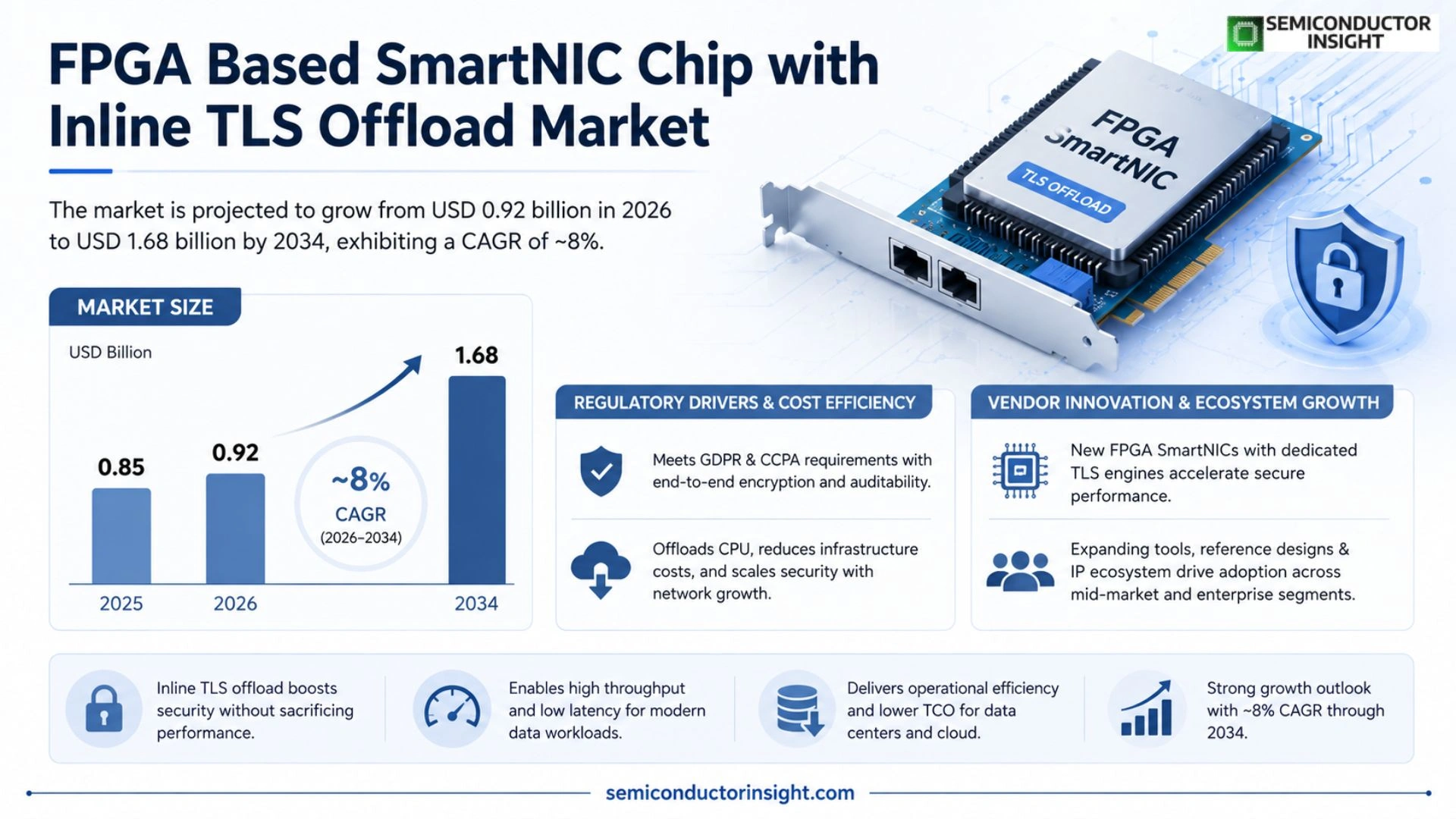
Global FPGA based smartNIC chip with inline TLS offload market size was valued at USD 0.85 billion in 2025. The market is projected to grow from USD 0.92 billion in 2026 to USD 1.68 billion by 2034, exhibiting a CAGR of approximately 8 % during the forecast period.
FPGA based smartNIC chips integrate programmable logic directly onto network interface cards, enabling inline Transport Layer Security (TLS) offload that accelerates encryption/decryption without burdening host CPUs. These devices combine high‑throughput packet processing with flexible re‑configurability, allowing data‑center operators to adapt security policies on‑the‑fly while maintaining low latency.
The market is gaining momentum because enterprises are confronting exponential growth in encrypted traffic, stricter compliance mandates such as GDPR and CCPA, and the need for cost‑effective scaling of cloud services. Furthermore, recent announcements,such as AMD’s release of Xilinx Alveo cards featuring dedicated TLS engines in early 2024,are driving adoption across hyperscale providers and telecom operators alike.
MARKET DRIVERS
Rising Data‑Center Bandwidth Demands
The explosive growth of cloud services, AI workloads, and 5G edge computing is driving a 10‑15% annual increase in data‑center traffic. Enterprises are turning to FPGA based smartNIC chip with inline TLS offload Market to sustain latency‑critical applications while maintaining encrypted flows.
Regulatory Push for End‑to‑End Encryption
Stringent data‑privacy regulations such as GDPR, CCPA, and emerging quantum‑resistant standards compel organizations to offload TLS processing to hardware. By leveraging programmable FPGA fabrics, the market offers reduced CPU overhead and consistent compliance across heterogeneous workloads.
➤ “Integrating FPGA‑based TLS offload reduces server CPU utilization by up to 45 % while delivering sub‑microsecond latency.”
Additionally, the convergence of networking and security functions into a single smartNIC accelerates total cost of ownership savings, spurring wider adoption across hyperscale operators and financial institutions.
MARKET CHALLENGES
High Initial Capital Expenditure
Deploying FPGA based smartNIC solutions requires significant upfront investment in hardware, licensing, and specialized engineering expertise, which can deter mid‑size enterprises from immediate adoption.
Other Challenges
Complex Development Ecosystem
Designers must master hardware description languages, vendor SDKs, and security certification processes, extending time‑to‑market for new TLS offload features.
MARKET RESTRAINTS
Limited Skilled Workforce
The scarcity of engineers proficient in both FPGA programming and network security creates a bottleneck, slowing large‑scale rollouts of FPGA based smartNIC chip with inline TLS offload Market.
Furthermore, legacy infrastructure in many data centers lacks the physical slot density or power budgeting required for high‑performance smartNICs, restricting upgrade paths.
Vendor lock‑in concerns also arise, as proprietary IP cores can make migration to alternative platforms costly and technically risky.
MARKET OPPORTUNITIES
Emergence of Open‑Source FPGA Toolchains
Open‑source development environments are lowering barriers to entry, enabling faster prototyping and reducing licensing fees, which could accelerate market penetration in the next 3‑5 years.
Moreover, the rise of hybrid cloud architectures creates demand for portable, high‑throughput security accelerators that can seamlessly operate across on‑premises and public‑cloud environments, positioning FPGA based smartNIC chip with inline TLS offload Market as a strategic enabler.
Finally, strategic partnerships between FPGA vendors and hyperscale cloud providers are expected to unlock customized TLS offload pipelines, unlocking new revenue streams and expanding the addressable market.
FPGA based smartNIC chip with inline TLS offload Market Trends
Rising Demand for Encrypted Traffic Acceleration
Enterprises are facing a rapid increase in encrypted payloads across data‑center interconnects, prompting a shift toward hardware‑assisted security processing. FPGA based smartNIC chip with inline TLS offload Market solutions embed programmable logic directly on the network interface, allowing TLS termination to occur without diverting packets to the host CPU. This architecture delivers high‑throughput throughput while preserving sub‑microsecond latency, a critical factor for latency‑sensitive applications such as financial trading and real‑time analytics. The re‑configurable nature of FPGAs enables operators to update cryptographic algorithms and policy rules on‑the‑fly, reducing operational risk and simplifying compliance management.
Other Trends
Regulatory Drivers and Cloud Cost Efficiency
Stricter data‑privacy regulations, including GDPR and CCPA, compel organizations to enforce end‑to‑end encryption and maintain auditable security controls. Deploying inline TLS offload on smartNICs satisfies these mandates while offloading CPU cycles, translating into lower infrastructure spend for hyperscale cloud providers. The ability to scale security processing linearly with network bandwidth helps cloud operators meet growing service‑level agreements without proportionally increasing server count, delivering a clear cost advantage over pure software‑based approaches.
Vendor Innovation and Ecosystem Expansion
Recent product announcements, such as AMD’s Xilinx Alveo accelerator cards equipped with dedicated TLS engines in early 2024, illustrate a momentum shift toward integrated security functionality. These offerings are gaining traction among telecom operators and large‑scale data‑center owners who prioritize flexibility and rapid deployment cycles. The expanding ecosystem of development tools, reference designs, and third‑party IP libraries is lowering entry barriers, encouraging broader adoption across mid‑market segments that previously relied on generic NICs.
COMPETITIVE LANDSCAPE
Key Industry Players
Competitive Dynamics in the FPGA‑Based SmartNIC TLS Offload Space
The market is anchored by a small group of large semiconductor firms that leverage mature FPGA portfolios to deliver high‑performance SmartNICs with dedicated TLS engines. AMD’s Xilinx Alveo line, launched in early 2024, commands the premium segment by offering scalable throughput up to 200 Gbps and tight integration with cloud orchestration tools. Intel’s acquisition of Achronix and its own Programmable Acceleration Card (PAC) family provide a complementary strategy, targeting hyperscale data‑centers that demand programmable security pipelines. Broadcom, through its acquisition of Barefoot Networks, supplies ASIC‑centric SmartNICs enriched with FPGA‑based TLS offload modules, positioning itself as a hybrid solution provider. These leaders shape market structure through extensive IP libraries, robust software stacks, and global OEM relationships, resulting in a tiered ecosystem where smaller innovators partner with the majors to reach end‑users.
Beyond the tier‑one tier, a vibrant cohort of niche players advances specialized features such as ultra‑low latency, on‑chip key management, or open‑source security frameworks. Marvell’s Octeon‑TX2 family adds a programmable data plane that can be repurposed for TLS offload, while NVIDIA (via Mellanox) offers BlueField‑3 cards that blend ARM cores with FPGA fabrics for flexible encryption pipelines. Netronome’s NFP‑6000 and Pensando’s Distributed Services Cards (DSC) emphasize software‑defined security policies. Smaller firms like BittWare, C4 Systems, and Enyx deliver boutique FPGA SmartNICs optimized for specific workloads, often integrating with open‑source TLS libraries to reduce licensing costs. Collectively, these players enrich the competitive landscape by driving innovation, price competition, and rapid feature cycles that benefit data‑center operators.
List of Key FPGA based SmartNIC Companies Profiled
- AMD Xilinx
- Intel
- Broadcom (Barefoot Networks)
- Marvell
- NVIDIA (Mellanox)
- Netronome
- Pensando Systems
- BittWare
- C4 Systems
- Enyx
- HPE Aruba Networking
- Cisco Systems
Segment Analysis:
| Segment Category | Sub-Segments | Key Insights |
| By Type |
|
Reconfigurable SmartNICs enable dynamic adaptation to new security protocols, allow firmware upgrades without hardware replacement, and support multi‑tenant environments. – Consolidates encryption, compression and traffic steering on a single programmable platform. – Reduces operational overhead by streamlining firmware lifecycle management. |
| By Application |
|
Cloud Data‑Center Acceleration drives high‑throughput encrypted traffic handling while preserving low latency for latency‑sensitive workloads. – Offloads TLS processing from host CPUs, freeing compute cycles for application workloads. – Provides programmable pipelines that can be tuned for specific cloud service patterns and SLAs. |
| By End User |
|
Hyperscale Cloud Providers prioritize massive encrypted traffic volumes and seek deterministic latency. – Leverage FPGA smartNICs to guarantee compliance with data‑privacy regulations while scaling cost‑effectively. – Benefit from the ability to roll out security policy updates across thousands of servers without service interruption. |
| By Deployment Model |
|
On‑Premises Deployment offers tight control over hardware configuration and security policy enforcement. – Aligns with strict regulatory environments that demand data residency. – Enables direct integration with existing network orchestration tools for seamless workflow automation. |
| By Security Function |
|
TLS Termination is the core differentiator for FPGA based smartNICs, delivering near‑wire speed encryption handling. – Facilitates end‑to‑end security without degrading application performance. – Allows centralized policy enforcement while supporting granular per‑flow security controls. |
Regional Analysis: North America
North America
The data center sector is a primary driver of FPGA based smartNIC chip with inline TLS offload Market in North America. The need for high-speed networking and robust security within data centers is constantly increasing, making these chips essential for optimizing performance and safeguarding sensitive data.
Cloud providers in North America are actively integrating FPGA based smartNIC chips with inline TLS offload into their infrastructure to enhance security and accelerate service delivery. This trend is contributing significantly to the market growth. The ability to offload TLS processing improves the efficiency of cloud-based applications and services.
The HPC segment in North America utilizes FPGA based smartNIC chips with inline TLS offload for demanding computational tasks. The enhanced networking capabilities and security features offered by these chips are crucial for accelerating scientific research and complex data analysis.
The financial services sector in North America is increasingly adopting FPGA based smartNIC chips with inline TLS offload to meet stringent regulatory requirements and enhance the security of financial transactions.
Europe
The European market for FPGA based smartNIC chip with inline TLS offload is experiencing steady growth, driven by increasing data security concerns and the expansion of cloud infrastructure investments. Several government initiatives promoting digital transformation are also contributing to market expansion. The focus in Europe is on energy efficiency and compliance with data privacy regulations like GDPR.
Asia-Pacific
Asia-Pacific is emerging as a key growth region for FPGA based smartNIC chip with inline TLS offload Market. Rapid digitalization, increasing cloud adoption, and the growth of 5G networks are fueling demand. Countries like China, Japan, and South Korea are leading this growth, with significant investments in data center infrastructure and network upgrades.
South America
South America represents a nascent but promising market for FPGA based smartNIC chip with inline TLS offload. The increasing demand for cloud services and the growing adoption of digital technologies are creating opportunities for market growth. However, challenges related to infrastructure development and economic stability need to be addressed.
Middle East & Africa
The Middle East & Africa market for FPGA based smartNIC chip with inline TLS offload is in its early stages of development. Significant investments in digital transformation initiatives and the growth of the cloud computing sector are expected to drive market expansion in the coming years. The increasing adoption of IoT devices is also contributing to the demand for secure network infrastructure.
Report Scope
This market research report provides a comprehensive analysis of the FPGA based smartNIC chip with inline TLS offload Market , covering the forecast period 2026–2034. It offers detailed insights into market dynamics, technological advancements, competitive landscape, and key trends shaping the industry.
Key focus areas of the report include:
- Market Overview: The report begins with an overview outlining its current market scenario, key growth indicators, and industry transformation drivers. It discusses macroeconomic factors, demand–supply balance, regulatory landscape, and the strategic role of semiconductors in powering advancements across industries such as automotive, telecommunications, consumer electronics, and industrial automation.
- Market Size & Forecast: Historical data and future projections for revenue, unit shipments, and market value across major regions and segments.
- Segmentation Analysis: Detailed breakdown by product type, technology, application, and end-user industry to identify high-growth segments and investment opportunities.
- Regional Insights: Insights into market performance across North America, Europe, Asia-Pacific, Latin America, and the Middle East & Africa, including country-level analysis where relevant.
- Competitive Landscape: Profiles of leading market participants, including their product offerings, R&D focus, manufacturing capacity, pricing strategies, and recent developments such as mergers, acquisitions, and partnerships.
- Technology Trends & Innovation: Assessment of emerging technologies, integration of AI/IoT, semiconductor design trends, fabrication techniques, and evolving industry standards.
- Market Drivers & Restraints: Evaluation of factors driving market growth along with challenges, supply chain constraints, regulatory issues, and market-entry barriers.
- Stakeholder Insights: Insights for component suppliers, OEMs, system integrators, investors, and policymakers regarding the evolving ecosystem and strategic opportunities.
Primary and secondary research methods are employed, including interviews with industry experts, data from verified sources, and real-time market intelligence to ensure the accuracy and reliability of the insights presented.
FREQUENTLY ASKED QUESTIONS:
What is the current market size of FPGA based smartNIC chip with inline TLS offload Market?
-> FPGA based smartNIC chip with inline TLS offload Market was valued at USD 0.85 billion in 2025 and is expected to reach USD 1.68 billion by 2034.
Which key companies operate in FPGA based smartNIC chip with inline TLS offload Market?
-> Key players include AMD (Xilinx), Intel, Broadcom, Marvell and Nvidia, among others.
What are the key growth drivers?
-> Key growth drivers include exponential growth in encrypted traffic, stricter compliance mandates such as GDPR and CCPA, need for cost‑effective scaling of cloud services, and the introduction of dedicated TLS engines in FPGA cards.
Which region dominates the market?
-> North America leads the market, while Asia‑Pacific shows rapid growth potential.
What are the emerging trends?
-> Emerging trends include integration of AI/ML for traffic analysis, edge computing adoption, and increasing programmable smartNIC functionality for security and acceleration.

Get Sample Report PDF for Exclusive Insights
Report Sample Includes
- Table of Contents
- List of Tables & Figures
- Charts, Research Methodology, and more...