
Disposable Bioprocessing Sensor Market Powering Next-Generation Biopharma Production
Biopharmaceutical manufacturing has entered a technologically advanced phase where automation, precision monitoring, and contamination-free production are essential. Within this evolving landscape, Disposable Bioprocessing Sensor Market has emerged as a critical component in modern production environments.
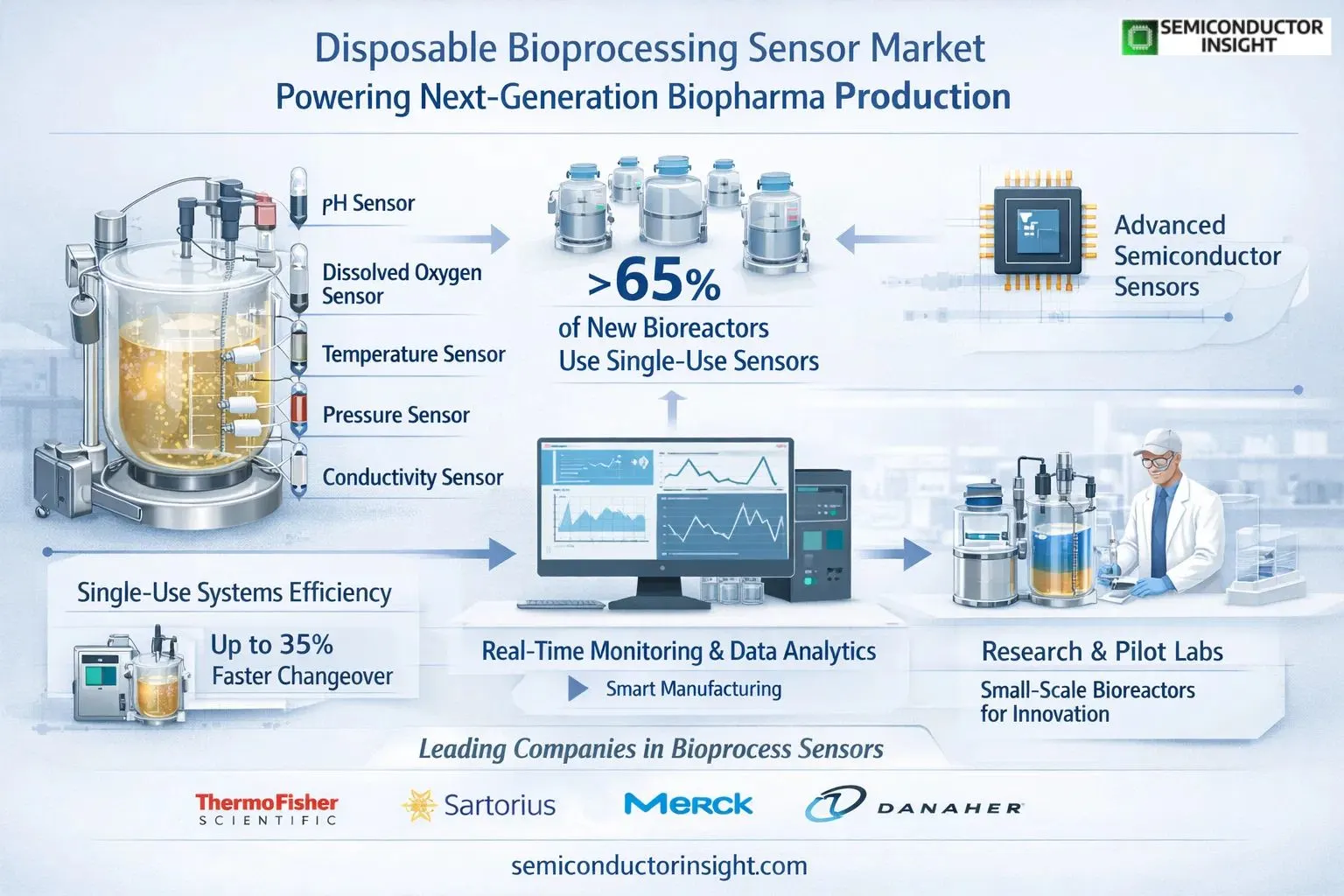
Disposable sensors are designed to measure key parameters such as pH, dissolved oxygen, temperature, pressure, and conductivity during cell culture and fermentation processes. These sensors are built right into single-use devices, which means they don’t need to be cleaned and there is less chance of cross-contamination.
Across global biologics manufacturing facilities, the adoption of disposable sensors has increased rapidly as companies shift toward flexible production platforms capable of supporting smaller batch sizes and faster product development cycles.
Precision Monitoring Inside Modern Bioreactors
- Bioreactors are at the core of biological production systems where living cells produce complex molecules such as monoclonal antibodies, vaccines, and recombinant proteins.
- Monitoring conditions within these systems is essential because even small fluctuations can affect yield and product quality.
- Disposable sensors provide continuous real-time data, allowing operators to maintain optimal environmental conditions for cell growth.
- Studies indicate that more than 65% of new bioreactor installations now integrate single-use sensor technology, demonstrating the growing reliance on disposable monitoring tools.
- By enabling precise measurement of process variables, these sensors help manufacturers maintain stable cell culture environments and reduce batch failures.
Semiconductor Engineering Enhancing Sensor Performance
A notable technological development within the market is the integration of semiconductor sensors into disposable bioprocess monitoring systems. Semiconductor fabrication techniques allow the production of highly miniaturized sensing elements capable of detecting subtle chemical and biological signals.
These sensors rely on microelectronic components that convert biochemical interactions into electrical signals, enabling highly sensitive measurements within bioprocess environments. Microfabrication techniques derived from the semiconductor industry have significantly improved sensor responsiveness and durability.
Approximately 50% of newly developed disposable biosensors incorporate semiconductor-based detection technologies, reflecting how microelectronics are reshaping bioprocess instrumentation.
Advances in semiconductor materials are also improving signal stability and enabling longer operational lifetimes for disposable sensors used in extended fermentation processes.
Single-Use Manufacturing Transforming Bioprocess Facilities
Over the past decade, biopharmaceutical companies have increasingly adopted single-use systems that replace traditional stainless-steel equipment. These systems include disposable bioreactor bags, tubing assemblies, and sensor components.
Disposable sensors align perfectly with this approach because they can be pre-calibrated and integrated into manufacturing setups without requiring sterilization or cleaning procedures. Facilities that rely on single-use technologies report operational efficiency improvements of nearly 35% in setup and changeover times.
For contract development and manufacturing organizations, this flexibility is particularly valuable because it allows rapid transitions between different biologic products without complex equipment preparation.
To Know More about the Report, You Can Freely Browse Our Latest Updated Report: https://semiconductorinsight.com/report/disposable-bioprocessing-sensor-market/
Digital Bioprocessing and Smart Manufacturing
- Another important shift influencing the disposable sensor ecosystem is the rise of digital biomanufacturing.
- Real-time process analytics are becoming essential for improving production efficiency and ensuring regulatory compliance.
- Disposable sensors feed continuous data into process control systems, enabling automated adjustments to temperature, oxygen supply, and nutrient concentration. This integration supports the broader adoption of real-time monitoring platforms that analyze process data and optimize fermentation performance.
- Recent surveys show that nearly 58% of pharmaceutical manufacturers are investing in digital monitoring technologies that combine sensor networks with data analytics tools to enhance production reliability.
Companies Driving Innovation in Bioprocess Sensors
Several global biotechnology equipment manufacturers are advancing disposable sensor technologies and expanding their integration into bioprocessing systems.
Thermo Fisher Scientific has developed disposable pH and dissolved oxygen sensors designed specifically for single-use bioreactors used in biologics production.
Sartorius AG has introduced integrated sensor platforms that allow real-time monitoring of multiple parameters during fermentation and cell culture processes.
Another major contributor is Danaher Corporation through its life sciences subsidiaries that develop advanced biosensor technologies for pharmaceutical manufacturing facilities.
Meanwhile, Merck KGaA continues investing in sensor-enabled single-use bioprocess systems that combine digital monitoring with disposable fluid management technologies.
These companies are focusing heavily on sensor miniaturization, signal accuracy, and integration with automated manufacturing platforms.
Accelerating Innovation in Biotechnology Research Applications
Beyond large-scale pharmaceutical manufacturing, disposable bioprocess sensors are also gaining importance in research laboratories and pilot-scale production facilities.
Academic institutions and biotech start-ups increasingly rely on small-scale bioreactors to develop new biologic therapies. Disposable sensors provide cost-effective monitoring solutions for these research environments, allowing scientists to track cellular behavior without complex instrumentation.
Additionally, vaccine research programs and cell-therapy development facilities are adopting disposable sensors to monitor sensitive cell cultures used in regenerative medicine.
Smart Sensor Materials and Future Engineering Approaches
Materials science is playing a major role in the evolution of disposable biosensors. Engineers are developing advanced polymer substrates, nanostructured sensing surfaces, and semiconductor detection layers that improve sensitivity and reliability.
These developments enable sensors to detect extremely small biochemical changes during fermentation and cell growth processes. As a result, process engineers can identify deviations early and adjust operational parameters before production quality is affected.
With continued advances in bioprocess automation, improved semiconductor sensors, and the growing reliance on single-use systems, Disposable Bioprocessing Sensor Market is becoming an essential technology platform for modern biotechnology manufacturing.
By enabling accurate monitoring, flexible production design, and contamination-free operation, disposable sensors are helping biopharmaceutical facilities build more efficient and responsive production ecosystems that support the expanding demand for biologic medicines.

Comments (0)