
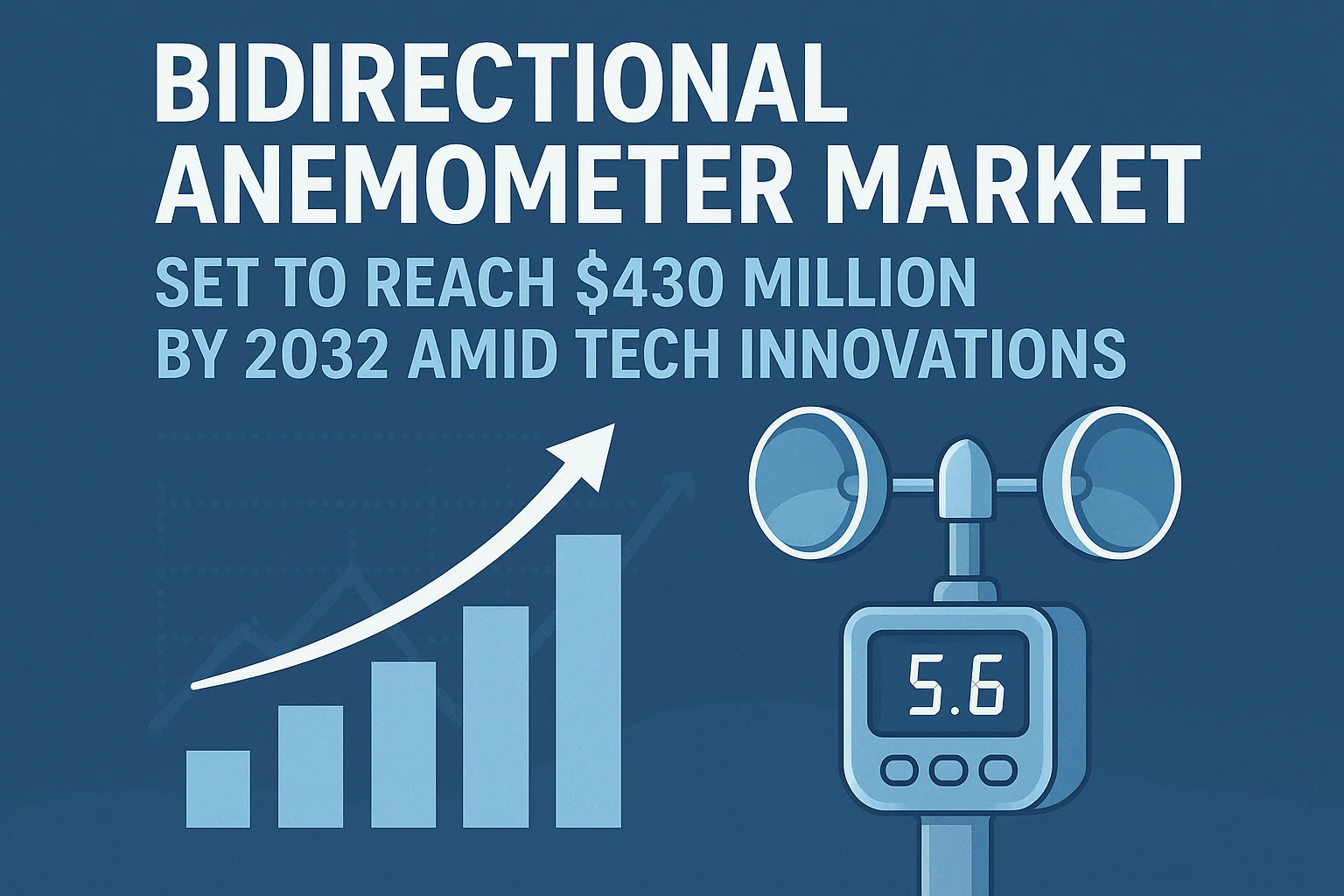
Bidirectional Anemometer Market Set to Reach $430 Million by 2032 Amid Tech Innovations
Wind is one of nature’s most unpredictable forces. From a gentle breeze cooling a summer evening to powerful gusts shaping global weather systems, its behavior directly affects industries ranging from aviation and shipping to renewable energy and atmospheric science. Understanding wind its speed, direction, and turbulence has long been a scientific and engineering priority. At the heart of this quest lies the anemometer, a device designed to measure wind. While traditional cup or vane models have been used for centuries, modern industries increasingly require bidirectional and sonic anemometers instruments capable of capturing complex, multi-directional wind patterns with high precision.
The bidirectional anemometer market is currently undergoing a dynamic transformation. Valued at USD 291 million in 2024, it is projected to reach USD 430 million by 2032, growing at a CAGR of 5.8% during the forecast period. This growth is not just fueled by rising demand for renewable energy projects and smart cities but also by cutting-edge research and product innovation.
Access Your Free Sample Report- Bidirectional Anemometer Market
The Essence of Bidirectional Anemometry
Traditional anemometers measure wind from a single direction, often requiring re-orientation to capture varying flows. However, in complex environments such as turbine wakes, tunnel ventilation systems, or planetary exploration wind rarely flows neatly from one direction. This is where bidirectional anemometers excel.
By design, these devices can measure wind speeds and flow patterns in two opposing directions, enabling more accurate monitoring of turbulent or multi-directional airflows. The principle is particularly vital for applications such as:
- Renewable energy – Assessing wind farm site conditions and turbine performance.
- Aerospace and defense – Capturing turbulence and air movement during flights or rocket launches.
- Meteorology – Studying atmospheric boundary layers and storm dynamics.
- Industrial safety – Monitoring airflow in tunnels, mines, and chemical plants.
- Space exploration – Recording wind-like motions in extraterrestrial environments such as Mars.
With these applications expanding, the demand for more precise, energy-efficient, and mobile anemometer designs has surged.
Recent Developments Driving the Industry Forward
1. High-Altitude Sonic Anemometers on Balloons
A notable leap in bidirectional anemometry comes from Tufts University’s collaboration with NASA. Researchers designed a sonic anemometer mounted on a high-altitude balloon to collect wind data as it circumnavigated the globe.
- Why it matters: Unlike traditional instruments that move with the balloon, this system captures relative wind speeds at different altitudes, providing valuable insight into global circulation patterns.
- How it works: Using ultrasonic pulses, the sensor measures travel-time differences of sound waves moving with and against the wind, translating this into highly accurate 3D wind data.
- Performance: The balloon transmitted data every 20 minutes via Iridium satellites. While the mission was cut short for safety reasons, the experiment proved the viability of sonic anemometers in high-altitude, low-pressure conditions.
Implication for industry: This breakthrough shows that lightweight, autonomous anemometers could soon support global climate studies, stratospheric research, and even weather modeling for aviation routes.
2. Drone-Supported Sling Anemometers: SAMURAI-S
Another cutting-edge project is the SAMURAI-S (Suspended Anemometer for Measuring Unmanned Aerial Research of Atmospheric Inflows – Sonic), developed by the University of Bergen and partners.
- The challenge: Mounting an anemometer directly on a drone often leads to distorted readings due to propeller-induced flow (PIF).
- The solution: The sonic anemometer is suspended below the drone as a sling load, distancing it from rotor turbulence.
- Validation: Comparative tests against masts at 30–60 meters showed accurate horizontal wind data. Vertical turbulence was slightly exaggerated at high wind speeds but still within acceptable error margins.
Implication for industry: By enabling mobile, precise wind measurements, drone-mounted bidirectional anemometers open doors for applications in wind farm siting, atmospheric turbulence studies, and disaster monitoring.
3. Self-Waking Anemometers with Triboelectric Nanogenerators
A key innovation in the low-power domain is the Breeze Wake-Up Anemometer (B-WA) developed with rolling-bearing triboelectric nanogenerators (RB-TENGs).
- Unique feature: The device remains dormant until wind speeds exceed ~2 m/s, at which point it self-activates within one second.
- Energy efficiency: Eliminates the need for constant power supply, making it suitable for remote, off-grid installations.
- Performance: Demonstrates high sensitivity (~9.45 Hz per m/s) across test scenarios.
Implication for industry: This advancement aligns with the growing demand for sustainable, maintenance-free sensors in smart cities, agriculture, and environmental monitoring.
Download Sample Report PDF- Bidirectional Anemometer Market
4. Anemometers for Planetary Exploration
NASA’s Mars missions have underscored the need for ultra-sensitive, bidirectional anemometers capable of working in thin, low-pressure atmospheres. Recent prototypes use ultrasonic travel-time differences to detect winds as low as 1 cm/s at sample rates of up to 100 Hz.
- Relevance: On Mars, even gentle airflows can lift dust and shape weather.
- Cross-over applications: These sensors, initially designed for planetary science, are finding uses in high-precision Earth applications, such as aerospace testing and microclimate monitoring.
5. Smart Anemometry and IoT Integration
Modern bidirectional anemometers are increasingly being integrated with IoT (Internet of Things) frameworks.
- Cloud connectivity: Real-time data streaming to cloud platforms for remote access.
- Predictive analytics: Machine learning models predicting wind behavior using continuous sensor inputs.
- Industrial adoption: Ports, airports, and chemical facilities are embedding IoT-enabled anemometers into broader safety and monitoring systems.
Market Insights: Growth Factors and Dynamics
The projected 5.8% CAGR growth of the bidirectional anemometer market between 2024 and 2032 is underpinned by several driving forces:
1. Expansion of Renewable Energy Projects
- Global wind energy capacity continues to rise, demanding accurate site assessments and operational monitoring.
- Bidirectional anemometers are key for capturing turbulence and optimizing turbine positioning.
2. Smart Infrastructure and Safety
- In tunnels, metros, and industrial plants, airflow monitoring ensures ventilation safety.
- Governments are mandating advanced airflow sensing for emergency preparedness.
3. Climate Research and Meteorology
- Institutions worldwide are investing in precision tools to study microclimates, urban heat islands, and storm dynamics.
- Projects like high-altitude balloon flights highlight the growing role of scientific collaborations.
4. Technological Innovations
- Advances in nanogenerators, drone platforms, and IoT connectivity are lowering costs and expanding deployment possibilities.
5. Space and Defense Applications
- Space missions require rugged, low-power sensors.
- Defense sectors use bidirectional anemometers for flight safety, weapons testing, and atmospheric modeling.
Regional Trends
- North America: Strong demand from aerospace, defense, and renewable sectors. NASA-led research continues to push boundaries.
- Europe: Leaders in wind energy adoption. EU’s focus on green transition fuels demand for advanced anemometers.
- Asia-Pacific: Rapid urbanization and infrastructure projects (e.g., tunnels, metros) drive adoption. China and India are expanding wind energy capacity.
- Rest of the World: Growing demand in Middle East for industrial safety applications, and in Africa for remote climate monitoring.
Challenges Facing the Industry
Despite the growth, the sector faces challenges that innovators are actively addressing:
- Cost Barriers – Advanced sonic or nanogenerator-based sensors are expensive for small-scale users.
- Calibration Complexity – Ensuring accuracy across diverse conditions (humidity, pressure, turbulence) remains a challenge.
- Durability in Extreme Conditions – From deserts to polar climates, sensors need to resist dust, ice, and extreme temperature shifts.
- Data Overload – With IoT integration, vast data streams require robust storage, processing, and analytics solutions.
Click Here To Download Full Sample Report- Bidirectional Anemometer Market
Future Outlook
Looking ahead, the future of bidirectional anemometry is one of convergence:
- Hybrid Sensors: Combining wind measurement with temperature, humidity, and pollution tracking.
- AI-Powered Analytics: Predicting wind trends with higher reliability, useful for wind farms and aviation.
- Miniaturization: Pocket-sized, battery-free anemometers for environmental and personal safety monitoring.
- Space Applications: More sensitive versions adapted for lunar or Martian exploration.
- Decentralized Networks: Thousands of interconnected anemometers creating real-time atmospheric maps for weather prediction.
By 2032, the industry is expected to nearly double in size, and bidirectional anemometers will move from niche scientific tools to mainstream industrial and environmental instruments.
From stratospheric balloons capturing global wind patterns to drones carrying sling-mounted sonic sensors, the bidirectional anemometer industry is in the midst of a technological renaissance. As the market grows from USD 291 million in 2024 to USD 430 million by 2032, industries across energy, aerospace, meteorology, and defense will increasingly rely on these tools.

Comments (0)