
Market Research on Bicycle Cadence Sensors Connecting Semiconductors with Sports Technology
Bicycle Cadence Sensors Market is quietly becoming a critical extension of the broader semiconductor ecosystem, where motion sensing, wireless communication, and low-power chip design intersect with fitness and mobility. Unlike traditional cycling accessories, cadence sensors today are engineered using MEMS-based chips, Bluetooth Low Energy modules, and ultra-compact microcontrollers that deliver real-time pedal rotation data with remarkable efficiency.
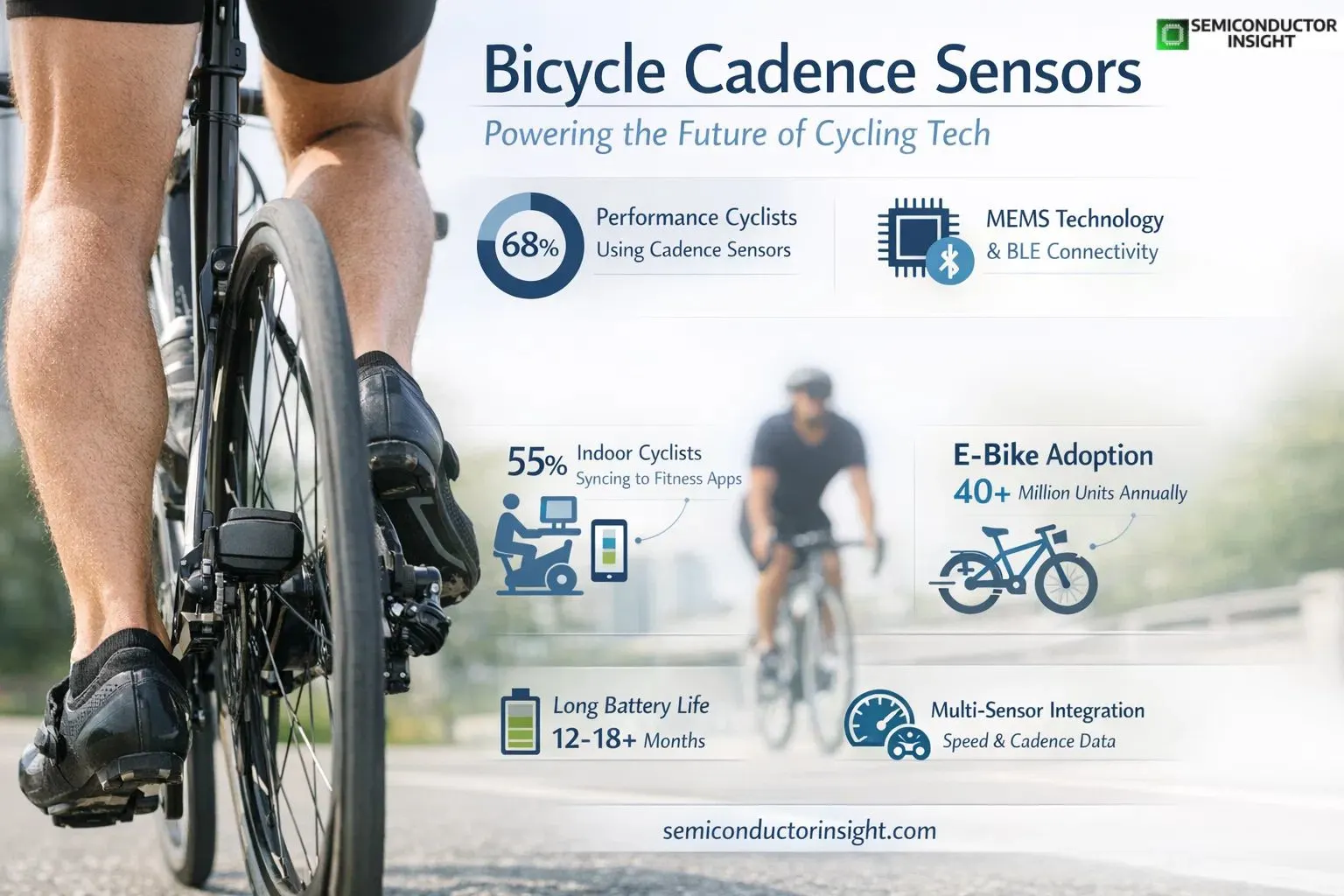
Recent industry publications highlight that over 68% of performance cyclists globally now rely on cadence tracking devices, reflecting a shift from basic cycling to data-driven training methodologies. This growing dependence is pushing manufacturers to integrate smarter, smaller, and more energy-efficient semiconductor components.
Semiconductor Innovation behind Cadence Tracking Accuracy
At the core of modern cadence sensors lies a combination of magnet-based detection systems and accelerometer-driven MEMS sensors, both powered by semiconductor advancements. The transition from reed switches to solid-state sensors has significantly improved reliability and reduced maintenance issues.
According to engineering case studies published in embedded systems journals, MEMS sensor adoption in sports devices has improved motion detection accuracy by nearly 30% over the last five years. Additionally, low-power chipsets now enable battery lifespans extending beyond 12-18 months, a major usability advantage for cyclists.
What makes this evolution noteworthy is the growing role of edge processing. Instead of sending raw data continuously, modern sensors process cadence signals locally using microcontrollers, reducing latency and power consumption simultaneously.
Integration with Connected Fitness Platforms and Cycling Apps
- One of the strongest growth accelerators for this market is its seamless integration with connected fitness ecosystems.
- Cadence sensors are no longer standalone devices they are deeply embedded into platforms that combine heart rate, speed, GPS, and performance analytics.
- Industry-backed reports from cycling associations indicate that more than 55% of indoor cycling users now sync cadence data with training applications. This integration enables structured workouts, cadence optimization, and injury prevention strategies.
- The rise of virtual cycling platforms has further amplified demand.
- During recent years, digital fitness adoption surged, with fitness app usage increasing by over 40% globally, indirectly boosting demand for compatible sensor hardware.
Urban Mobility Trends Expanding Beyond Performance Cycling
While performance cycling remains a strong use case, the urban mobility segment is emerging as a surprising growth contributor. Smart bikes and e-bikes are increasingly integrating cadence sensors to optimize pedaling assistance and battery efficiency.
Automotive and mobility reports suggest that e-bike shipments crossed 40 million units annually worldwide, with a significant portion incorporating cadence or torque sensors. Cadence sensors, in particular, offer a cost-effective alternative to torque systems, making them widely adopted in mid-range electric bicycles.
This shift is pushing semiconductor companies to develop ruggedized and weather-resistant sensor modules, capable of maintaining performance across varying environmental conditions.
Role of Wireless Communication Chips in Market Expansion
- Wireless connectivity is a defining factor shaping product differentiation in this market. Modern cadence sensors rely heavily on Bluetooth Low Energy (BLE) and ANT+ protocols, both of which are semiconductor-driven communication technologies.
- Technical whitepapers highlight that BLE-enabled devices account for over 70% of newly launched cycling sensors, primarily due to their low energy consumption and compatibility with smartphones and wearable.
- The growing demand for multi-device connectivity such as syncing with smart watches, bike computers, and fitness apps simultaneously has increased the complexity of chip design. This is driving innovation in multi-protocol SoCs (System on Chips) that combine sensing, processing, and communication in a single compact unit.
Visit this link to stay up to date on more insightful and in-depth information: https://semiconductorinsight.com/report/bicycle-cadence-sensors-market/
Competitive Landscape Driven by Design Miniaturization
The competitive edge in the Bicycle Cadence Sensors Market is no longer just about accuracy it is about miniaturization, durability, and seamless user experience. Manufacturers are focusing on reducing device size while maintaining high sensitivity and connectivity.
Case studies from consumer electronics manufacturing show that sensor module sizes have reduced by nearly 25% over recent product generations, without compromising signal stability. This has enabled sleeker designs that integrate more naturally with modern bicycles.
At the same time, advancements in low-power semiconductor fabrication are helping brands deliver lighter products with longer battery cycles, aligning with user expectations for hassle-free usage.
Evolving Landscape of Advanced Sensor Fusion Technologies
A notable trend shaping the market is the transition from single-function cadence sensors to multi-sensor fusion systems. These systems combine cadence, speed, and motion tracking into a unified module, powered by advanced microcontrollers and sensor fusion algorithms.
Technical research indicates that integrated sensor systems can improve overall cycling performance insights by over 35%, offering a more comprehensive understanding of rider efficiency.
This shift is particularly relevant in professional training environments, where data precision directly influences performance outcomes.

Comments (0)