MARKET INSIGHTS
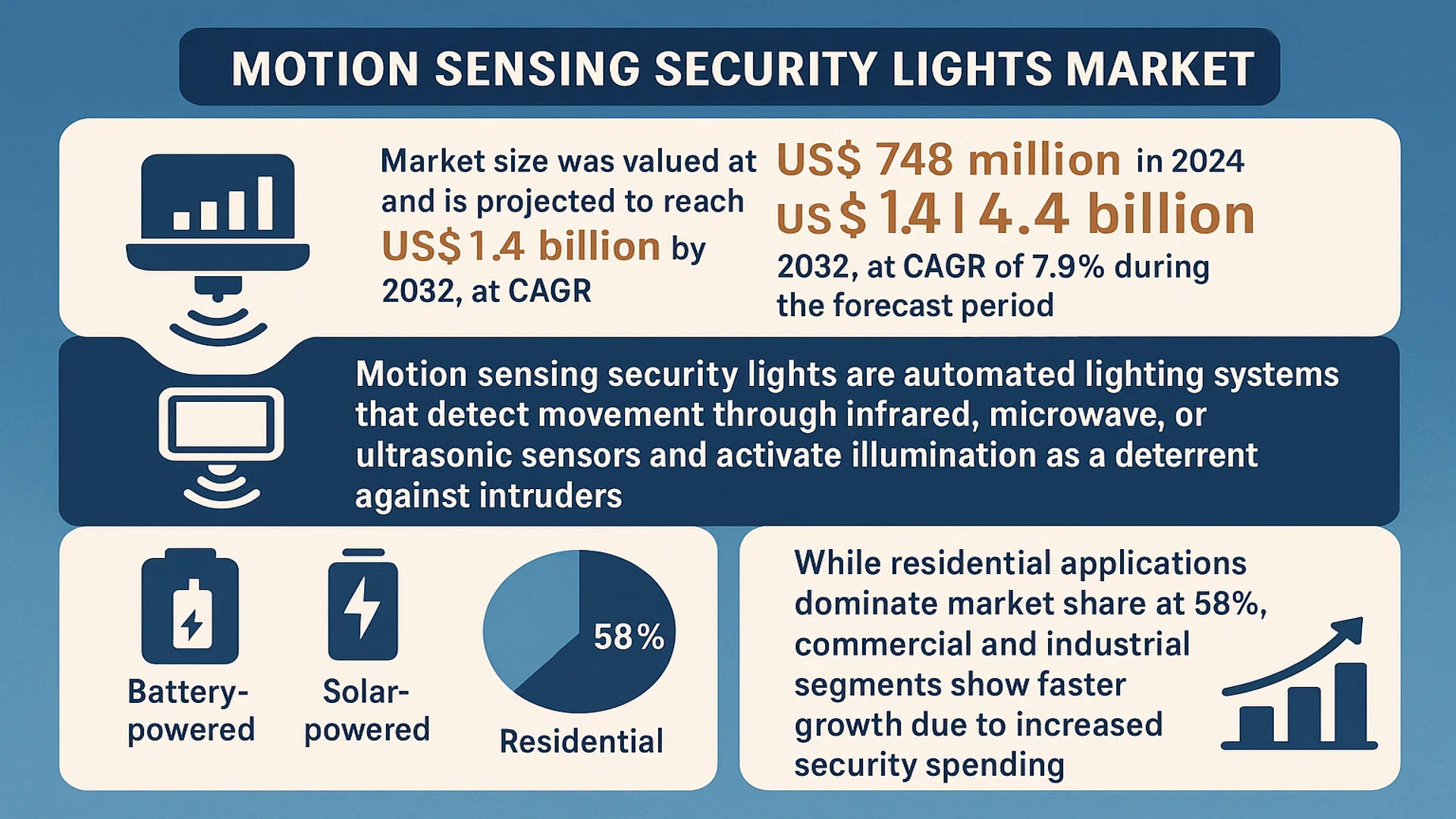
The global Motion Sensing Security Lights Market size was valued at US$ 748 million in 2024 and is projected to reach US$ 1.4 billion by 2032, at a CAGR of 7.9% during the forecast period 2025-2032.
Motion sensing security lights are automated lighting systems that detect movement through infrared, microwave, or ultrasonic sensors and activate illumination as a deterrent against intruders. These systems are designed for outdoor and indoor security applications, offering energy efficiency through intelligent activation. The product categories include battery-powered, solar-powered, and plug-in electric types, each catering to different installation requirements and use cases.
While residential applications dominate market share at 58%, commercial and industrial segments show faster growth due to increased security spending. Key players like OSRAM, Philips, and Panasonic collectively hold 45% of the market, with innovation focused on smart connectivity and longer battery life. North America currently leads regional adoption at 37% market share, though Asia-Pacific demonstrates higher growth potential with a projected 8.2% CAGR through 2032.
MARKET DYNAMICS
MARKET DRIVERS
Increasing Security Concerns and Smart Home Adoption Fuel Market Expansion
The global motion sensing security lights market is experiencing robust growth, primarily driven by rising security concerns across residential and commercial sectors. With crime rates increasing in urban areas, property owners are investing heavily in security infrastructure. Motion-sensing lights act as an effective deterrent, reducing burglary risks by up to 50% compared to unlit properties. Furthermore, the rapid adoption of smart home technologies has accelerated demand, as these devices integrate seamlessly with home automation systems for enhanced security management.
Energy Efficiency Regulations and Cost Savings Drive Product Innovation
Government mandates promoting energy-efficient lighting solutions have significantly influenced market dynamics. Many countries have implemented strict regulations phasing out traditional incandescent bulbs, creating lucrative opportunities for motion-sensing LED alternatives. These products consume up to 80% less energy than conventional lighting while providing superior illumination. Additionally, the long lifespan of LED-based motion lights – often exceeding 50,000 hours – reduces replacement costs, making them increasingly attractive for budget-conscious consumers.
Advancements in sensor technology have further enhanced product capabilities. Modern PIR (passive infrared) sensors now offer detection ranges exceeding 20 meters with 180-degree coverage, while microwave sensors provide even greater accuracy in challenging environments.
MARKET RESTRAINTS
High Initial Costs and Technical Limitations Hinder Widespread Adoption
Despite strong market growth, premium pricing remains a significant barrier, especially in developing regions. Advanced motion-sensing security lights with smart connectivity features can cost 3-5 times more than basic models, putting them out of reach for price-sensitive consumers. Installation complexities further add to overall expenses, particularly for hardwired systems requiring professional electricians.
False Triggering Issues and Environmental Factors Impact Performance
Technical challenges continue to plague market penetration, with false activations being a persistent pain point. Environmental factors such as wind-blown debris, small animals, or temperature fluctuations can trigger unnecessary activations, leading to energy waste and nuisance lighting. Manufacturers are addressing these issues through advanced algorithms and dual-technology sensors, but completely eliminating false triggers remains an industry challenge.
Weather resistance presents another limitation. While most outdoor models claim IP65 or higher ratings, extreme temperatures (-40°C to +50°C operational range) still affect sensor performance and LED lifespan in harsh climates. These technical constraints create hesitancy among potential buyers in regions with volatile weather patterns.
MARKET OPPORTUNITIES
Solar-Powered Solutions and Emerging Markets Present Growth Potential
The shift toward renewable energy sources has created substantial opportunities for solar-powered motion sensing lights. These products eliminate wiring requirements and reduce electricity bills while maintaining robust security features. Installation in off-grid locations has become increasingly viable, with some models offering 3-5 nights of operation from a single solar charge. Rural areas and developing nations with unreliable power infrastructure represent particularly promising markets for these solutions.
AI Integration and Smart City Development Drive Next-Gen Innovation
Artificial intelligence integration represents the next frontier for motion-sensing security lights. Advanced systems now incorporate machine learning to distinguish between humans, animals, and vehicles, significantly reducing false alarms. Smart city initiatives worldwide are incorporating these intelligent lighting systems into broader infrastructure projects, creating new revenue streams for manufacturers. When integrated with IoT platforms, these solutions provide valuable data analytics for urban planning and security monitoring.
The commercial sector offers additional growth avenues, with businesses increasingly adopting motion-activated lighting to comply with safety regulations and reduce operational costs. Industrial facilities, parking lots, and warehouses represent high-volume opportunities as they transition to automated lighting systems.
MARKET CHALLENGES
Intense Competition and Price Wars Squeeze Profit Margins
The market faces mounting pressure from low-cost manufacturers, particularly in Asia-Pacific regions, leading to aggressive price competition. Many established brands struggle to maintain profitability while matching competitor pricing, with average selling prices declining by approximately 8% annually. This environment makes it challenging to recoup R&D investments in advanced features and technologies.
Regulatory Complexity and Certification Delays Impact Time-to-Market
Navigating diverse regional regulatory landscapes presents significant hurdles for global manufacturers. Compliance with varying safety standards, wireless communication protocols, and energy efficiency requirements often necessitates product modifications, increasing development costs and timeline. Some markets require extensive certification processes that can delay product launches by 6-12 months, putting companies at a competitive disadvantage.
Consumer education remains another critical challenge. Many end-users lack understanding of advanced features like lux adjustment, timer settings, or smart integration capabilities, leading to suboptimal usage and dissatisfaction. Manufacturers must invest heavily in clear instructions and after-sales support to overcome these knowledge gaps.
MOTION SENSING SECURITY LIGHTS MARKET TRENDS
Smart Home Integration Drives Demand for Advanced Motion Sensing Security Lights
The global motion sensing security lights market is experiencing a surge in demand due to the increasing adoption of smart home systems. As homeowners prioritize safety and energy efficiency, intelligent lighting solutions with motion detection capabilities are becoming essential. The integration of WiFi-enabled and IoT-compatible security lights allows users to control lighting remotely via smartphones, significantly enhancing convenience. Furthermore, advancements in sensor accuracy and response time have improved the reliability of these systems. Market projections indicate substantial growth, with the battery-powered segment expected to expand at a notable CAGR, driven by its ease of installation and versatility in both residential and commercial applications.
Other Trends
Transition to Energy-Efficient Lighting Solutions
The shift toward sustainable lighting solutions is reshaping the motion sensing security lights market. Solar-powered models are gaining traction as they reduce electricity consumption and minimize environmental impact. Governments and regulatory bodies worldwide are encouraging energy-efficient lighting through incentives and stricter regulations, further accelerating product adoption. Residential consumers, in particular, are increasingly opting for solar and LED-based motion-sensing lights, given their long lifespan and low maintenance requirements. The commercial sector is also contributing to this trend, with businesses looking to cut operational costs while enhancing security infrastructure.
Expansion of Smart City Initiatives
The proliferation of smart city projects across major economies is creating substantial opportunities for motion sensing security light manufacturers. Urban planning authorities are incorporating intelligent lighting systems into public spaces to improve safety and reduce energy wastage. These systems often utilize motion sensors to illuminate streets, parks, and transportation hubs only when needed, ensuring both security and cost-effectiveness. Emerging economies in Asia and the Middle East are leading this trend, with significant investments in modernizing urban infrastructure. Leading manufacturers are responding with innovative product designs tailored for large-scale municipal deployments, further driving market expansion.
COMPETITIVE LANDSCAPE
Key Industry Players
Market Leaders Focus on IoT Integration and Energy Efficiency to Gain Competitive Edge
The global motion sensing security lights market features a moderately fragmented competitive landscape with multinational corporations dominating revenue share while regional players compete on price and customization. OSRAM and Philips (Signify) collectively held over 25% market share in 2024, leveraging their established lighting technologies and extensive distribution networks across residential and commercial sectors.
Panasonic has been gaining significant traction in the Asian market through its solar-powered motion light solutions, which accounted for nearly 18% of its security lighting revenue last year. Meanwhile, GE Lighting maintains strong positioning in North America through strategic partnerships with home security system providers and smart home integrators.
Smaller but innovative players like Mr Beams and MAXSA Innovations are carving niche positions through battery-operated wireless solutions favored for retrofit installations. These companies have shown remarkable 12-15% year-on-year growth since 2022 by addressing specific customer pain points around installation convenience.
Product differentiation through advanced features such as adjustable sensitivity, multi-zone detection, and smartphone connectivity is becoming a key battleground. Market leaders are investing heavily in R&D, with Siemens and Eaton reporting 8-10% of revenue dedicated to developing next-gen motion lighting solutions integrated with broader security ecosystems.
List of Key Motion Sensing Security Light Manufacturers
- OSRAM Licht AG (Germany)
- Philips (Signify) (Netherlands)
- Panasonic Corporation (Japan)
- GE Lighting (U.S.)
- Siemens AG (Germany)
- Mr Beams (U.S.)
- First Alert (U.S.)
- RAB Lighting (U.S.)
- Heath Zenith (U.S.)
- MAXSA Innovations (U.S.)
- Halo (Eaton Corporation) (U.S.)
Segment Analysis:
By Type
Battery Powered Type Leads the Market Due to Ease of Installation and Portability
The market is segmented based on type into:
- Battery Powered Type
- Subtypes: Lithium-ion, Alkaline, and others
- Solar Powered Type
- Plug-in Electric Type
- Subtypes: Hardwired, Plug-in adapters
- Others
By Application
Residential Use Segment Dominates Owing to Rising Home Security Concerns
The market is segmented based on application into:
- Residential Use
- Commercial Use
- Subtypes: Retail spaces, Offices, others
- Industrial Use
- Others
By Technology
Infrared Sensing Technology Gains Traction Due to High Accuracy
The market is segmented based on technology into:
- Infrared
- Microwave
- Dual Technology
- Others
By Distribution Channel
Online Sales Channel Growing Rapidly Due to E-Commerce Penetration
The market is segmented based on distribution channel into:
- Online
- Subtypes: E-commerce platforms, Brand websites
- Offline
- Subtypes: Specialty stores, Hypermarkets, others
Regional Analysis: Motion Sensing Security Lights Market
North America
North America remains the leading market for motion sensing security lights, driven by high consumer awareness about home security and technological advancements. With the U.S. being a significant contributor, the region is witnessing rapid adoption of smart lighting solutions integrated with IoT capabilities. The demand for energy-efficient and solar-powered variants is rising, supported by favorable government initiatives for sustainable infrastructure. Key players like GE, Philips, and First Alert dominate the market, introducing AI-based motion detection systems that enhance security while minimizing false triggers. The commercial sector, including offices and warehouses, is increasingly deploying these lights to reduce operational costs.
Europe
Europe is characterized by stringent energy efficiency regulations, such as the EU’s Eco-design Directive, pushing manufacturers to develop low-power-consuming and long-lasting security lights. Countries like Germany and the U.K. are early adopters of smart home ecosystems, where motion-sensing lights function seamlessly with other security devices. The residential segment accounts for the largest market share, followed by industrial applications. OSRAM and Siemens are among the key innovators, focusing on wireless connectivity and customizable lighting solutions. Rising urbanization and safety concerns further propel market growth.
Asia-Pacific
The Asia-Pacific region is experiencing exponential growth, fueled by expanding urbanization and rising disposable incomes in countries like China and India. While cost-sensitive markets still prefer battery-powered solutions, the shift toward solar-powered lights is accelerating due to government-led renewable energy initiatives. Japan and South Korea, with their advanced technological infrastructure, are investing in AI-integrated security lighting for smart cities. However, fragmented pricing strategies and local competitors create challenges for global brands. Panasonic and regional players are expanding their presence by offering affordable yet feature-rich products tailored to local needs.
South America
South America’s market is evolving gradually, with Brazil and Argentina leading adoption due to increasing crime rates and residential security concerns. However, economic volatility and limited consumer awareness hinder widespread penetration. Plug-in electric variants dominate due to unreliable power supply in remote areas, though solar options are gaining traction in rural markets. Local brands compete intensely on price, while multinational companies focus on premium smart lighting solutions for urban households. Infrastructure development projects present long-term opportunities for commercial and industrial applications.
Middle East & Africa
The Middle East and Africa exhibit untapped potential, with urban centers like the UAE and Saudi Arabia driving demand for high-end security lighting solutions. The harsh climate necessitates durable, weather-resistant products, boosting the adoption of industrial-grade motion-sensing lights. However, limited purchasing power in African nations restricts market growth to budget-friendly alternatives. Governments are gradually investing in smart city projects, creating opportunities for IoT-enabled lighting systems. Regional suppliers are partnering with global brands like Philips to enhance product accessibility and reliability.
Report Scope
This market research report provides a comprehensive analysis of the Global Motion Sensing Security Lights Market, covering the forecast period 2024–2032. It offers detailed insights into market dynamics, technological advancements, competitive landscape, and key trends shaping the industry.
Key focus areas of the report include:
- Market Size & Forecast: Historical data and future projections for revenue, unit shipments, and market value across major regions and segments. The market was valued at US$ 748 million in 2024 and is projected to reach US$ 1.4 billion by 2032.
- Segmentation Analysis: Detailed breakdown by product type (Battery Powered, Solar Powered, Plug-in Electric), application (Residential, Commercial, Industrial), and region to identify high-growth segments.
- Regional Outlook: Insights into market performance across North America, Europe, Asia-Pacific, Latin America, and the Middle East & Africa, with country-level analysis for key markets like the U.S., China, and Germany.
- Competitive Landscape: Profiles of leading market participants including OSRAM, Philips, Panasonic, GE, and Siemens, covering their product portfolios, market share, and strategic developments.
- Technology Trends & Innovation: Assessment of emerging technologies such as smart lighting integration, improved sensor accuracy, and energy-efficient solutions.
- Market Drivers & Restraints: Evaluation of factors including rising security concerns, urbanization, and energy efficiency regulations alongside challenges like high installation costs.
- Stakeholder Analysis: Strategic insights for manufacturers, suppliers, distributors, and investors regarding market opportunities and competitive positioning.
The research employs both primary and secondary methodologies, including manufacturer surveys, industry expert interviews, and analysis of verified market data to ensure accuracy and reliability.
FREQUENTLY ASKED QUESTIONS:
What is the current market size of the Global Motion Sensing Security Lights Market?
-> Motion Sensing Security Lights Market size was valued at US$ 748 million in 2024 and is projected to reach US$ 1.4 billion by 2032, at a CAGR of 7.9% during the forecast period 2025-2032.
Which key companies operate in the Global Motion Sensing Security Lights Market?
-> Key players include OSRAM, Philips, Panasonic, GE, Siemens, Mr Beams, First Alert, RAB Lighting, Heath Zenith, and MAXSA Innovations.
What are the key growth drivers?
-> Key growth drivers include rising security concerns, increasing urbanization, and government initiatives for energy-efficient lighting solutions.
Which region dominates the market?
-> North America holds a significant market share, while Asia-Pacific is expected to witness the highest growth rate during the forecast period.
What are the emerging trends?
-> Emerging trends include integration with smart home systems, solar-powered solutions, and advanced motion detection technologies.

Get Sample Report PDF for Exclusive Insights
Report Sample Includes
- Table of Contents
- List of Tables & Figures
- Charts, Research Methodology, and more...