
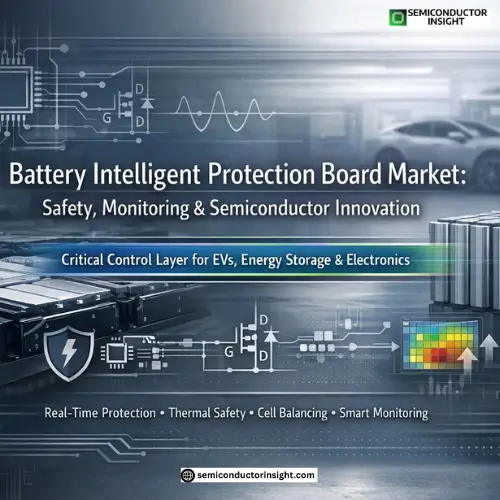
Battery Intelligent Protection Board Market Insights Aligning Chemistry, Electronics, and Control
A battery intelligent protection board is a critical electronic control layer embedded within rechargeable battery systems to monitor, regulate, and protect battery cells from electrical, thermal, and chemical stress. These boards integrate semiconductor components, sensing circuits, and control logic to ensure safe charging, discharging, and long-term battery reliability.
As batteries become more energy-dense and application-specific especially in electric vehicles, energy storage systems, consumer electronics, and industrial equipment the role of intelligent protection boards has evolved from basic cut-off functions to real-time decision-making platforms that balance performance, safety, and lifespan.
Take a Quick Glance at Our In-Depth Analysis Report:
https://semiconductorinsight.com/report/battery-intelligent-protection-board-market/
Why This Market Is Gaining Strategic Importance?
The global shift toward electrification has placed batteries under unprecedented operating demands. Higher voltages, faster charging rates, and compact cell designs increase the risk of thermal runaway, overcurrent, and cell imbalance. Intelligent protection boards act as the first line of defence, preventing minor anomalies from escalating into system-level failures.
Recent industry data indicates that over 70% of battery-related safety incidents are linked to inadequate monitoring or delayed protection response, underscoring the growing reliance on advanced protection electronics rather than passive safeguards.
Semiconductor Architecture Powering Protection Boards
At the core of intelligent protection boards lies a tightly integrated semiconductor ecosystem. These boards typically combine battery management ICs (BMICs), MOSFETs, voltage references, microcontrollers, and communication interfaces into compact assemblies optimized for low power consumption and fast response times.
Modern protection boards increasingly rely on high-precision analog front-end ICs capable of detecting millivolt-level deviations across cells. This precision allows early detection of overvoltage, under voltage, and short-circuit conditions, significantly reducing battery degradation and safety risk.
In higher-end systems, embedded microcontrollers enable adaptive protection logic, adjusting thresholds dynamically based on temperature, charge cycles, and usage patterns rather than relying on static limits.
Chemical Perspective: Protecting Cell Chemistry
Beyond electronics, intelligent protection boards play a vital role in preserving battery chemistry stability. Lithium-ion and lithium-polymer cells are chemically sensitive to overcharging and deep discharge, which can trigger electrolyte decomposition, lithium plating, or internal gas generation.
Protection boards help maintain optimal electrochemical operating windows, preventing conditions that accelerate cathode degradation or separator failure. In practical terms, this contributes to 20-30% improvement in usable battery lifecycle in applications with frequent charge-discharge cycles.
As next-generation chemistries such as lithium iron phosphate (LFP), nickel-rich NMC, and solid-state variants gain traction, protection boards are being redesigned to match their distinct voltage profiles and thermal behaviors.
Market Demand Shaped by Application Diversity
Battery Intelligent Protection Board Market is not driven by a single industry but by a convergence of high-growth sectors.
Electric vehicles now account for a significant share of advanced protection board demand, where multi-cell packs require redundant protection layers to comply with stringent automotive safety standards. Consumer electronics continue to demand ultra-compact boards optimized for space efficiency, while energy storage systems prioritize long-term stability and remote diagnostics.
In industrial equipment and medical devices, reliability and fault tolerance outweigh cost considerations, pushing manufacturers toward customized protection architectures rather than standardized designs.
Integration with Smart Monitoring and Connectivity
Recent market evolution shows protection boards transitioning from standalone safety components to connected intelligence nodes. Many systems now include communication protocols such as CAN, I²C, or SMBus, enabling real-time data exchange with higher-level battery management systems.
This connectivity allows predictive maintenance strategies, where anomalies in voltage drift or temperature gradients are flagged early. In large battery arrays, such as grid storage systems, this capability has helped reduce unplanned downtime by nearly 25%, according to industry observations.
Manufacturing and Supply Chain Considerations
Production of intelligent protection boards requires high-purity semiconductor materials, precision assembly, and stringent testing. Yield consistency is critical, as even minor defects can compromise protection accuracy.
Supply chain resilience has become a strategic focus, especially after recent disruptions highlighted the risks of single-source semiconductor dependencies. Manufacturers are increasingly diversifying component sourcing and investing in regionally balanced production strategies to ensure continuity for high-volume battery customers.
Regulatory and Safety Compliance Landscape
Regulatory frameworks play a decisive role in shaping this market. Battery systems deployed in vehicles, medical equipment, and energy storage must comply with international safety standards covering overcurrent protection, thermal management, and fault isolation.
Intelligent protection boards are central to meeting these requirements, as they provide verifiable electronic safeguards that can be validated during certification processes. Compliance-driven demand has accelerated adoption in markets where regulatory enforcement is tightening.
Competitive Focus and Design Differentiation
Rather than competing purely on cost, suppliers in this market differentiate through response accuracy, integration density, and software intelligence. Some focus on ultra-low-power designs for wearable and IoT batteries, while others emphasize high-current handling for EV and industrial applications.
Customization capability is becoming a competitive advantage, allowing suppliers to tailor protection logic and semiconductor layouts to specific battery chemistries and end-use scenarios.
The Battery Intelligent Protection Board Market is positioned at the intersection of semiconductor innovation, chemical stability, and electrification growth. As batteries become smarter and more application-specific, protection boards will evolve into increasingly sophisticated control platforms rather than passive safety add-ons.
Future development is expected to emphasize higher integration, faster fault detection, and deeper compatibility with emerging battery chemistries, ensuring these boards remain indispensable across the energy storage value chain.

Comments (0)