
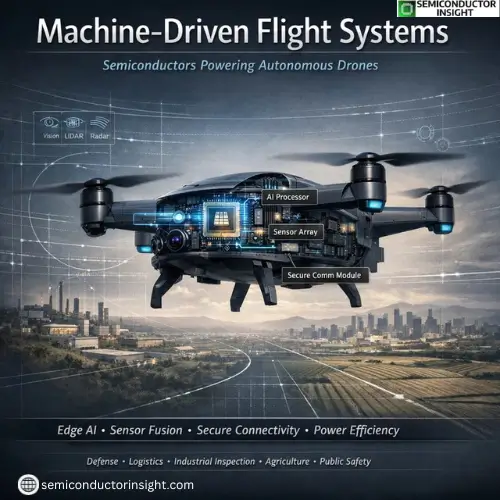
Autonomous Drones Market Size, Analysis Fuels Silicon-Enabled Intelligence Shaping the Future of Flight
A Shift beyond Remote Control toward Machine-Driven Flight Systems
Autonomous drones are no longer futuristic prototypes tucked in research labs. They are rapidly becoming mission-critical assets across industries, powered by cutting-edge semiconductors that merge sensing, computation, connectivity, and real-time decision-making. From warehouse logistics to agricultural monitoring, public safety to infrastructure inspection, these air-borne robots are rewriting conventional workflows and semiconductors are the enabling backbone.
At its core, an autonomous drone is an integrated cyber-physical system. It senses the environment, interprets data, plans actions, and executes maneuvers independently. The agility and autonomy that define these systems are driven almost entirely by advances in semiconductor technologies particularly in sensing, processing, power efficiency, and edge AI.
Edge Intelligence: Processors and AI Accelerators in the Sky
One of the defining elements of autonomy in drones is on-board intelligence. Unlike traditional UAVs that rely heavily on remote operator commands, autonomous drones must perceive dynamic environments and make split-second decisions in real time.
This demand has given rise to a class of semiconductors tailored to edge AI workloads:
- AI accelerators and neural processing units (NPUs) designed for object detection, trajectory prediction, and semantic understanding
- Multi-core CPUs and parallel GPU engines for concurrent data processing from multiple sensors
- Programmable logic devices (FPGAs) that can adapt to evolving AI and control algorithms
These components are not auxiliary they are central to autonomy. They determine how fast a drone can react, how accurately it can interpret its surroundings, and how reliability-tolerant its behavior can be in mission-critical conditions.
Sensing and Perception: Vision, Radar, and Beyond
The flight path of an autonomous drone begins with sensing. Cameras, LiDAR, ultrasonic sensors, infrared, and radar systems generate streams of data that must be fused, filtered, and interpreted. This is where specialized semiconductor chips come into play.
Modern sensing stacks often include:
- High-resolution CMOS image sensors with global shutter and HDR capability for reliable vision in diverse lighting
- Time-of-Flight (ToF) and lidar ASICs enabling precise depth perception
- Integrated IMUs (Inertial Measurement Units) with accelerometers and gyroscopes for position tracking
These chips work in concert to build a coherent representation of the drone’s environment. Sensor fusion combining data from different modalities depends on factorized processing architectures that can balance computational load while minimizing latency.
Connectivity Protocols: Secure, High-Throughput Silicon Layers
For autonomous operations, drones must communicate not just with ground stations but often with each other and network infrastructure. Secure, high-speed connectivity becomes essential for coordination, fleet management, and remote command override.
Semiconductor developments in connectivity include:
- mmWave and sub-6 GHz RF transceivers that support high-bandwidth communication channels
- Low-power wide-area network (LPWAN) modules for extended operational range
- Secure enclave processors that preserve data integrity and encryption, crucial for military, logistics, and regulated industry use cases
These integrated silicon solutions ensure stable links between drones, control centres, and cloud platforms even in contested or harsh environments.
Power Management Viewpoint
A perennial challenge in drone design is energy. Flight endurance is fundamentally limited by battery capacity and power system efficiency. Semiconductors play a pivotal role in minimizing power loss and maximizing usable flight time.
Power electronics in autonomous drones include:
- Highly efficient motor drivers that translate control signals into smooth thrust with minimal electrical waste
- Model-based battery management systems (BMS) that monitor cell health, temperature, and charge state
- Advanced PMICs (Power Management Integrated Circuits) that optimize power distribution for sensors, processors, and radios
Each watt saved in internal electronics translates into longer endurance, higher payload capacity, or both directly impacting operational scalability.
Autonomy in Action: Industry Use Cases and Semiconductor Dependencies
The autonomous drone market is being shaped by a variety of real-world applications, each with unique semiconductor inflections:
- Industrial Inspection and Asset Monitoring Drones equipped with AI accelerators and RGB/LiDAR sensing fly inspection missions over power lines, pipelines, and offshore platforms, automating hazardous tasks and reducing operational risk.
- Public Safety and Emergency Response Real-time image processing and secure communication silicon improve situational awareness for first responders in disaster zones.
- Agricultural Intelligence Multispectral sensors, enabled by specialized semiconductor front ends, map crop health and soil conditions, feeding agronomic decision systems that drive yield optimization.
- Logistics and Delivery Precision navigation and high-reliability edge computing modules allow autonomous parcel delivery in urban environments, coordinated through cloud-connected drone fleets.
Regulatory Influence and Operational Safety
As autonomy grows, so does regulatory scrutiny. Aviation authorities worldwide are developing frameworks to ensure safe integration of autonomous drones into national airspaces. This places a premium on safety-critical silicon design processors and sensors with fault tolerance, redundant pathways, and certified performance.
Semiconductor vendors are responding with:
- Enhanced hardware redundancy
- Real-time monitoring logic embedded in silicon
- Fail-secure architectures that can always return home or safely land
Manufacturing Scalability and Supply Dynamics
The autonomous drone ecosystem is part of a broader semiconductor supply network that spans multiple technology nodes, from advanced logic for AI to specialized mixed-signal ICs for sensors and connectivity. The market’s rapid growth has put pressure on supply chains, with key questions emerging around production capacity, yield optimization, and long-term reliability.
Foundries, fabless semiconductor firms, and specialized OEMs are aligning production closer to demand signals from the autonomous systems sector, particularly in high-growth regions such as North America, East Asia, and Europe.
At Last before Ending, Don’t Forget to Browse Our Recent Exclusive Relevant Report for Detailed Insights:
https://semiconductorinsight.com/report/global-drones-in-military-market/
Looking forward, autonomous drone market is not just about individual chips but it is about integrated silicon platforms that enable developer ecosystems. Companies are pushing toward modular hardware architectures where semiconductors come with software stacks, development tools, and ecosystem support that accelerate innovation cycles.
This convergence is enabling:
- Faster integration of next-gen AI models on edge hardware
- Standardized frameworks for secure communication
- Shared protocols for multi-drone coordination
Semiconductor companies that can deliver both hardware innovation and software co-design frameworks will lead the next wave of autonomous drone capabilities.
Sector Outlook and Strategic Imperatives
Autonomous drones exemplify how semiconductors are shifting from component level to systemic value drivers across industries. The next decade promises deeper integration of AI, sensing, connectivity, and power efficiency all hinging on ongoing semiconductor advancement.
Clients evaluating investment and deployment strategies in this market should consider:
- Cross-stack performance capabilities (not just individual features)
- Long-term supplier roadmaps in silicon and firmware
- Regulatory compliance and safety certification readiness
- Scalability of supply chains to support rapid fleet growth
The autonomous drone market is competitive, fast-evolving, and increasingly critical to digital transformation agendas in logistics, public safety, industrial operations, and beyond.

Comments (0)