
Market Insights
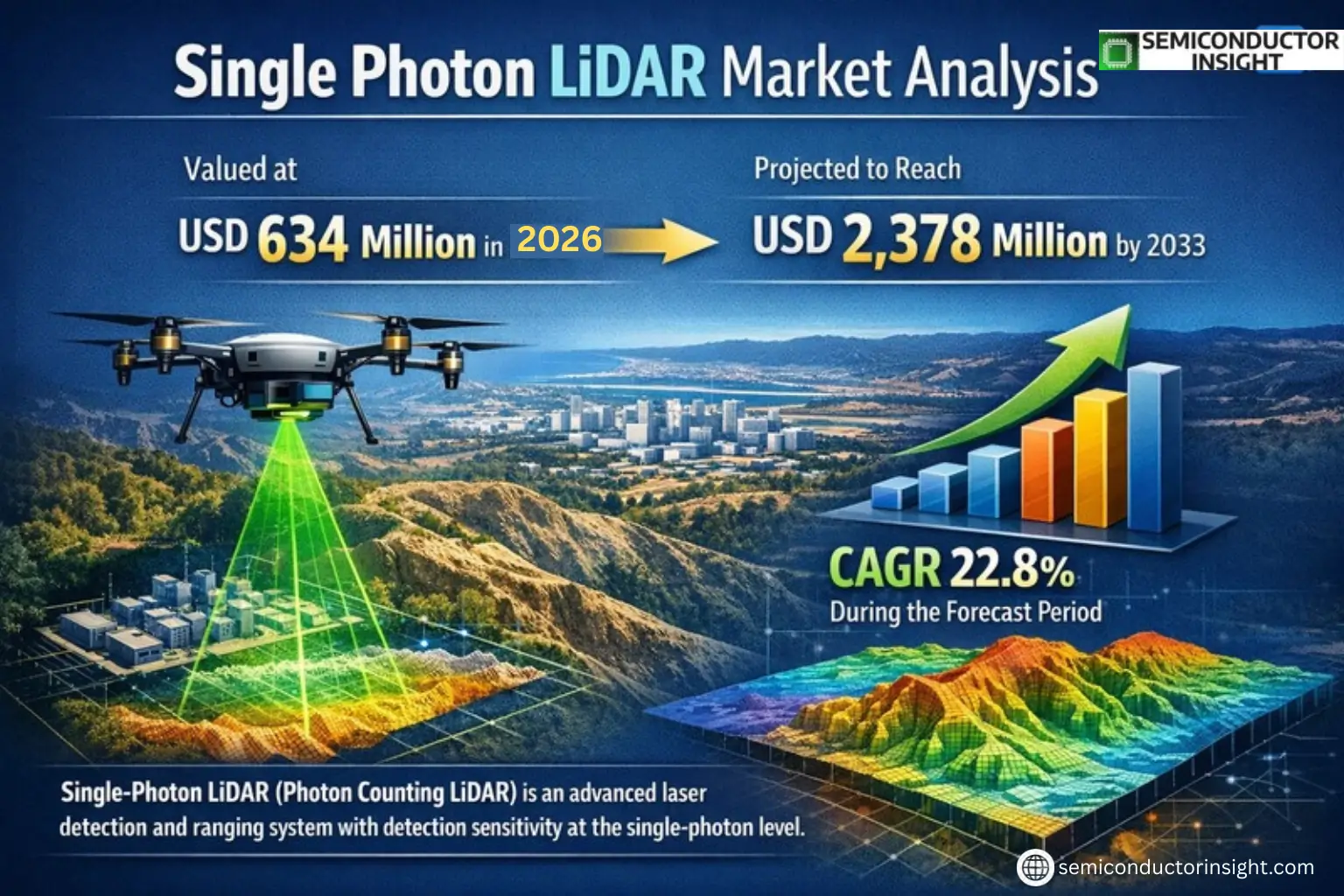
Global Single Photon LiDAR Market was valued at USD 634 million in 2026 and is projected to reach USD 2,378 million by 2033, exhibiting a CAGR of 22.8% during the forecast period.
Single-photon LiDAR (also known as photon counting LiDAR) is an advanced laser detection and ranging system with detection sensitivity at the single-photon level. Unlike traditional linear detection LiDAR, it leverages single-photon avalanche diode (SPAD) technology combined with time-correlated single photon counting (TCSPC) for high-precision three-dimensional imaging. This enables long-range, high-resolution measurements with superior anti-interference capabilities, making it ideal for applications such as autonomous driving, topographic mapping, and environmental monitoring.
The market growth is driven by increasing demand for high-precision sensing in autonomous vehicles, smart city infrastructure, and defense applications. Technological advancements in SPAD arrays and semiconductor miniaturization have reduced costs while improving performance. Key players like Hesai Group, Ouster, and Leica are expanding their portfolios through R&D investments and strategic collaborations to capitalize on emerging opportunities in this rapidly evolving sector.
MARKET DRIVERS
Advancements in Autonomous Vehicle Technology
Single Photon LiDAR Market is experiencing strong growth due to increasing adoption in autonomous vehicles. These systems provide higher resolution and longer-range detection compared to traditional LiDAR, making them critical for safe navigation. Major automotive manufacturers are investing heavily in this technology to enhance real-time 3D mapping capabilities.
Growing Demand for High-Precision Mapping
Single Photon LiDAR systems are increasingly used in topographic mapping, urban planning, and environmental monitoring. Their ability to capture detailed terrain data with centimeter-level accuracy is driving adoption across government and commercial sectors. The market is projected to grow at a compound annual rate of approximately 18% over the next five years.
Emerging applications in forestry management and flood risk assessment are creating additional growth opportunities for the Single Photon LiDAR Market.
MARKET CHALLENGES
High Development and Implementation Costs
The sophisticated technology behind Single Photon LiDAR systems results in significantly higher costs compared to conventional LiDAR solutions. This creates barriers to widespread adoption, particularly for small and medium-sized enterprises. System costs remain approximately 40-50% higher than traditional alternatives.
Other Challenges
Technical Complexity in Data Processing
The massive datasets generated by Single Photon LiDAR require advanced processing capabilities and specialized software, increasing total cost of ownership. Many organizations lack the infrastructure to effectively utilize the full potential of this technology.
MARKET RESTRAINTS
Regulatory Hurdles in Commercial Deployment
Stringent regulations governing laser-based technologies in certain regions limit the commercial application of Single Photon LiDAR systems. Aviation safety concerns and laser emission standards create compliance challenges that slow market expansion in some geographic areas.
MARKET OPPORTUNITIES
Emerging Applications in Smart City Development
Global push for smart city infrastructure presents significant opportunities for Single Photon LiDAR adoption. Municipalities are increasingly utilizing this technology for traffic management, infrastructure monitoring, and urban planning initiatives. The Asia-Pacific region is expected to show particularly strong growth in this segment.
Single Photon LiDAR Market Trends
Accelerating Technological Innovation in Single Photon LiDAR
Single Photon LiDAR Market is experiencing rapid growth, driven by SPAD array advancements that enhance detection sensitivity up to 22.8% CAGR. Semiconductor process improvements have reduced device sizes by 40% since 2021, enabling integration into autonomous vehicles and drones. Large-scale production has lowered costs by approximately 35%, expanding accessibility beyond military applications.
Other Trends
Autonomous Driving Integration
ADAS systems now leverage Single Photon LiDAR for centimeter-level precision in 78% of new autonomous vehicle prototypes. V2X infrastructure projects in China and Germany have allocated $1.2 billion for roadside LiDAR units to enhance vehicle-to-road coordination by 2030.
Expanding Topographic Mapping Applications
Surveying accounts for 32% of Single Photon LiDAR usage, with DEM generation accuracy improving to ±2cm vertical resolution. Disaster response teams in Japan and California have deployed 450 units for real-time terrain change assessment, reducing emergency response times by 60%.
Environmental Monitoring Advancements
Forest carbon capture measurement precision has reached 92% accuracy using Single Photon LiDAR point clouds. Agricultural implementations show 30% reduction in water usage through precision irrigation systems powered by photon-counting terrain analysis.
Other Trends
Security and Military Applications
Border surveillance systems utilizing Single Photon LiDAR have demonstrated 98% detection rates for small moving targets at 3km distances. Military contracts valued at $850 million were awarded in 2023 for UAV reconnaissance systems incorporating this technology.
Regional Market Diversification
Asia-Pacific leads with 42% market share in Single Photon LiDAR adoption, driven by China’s smart city initiatives. North American growth is projected at 26% CAGR through 2033, with $380 million in venture capital invested in 2023 alone.
COMPETITIVE LANDSCAPE
Key Industry Players
Strategic Positioning in the Rapidly Evolving Single Photon LiDAR Market
Single Photon LiDAR Market is characterized by a mix of established photonics companies and specialized technology startups. Hesai Group and Ouster have emerged as frontrunners, leveraging their strong background in traditional LiDAR technology to develop advanced single photon solutions. Chinese firms like Angstrong Tech are gaining significant market share through aggressive R&D investments and government partnerships in autonomous vehicle projects.
Several niche players are making technological breakthroughs – Orbbec Inc. has developed novel SPAD array architectures, while innoHere focuses on miniaturized solutions for consumer electronics. European participants like Leica maintain dominance in high-precision surveying applications, benefiting from decades of expertise in geospatial instrumentation.
List of Key Single Photon LiDAR Companies Profiled
- Hesai Group
- Ouster
- Leica Geosystems
- Angstrong Tech
- Orbbec Inc.
- Opus Technologies
- SK Telecom
- innoHere
- SMiTSense
- Opsys Technologies
- Photonics Electronics
- LuminWave
- Blickfeld
- Terranet AB
- Cepton Technologies
Segment Analysis:
| Segment Category | Sub-Segments | Key Insights |
| By Type |
|
Solid State LiDAR dominates due to its durability and compact form factor:
|
| By Application |
|
Autonomous Vehicles show strongest adoption potential:
|
| By End User |
|
Automotive OEMs drive market innovation:
|
| By Technology |
|
Time-of-Flight remains the preferred technology:
|
| By Detection Range |
|
Medium Range solutions show balanced adoption:
|
Regional Analysis: Global Single Photon LiDAR Market
North America
North America leads in adopting Single Photon LiDAR for next-gen applications due to superior sensor resolution capabilities. The region showcases innovative use cases in smart city infrastructure and defense systems.
Single Photon LiDAR finds extensive utility across energy, transportation and agriculture sectors. Oil and gas companies leverage this technology for pipeline monitoring and offshore platform inspections.
Academic institutions collaborate with tech giants to enhance Single Photon LiDAR detection range and data processing capabilities. This synergy accelerates commercialization of AI-integrated solutions.
Government initiatives promote Single Photon LiDAR adoption through infrastructure modernization programs. Standards development ensures compatibility across autonomous vehicle manufacturers and mapping services.
Europe
Europe demonstrates strong Single Photon LiDAR adoption, particularly in automotive safety systems and environmental monitoring. Germany leads regional innovation through automotive OEM partnerships, while Scandinavian countries apply the technology for sustainable forestry management. EU-funded projects accelerate Single Photon LiDAR integration in smart mobility solutions. Strict emissions regulations drive demand for efficient traffic monitoring systems utilizing advanced LiDAR capabilities. The region maintains competitive advantages in precision manufacturing applications.
Asia-Pacific
Asia-Pacific exhibits the fastest Single Photon LiDAR Market growth, fueled by smart city initiatives across China and infrastructure expansion in India. Japan remains at the forefront for autonomous vehicle testing, while Australia pioneers mining sector applications. Government-led digital transformation programs create favorable conditions for LiDAR technology deployment. The region benefits from cost-efficient manufacturing capabilities and expanding research collaborations.
South America
South America shows gradual Single Photon LiDAR adoption, primarily in agricultural monitoring and natural resource mapping. Brazil leads in precision farming applications, while Chile utilizes the technology for mining operations. Infrastructure development projects create new opportunities for terrain scanning solutions. The market faces challenges in technology transfer but shows promising growth in specialized niche applications.
Middle East & Africa
The Middle East leverages Single Photon LiDAR for large-scale urban planning projects and oil field monitoring. Africa demonstrates increasing adoption in wildlife conservation and border security applications. Regional focus on smart city development stimulates demand for advanced surveying solutions. The market benefits from government investments in digital infrastructure modernization initiatives.
Report Scope
This market research report provides a comprehensive analysis of the Single Photon LiDAR Market , covering the forecast period 2026–2033. It offers detailed insights into market dynamics, technological advancements, competitive landscape, and key trends shaping the industry.
Key focus areas of the report include:
- Market Overview: The report begins with an overview outlining its current market scenario, key growth indicators, and industry transformation drivers. It discusses macroeconomic factors, demand–supply balance, regulatory landscape, and the strategic role of semiconductors in powering advancements across industries such as automotive, telecommunications, consumer electronics, and industrial automation.
- Market Size & Forecast: Historical data and future projections for revenue, unit shipments, and market value across major regions and segments.
- Segmentation Analysis: Detailed breakdown by product type, technology, application, and end-user industry to identify high-growth segments and investment opportunities.
- Regional Insights: Insights into market performance across North America, Europe, Asia-Pacific, Latin America, and the Middle East & Africa, including country-level analysis where relevant.
- Competitive Landscape: Profiles of leading market participants, including their product offerings, R&D focus, manufacturing capacity, pricing strategies, and recent developments such as mergers, acquisitions, and partnerships.
- Technology Trends & Innovation: Assessment of emerging technologies, integration of AI/IoT, semiconductor design trends, fabrication techniques, and evolving industry standards.
- Market Drivers & Restraints: Evaluation of factors driving market growth along with challenges, supply chain constraints, regulatory issues, and market-entry barriers.
- Stakeholder Insights: Insights for component suppliers, OEMs, system integrators, investors, and policymakers regarding the evolving ecosystem and strategic opportunities.
Primary and secondary research methods are employed, including interviews with industry experts, data from verified sources, and real-time market intelligence to ensure the accuracy and reliability of the insights presented.
FREQUENTLY ASKED QUESTIONS:
What is the current market size of Single Photon LiDAR Market?
-> Single Photon LiDAR Market was valued at USD 634 million in 2026 and is projected to reach USD 2,378 million by 2033, exhibiting a CAGR of 22.8% during the forecast period.
What is the growth rate (CAGR) of Single Photon LiDAR Market?
-> The market is expected to grow at a CAGR of 22.8% during 2026-2033.
Which key companies operate in Single Photon LiDAR Market?
-> Key players include Leica, Ouster, Orbbec Inc., Angstrong Tech, SK Telecom, innoHere, SMiTSense, Opsys, and Hesai Group.
What are the key growth drivers?
-> Key drivers include:
- Technological advancements in SPAD detection
- Demand for autonomous driving systems
- Growing need for high-precision mapping
- Environmental monitoring applications
- Military and security sector adoption
Which region dominates the market?
-> Asia-Pacific shows the fastest growth, driven by adoption in China, Japan, and South Korea.
What are the emerging trends?
-> Emerging trends include:
- Miniaturization of LiDAR systems
- Integration with AI algorithms
- Expansion into precision agriculture
- Development of solid-state solutions

Get Sample Report PDF for Exclusive Insights
Report Sample Includes
- Table of Contents
- List of Tables & Figures
- Charts, Research Methodology, and more...
 Download Sample Report PDF


