
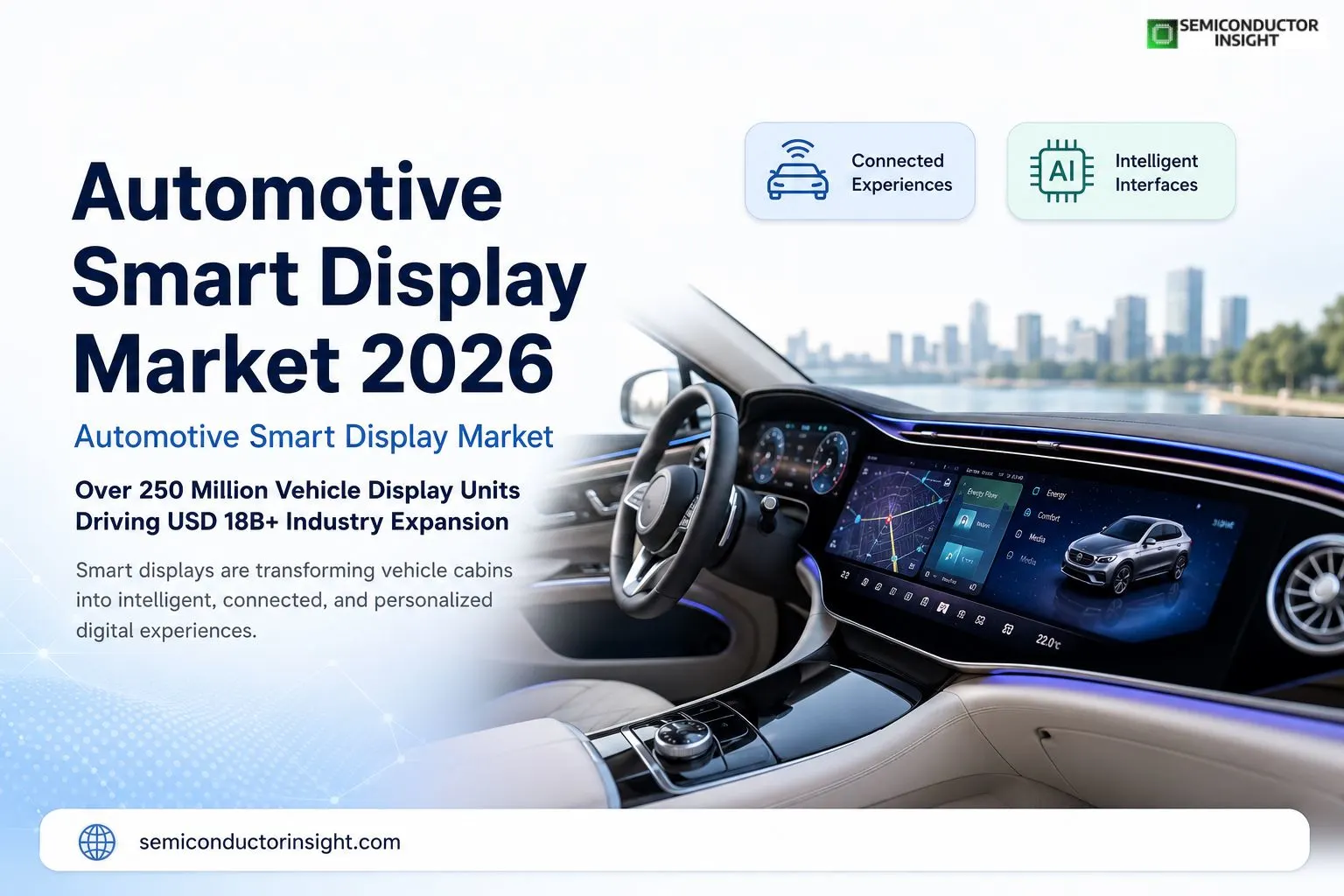
Automotive Smart Display Market 2026: Over 250 Million Vehicle Display Units Driving USD 18B+ Industry Expansion across Digital Cockpits and Connected Mobility Platforms
The automotive industry is rapidly redefining how drivers and passengers interact with vehicles. An advanced digital ecosystem driven by software-driven interfaces, high-performance processors, artificial intelligence, and sophisticated displays has developed from what was originally a straightforward instrument cluster. Automotive Smart Display Market sits at the centre of this transformation, enabling vehicles to become interactive platforms capable of delivering navigation, safety alerts, entertainment, diagnostics, and personalized user experiences.
Modern vehicles increasingly feature multiple display surfaces, including digital instrument clusters, infotainment screens, passenger displays, rear-seat entertainment systems, and augmented reality head-up displays. These developments are creating new opportunities for semiconductor manufacturers specializing in automotive-grade system-on-chip (SoC) platforms.
Measuring the Impact of Digital Innovation
Vehicle display content continues to expand significantly across global automotive production.
According to data from the International Organization of Motor Vehicle Manufacturers (OICA), global vehicle production exceeded 93 million units in recent years. Many newly launched electric and premium vehicles now incorporate between two and five displays per vehicle, creating demand for hundreds of millions of automotive display panels annually.
Several flagship vehicle launches now feature display sizes exceeding 30 inches of combined screen real estate, while luxury electric vehicles are introducing pillar-to-pillar display architectures spanning nearly the entire dashboard width.
These developments are increasing semiconductor content per vehicle, particularly for graphics processors, display controllers, memory modules, and AI accelerators.
Digital Cockpits Become the New Brand Identity
Automakers are increasingly competing through software experiences rather than traditional mechanical differentiation.
Examples include:
- The Mercedes-Benz MBUX Hyperscreen integrating multiple displays into a seamless glass interface.
- Tesla vehicles relying heavily on touchscreen-based controls and centralized computing.
- BMW introducing panoramic display concepts that merge information across multiple viewing zones.
The display is no longer an accessory; it has become a central component of vehicle identity, influencing customer purchasing decisions and long-term brand loyalty.
Explore the full report details in our recently refreshed edition anytime: https://semiconductorinsight.com/report/automotive-smart-display-market/
AI Moves Directly Into the Display Layer
The latest generation of smart displays extends beyond visualization. Artificial intelligence is becoming embedded within the display experience itself.
Modern systems can now:
- Monitor driver attention and fatigue.
- Adapt interface layouts based on user behavior.
- Predict navigation destinations.
- Deliver contextual recommendations.
- Support voice assistants with natural language interactions.
As automotive software complexity grows, display systems are evolving into intelligent interfaces capable of processing information locally without relying entirely on cloud connectivity.
Electric Vehicles Create a New Semiconductor Opportunity
Electric vehicle manufacturers are among the largest adopters of advanced display technologies.
Many EV models launched globally during the last three years have featured larger displays, higher refresh rates, and richer graphical interfaces than traditional combustion vehicles. These requirements directly increase demand for display processors, memory bandwidth, graphics engines, and integrated AI capabilities.
In some premium EV platforms, display-related electronics now represent one of the fastest-growing semiconductor content categories inside the cabin.
The Rise of Curved, Flexible and Transparent Displays
Display innovation is moving beyond screen size alone.
Automotive suppliers are actively developing:
- Curved OLED dashboards.
- Transparent information displays.
- Pillar-to-pillar cockpit screens.
- Passenger-specific entertainment displays.
- Augmented reality windshield projections.
These technologies require increasingly sophisticated semiconductor architectures capable of handling high-resolution graphics, real-time rendering, and multi-display synchronization while maintaining automotive safety standards.
Software-Defined Vehicles Redefine Display Lifecycles
A major shift underway is the emergence of software-defined vehicles. Instead of remaining static after purchase, display capabilities can now evolve through over-the-air updates.
New interface designs, enhanced graphics features, AI functions, and navigation capabilities can be deployed remotely throughout a vehicle’s lifespan. This creates recurring opportunities for semiconductor vendors whose platforms must support continuous software enhancement over many years.
As connected vehicles become mainstream, Automotive Smart Display Market is transitioning from a hardware-driven segment into a software-enabled ecosystem where semiconductors, AI, and advanced visualization technologies work together to redefine the driving experience.

Comments (0)