
Automotive Smart Display Market Insights
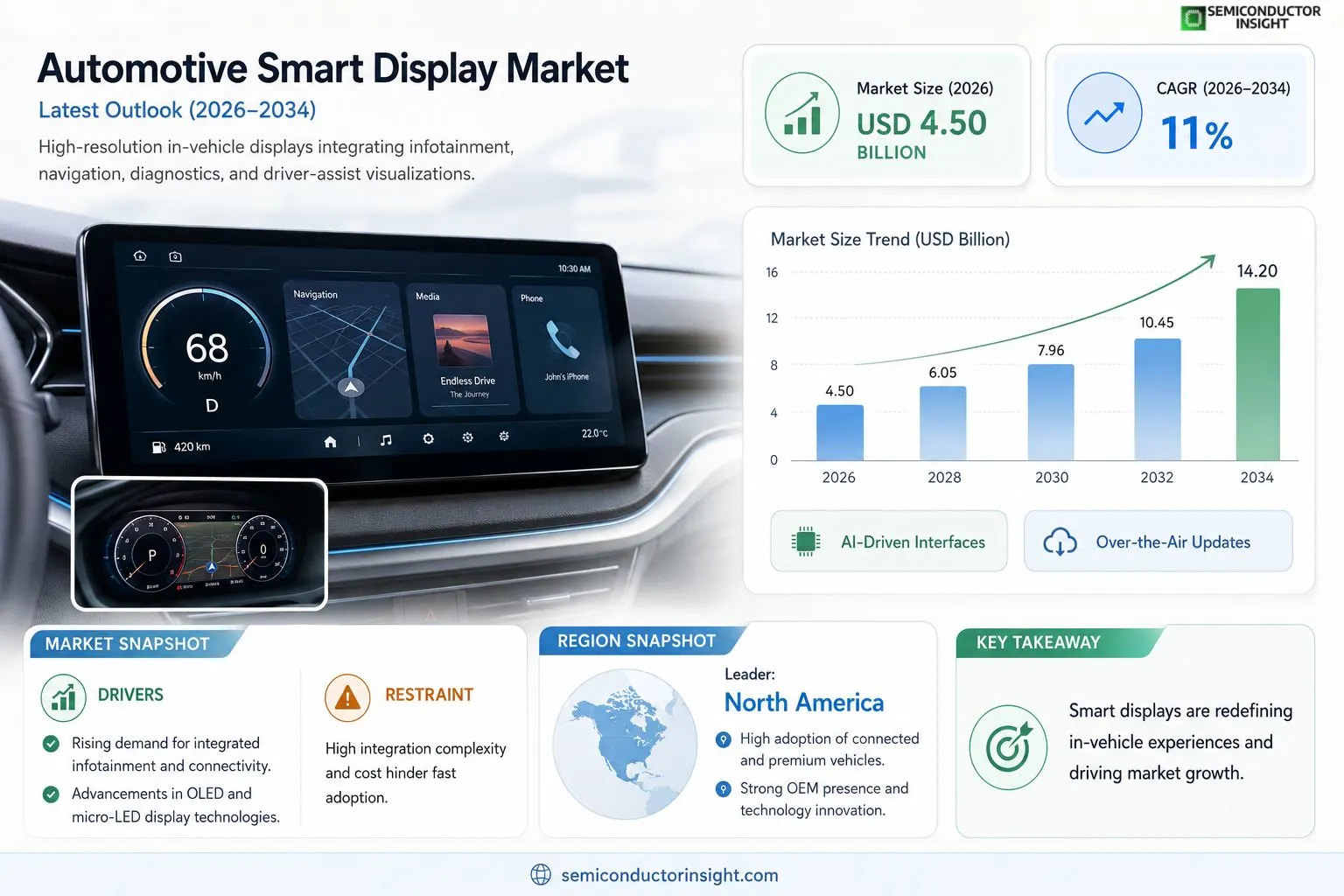
Global automotive smart display market size was valued at USD 4.50 billion in 2026.The market is projected to grow from USD 5.00 billion in 2026 to USD 14.20 billion by 2034, exhibiting a CAGR of 11% during the forecast period.
Automotive smart displays are high‑resolution touch‑screen interfaces that combine navigation, infotainment, vehicle diagnostics and driver‑assist visualizations into a single interactive panel.They replace traditional analog gauges with customizable digital clusters, often leveraging OLED or micro‑LED technology for superior contrast and flexibility.The integration of AI‑driven voice assistants and over‑the‑air updates further enhances user experience.The market is experiencing rapid growth because vehicle connectivity is expanding worldwide and consumers increasingly expect seamless integration of smartphones and cloud services.
MARKET DRIVERS
Consumer Demand for Integrated Infotainment
The rise of digitally‑native consumers is prompting vehicle manufacturers to embed larger, high‑resolution displays that combine navigation, media, and vehicle diagnostics. Automotive Smart Display Market growth is being propelled by the need for seamless smartphone integration and voice‑assistant capabilities, which enhance driver convenience and safety.
Advancements in Display Technologies
Emerging OLED and micro‑LED technologies deliver brighter visuals with lower power consumption, making them ideal for modern vehicle cabins. Automotive Smart Display Market participants are leveraging these gains to offer customizable dashboard layouts and over‑the‑air software updates.
➤ “The shift toward connected car ecosystems is accelerating the adoption of advanced smart displays across all vehicle segments.”
Regulatory encouragement for driver‑assistance systems also supports the rollout of larger, touch‑responsive panels that can host advanced HMI features, further energizing market dynamics.
MARKET CHALLENGES
Balancing Cost and Feature Richness
Manufacturers must manage the price premium associated with high‑end display hardware while meeting consumer expectations for premium look and feel. This cost‑versus‑value tension can limit the speed of adoption, especially in price‑sensitive segments.
Other Challenges
Supply Chain Constraints
Component shortages for OLED panels and specialized drivers can cause production bottlenecks, affecting the rollout timelines of new vehicle models equipped with cutting‑edge displays.
MARKET RESTRAINTS
Technical Integration Barriers
Integrating large, high‑resolution displays with existing vehicle electrical architectures requires extensive redesign, which can delay model releases and increase engineering costs.Furthermore, ensuring reliable performance under extreme temperature fluctuations and vibrations typical of automotive environments adds complexity to the development process.
MARKET OPPORTUNITIES
Growth of Over‑the‑Air (OTA) Updates
The expanding capability for OTA software delivery allows manufacturers to continuously enhance display functionality, creating a recurring revenue stream and extending the lifecycle of Automotive Smart Display Market offerings.Additionally, partnerships between display suppliers and automotive OEMs to co‑develop modular, upgradable display units position the market for rapid scaling as new vehicle generations launch.
Automotive Smart Display Market Trends
Increasing Integration of AI‑Driven Interfaces
OEMs are embedding AI‑powered voice assistants directly into the vehicle’s central display, turning the cockpit into an intuitive command hub. Natural‑language processing enables drivers to request navigation, climate control, or media playback without taking eyes off the road, while predictive algorithms pre‑load frequently visited destinations based on calendar data. The convergence of AI with high‑resolution touch panels also supports contextual driver‑assist visuals, such as lane‑keeping cues or speed‑limit alerts, displayed alongside traditional infotainment content. This layered information architecture reduces visual clutter and improves safety, a factor increasingly emphasized in regulatory discussions across major markets. As a result, Automotive Smart Display Market is seeing rapid adoption of integrated AI modules that blend connectivity, personalization, and safety in a single visual surface.
Other Trends
Shift Toward High‑Brightness OLED and Micro‑LED Panels
Manufacturers are transitioning from legacy LCD clusters to OLED and micro‑LED technologies to meet the demand for brighter, contrast‑rich displays that remain readable under direct sunlight. These emissive panels offer deeper blacks and wider color gamuts, which enhance the visual impact of navigation maps and driver‑assist overlays. Flexible substrate designs further allow curved instrument clusters that follow the dashboard contour, creating a seamless aesthetic that aligns with premium interior concepts. The improved power efficiency of micro‑LED also supports longer vehicle‑on‑time for ancillary systems, contributing to overall energy management strategies in electric powertrains.
Expansion of Over‑the‑Air Update Capabilities
Continuous software delivery has become a cornerstone for maintaining feature relevance throughout a vehicle’s lifecycle. OTA mechanisms now support incremental upgrades to the display firmware, UI layouts, and integrated apps without requiring service‑center visits. This capability enables manufacturers to roll out new navigation datasets, security patches, and UI refinements in response to emerging consumer expectations or regulatory changes. Moreover, OTA flexibility encourages third‑party developers to introduce value‑added services, such as real‑time traffic visualization or personalized media widgets, directly onto the automotive screen. The resulting ecosystem dynamism strengthens brand loyalty and extends the functional lifespan of the hardware platform.
COMPETITIVE LANDSCAPEKey Industry Players
Automotive Smart Display Market Competitive Overview
Automotive Smart Display Market is currently led by a small cohort of global Tier‑1 suppliers that dominate OEM procurement through extensive product portfolios and deep integration capabilities. Bosch, Continental, Samsung Electronics, and LG Display together account for more than half of the $4.5 billion market base in 2026, leveraging their strengths in sensor fusion, OLED/micro‑LED panel production, and OTA software ecosystems. Their scale enables aggressive pricing and rapid rollout of high‑resolution clusters across premium and mainstream vehicle segments, positioning them as the de‑facto standards for next‑generation digital instrument clusters. This concentration of supply has encouraged OEMs to adopt unified platforms that combine navigation, infotainment, and driver‑assist visualizations, thereby accelerating the market’s projected CAGR of 11 % toward a $14.2 billion valuation by 2034.Beyond the dominant four, a diverse set of niche innovators is expanding the competitive frontier. Denso and Harman (Samsung) focus on AI‑driven voice assistants and custom UI experiences for luxury marques, while Valeo and Magna prioritize modular architectures for electric‑vehicle platforms. Panasonic and NXP contribute specialized semiconductor and display driver technologies that enhance image quality and power efficiency. Companies such as Hisense, Sharp, and Fujitsu leverage cost‑effective LCD and emerging micro‑LED manufacturing to capture growth in emerging markets, where price sensitivity remains high. This breadth of capability ensures a dynamic ecosystem where smaller players can influence design trends and capture strategic OEM contracts.
List of Key Automotive Smart Display Companies Profiled
- Bosch
- Continental
- Samsung Electronics
- LG Display
- Denso
- Harman International
- Valeo
- Magna International
- Aptiv (formerly Delphi)
- Panasonic
- NXP Semiconductors
- Hisense
- Sharp
- Fujitsu
Segment Analysis:
| Segment Category | Sub-Segments | Key Insights |
| By Type |
|
Touchscreen Displays
|
| By Application |
|
Infotainment
|
| By End User |
|
Passenger Vehicles
|
| By Connectivity |
|
Cellular
|
| By Interface Technology |
|
OLED
|
Regional Analysis: North America
United States
The demand for sophisticated infotainment systems with integrated smart displays continues to surge, with a focus on user-friendly interfaces and seamless integration with smartphones and other devices.
Smart displays are increasingly becoming integral to driver assistance systems, providing visual cues and information related to features such as adaptive cruise control, lane departure warning, and parking assistance.
Enhanced connectivity options, including 5G and Wi-Fi, are crucial for enabling real-time data updates, OTA software deployments, and seamless integration with cloud-based services within automotive smart displays.
The integration of artificial intelligence (AI) and advanced software functionalities is enhancing the capabilities of automotive smart displays, enabling features such as voice control, personalized user experiences, and predictive maintenance alerts.
Europe
The European Automotive Smart Display Market is characterized by stringent regulatory standards, a strong emphasis on safety and environmental concerns, and a growing adoption of electric vehicles (EVs). The demand for smart displays in European vehicles is primarily driven by the need for advanced navigation systems, connected car services, and driver assistance features. The region is witnessing a shift towards more sustainable mobility solutions, which is influencing the development of smart displays with energy-efficient designs and features. Strong environmental regulations are also driving the adoption of digital solutions that can reduce the need for physical buttons and controls. The European market is also seeing increased collaboration between automotive manufacturers and technology providers to develop customized smart display solutions that meet regional preferences and regulatory requirements.
Asia-Pacific
Asia-Pacific represents a dynamic and rapidly growing market for Automotive Smart Displays, fueled by increasing automotive production, rising disposable incomes, and a growing preference for connected car technologies. China is the dominant player in the region, with a burgeoning automotive industry and a large consumer base that is embracing smart display features. The demand for smart displays in Asia-Pacific is driven by the need for enhanced infotainment systems, navigation, and connectivity options in vehicles. The region is also witnessing a growing adoption of EVs, which are increasingly equipped with advanced smart display features. The competitive landscape in Asia-Pacific is highly fragmented, with a mix of local and international players vying for market share.
North America
North America, particularly the United States, is a mature market for Automotive Smart Displays with a high level of technological adoption. The demand for smart displays in North American vehicles is driven by the need for advanced infotainment systems, driver-assistance features, and connectivity options. The region is witnessing a shift towards more sophisticated and integrated smart display solutions that seamlessly blend into the vehicle’s interior design. The market is also influenced by safety regulations and consumer preferences for user-friendly interfaces and intuitive controls.
South America
The South American Automotive Smart Display Market is an emerging market with significant growth potential, driven by increasing automotive sales and rising disposable incomes. The demand for smart displays in South American vehicles is primarily focused on infotainment systems, navigation, and connectivity features. The market is characterized by a growing acceptance of connected car technologies and a preference for value-for-money solutions.
Middle East & Africa
The Middle East & Africa Automotive Smart Display Market is a developing market with increasing demand for connected car technologies and infotainment systems. The adoption of smart displays in vehicles is primarily driven by the need for navigation, entertainment, and connectivity options. The market is witnessing a growing interest in advanced driver assistance features and safety systems that are integrated with smart displays.
Report Scope
This market research report provides a comprehensive analysis of the Automotive Smart Display Market , covering the forecast period 2026–2034. It offers detailed insights into market dynamics, technological advancements, competitive landscape, and key trends shaping the industry.
Key focus areas of the report include:
- Market Overview: The report begins with an overview outlining its current market scenario, key growth indicators, and industry transformation drivers. It discusses macroeconomic factors, demand–supply balance, regulatory landscape, and the strategic role of semiconductors in powering advancements across industries such as automotive, telecommunications, consumer electronics, and industrial automation.
- Market Size & Forecast: Historical data and future projections for revenue, unit shipments, and market value across major regions and segments.
- Segmentation Analysis: Detailed breakdown by product type, technology, application, and end-user industry to identify high-growth segments and investment opportunities.
- Regional Insights: Insights into market performance across North America, Europe, Asia-Pacific, Latin America, and the Middle East & Africa, including country-level analysis where relevant.
- Competitive Landscape: Profiles of leading market participants, including their product offerings, R&D focus, manufacturing capacity, pricing strategies, and recent developments such as mergers, acquisitions, and partnerships.
- Technology Trends & Innovation: Assessment of emerging technologies, integration of AI/IoT, semiconductor design trends, fabrication techniques, and evolving industry standards.
- Market Drivers & Restraints: Evaluation of factors driving market growth along with challenges, supply chain constraints, regulatory issues, and market-entry barriers.
- Stakeholder Insights: Insights for component suppliers, OEMs, system integrators, investors, and policymakers regarding the evolving ecosystem and strategic opportunities.
Primary and secondary research methods are employed, including interviews with industry experts, data from verified sources, and real-time market intelligence to ensure the accuracy and reliability of the insights presented.
FREQUENTLY ASKED QUESTIONS:
What is the current market size of Automotive Smart Display Market?
-> Automotive Smart Display Market was valued at USD 4.50 billion in 2026 and is expected to reach USD 14.20 billion by 2034, exhibiting a CAGR of 11% during the forecast period.
Which key companies operate in Automotive Smart Display Market?
-> Key players are not listed in the provided reference. Typically, major display manufacturers and automotive technology suppliers participate in this market.
What are the key growth drivers?
-> Key growth drivers include expanding vehicle connectivity, consumer demand for seamless smartphone and cloud integration, AI‑driven voice assistants, and over‑the‑air software updates.
Which region dominates the market?
-> The reference does not specify a dominant region for Automotive Smart Display Market.
What are the emerging trends?
-> Emerging trends comprise integration of AI/IoT, adoption of OLED and micro‑LED display technologies, OTA updates, and advanced driver‑assist visualizations.

Get Sample Report PDF for Exclusive Insights
Report Sample Includes
- Table of Contents
- List of Tables & Figures
- Charts, Research Methodology, and more...
 Download Sample Report PDF





