
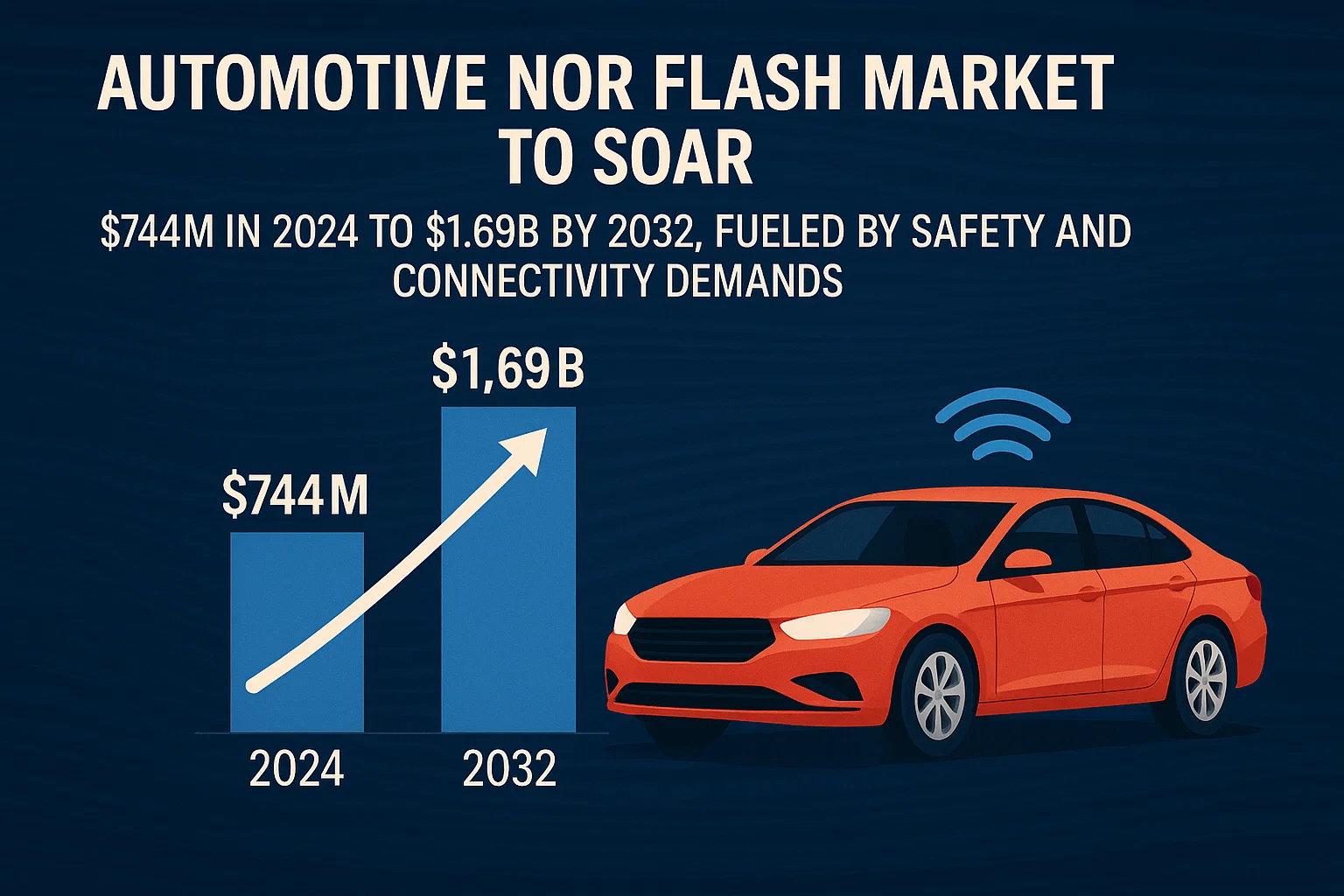
Automotive NOR Flash Market to Soar from $744M in 2024 to $1.69B by 2032, Fueled by Safety and Connectivity Demands
The automotive industry is undergoing the most dramatic transformation in its history. Vehicles are no longer just machines of metal, glass, and rubber they are evolving into complex, connected computers on wheels. From autonomous driving to over-the-air (OTA) updates and vehicle-to-everything (V2X) communication, modern cars demand memory solutions that are not only fast and reliable but also secure and safety-certified.
At the heart of this shift lies a humble but critical technology: NOR Flash memory. Long overshadowed by NAND Flash in consumer electronics, NOR Flash is now indispensable in cars because of its instant read capability, reliability in extreme conditions, and role in storing critical boot and code data. Without it, your car might not even start.
According to industry estimates, the automotive NOR Flash market was valued at US$ 744 million in 2024 and is projected to reach US$ 1.69 billion by 2032, growing at a CAGR of 12.7%. This rapid growth reflects how NOR Flash is becoming the backbone of next-generation automotive systems.
Access Your Free Sample Report- Automotive NOR Flash Market
Why NOR Flash Matters in Automotives
Before diving into the latest developments, it’s important to understand why NOR Flash is indispensable in automotive applications:
- Code Storage & Execution – NOR Flash allows fast, random access to program code, making it perfect for ECU (Electronic Control Unit) booting.
- Reliability Under Stress – Cars operate in extreme conditions (–40°C to +125°C), and NOR Flash provides endurance and data retention suited to these harsh environments.
- Functional Safety – As vehicles move toward autonomy, safety systems like ADAS, steering, and braking cannot tolerate memory failure. NOR Flash supports ISO 26262 functional safety standards.
- OTA Updates – Connected vehicles need to update firmware seamlessly. NOR Flash enables safe storage of multiple firmware images during updates.
- Security – With cyberattacks on vehicles rising, NOR Flash is increasingly embedded with secure boot, encryption, and tamper resistance.
Simply put, NOR Flash is no longer a supporting actor it’s becoming the main stage for automotive electronics reliability and safety.
Major Recent Developments in Automotive NOR Flash
1. Infineon’s SEMPER NOR Flash Achieves ASIL-D Certification
One of the most significant announcements comes from Infineon Technologies, a leader in automotive semiconductors.
Infineon’s SEMPER NOR Flash recently received ASIL-D certification from SGS-TÜV, making it one of the first NOR Flash products officially certified to the highest safety integrity level under ISO 26262.
Why this matters:
- ASIL-D is mandatory for safety-critical systems such as braking, steering, and advanced driver assistance (ADAS).
- By certifying NOR Flash itself, Infineon eliminates guesswork for Tier-1 suppliers and OEMs developers can trust that the memory will not become the weak link.
- It also simplifies compliance processes, reducing time-to-market for safety-critical automotive systems.
Implication: Infineon has positioned itself as the go-to supplier for safety-driven applications. As vehicles move toward Level 3–5 autonomy, ASIL-D certified components will be a non-negotiable requirement.
2. GigaDevice’s GD25/55 SPI NOR Flash Certified for ASIL-D
Chinese memory supplier GigaDevice has made a strong entry into the automotive space. Its GD25/55 family of automotive-grade SPI NOR Flash has been certified for ISO 26262 ASIL-D, just like Infineon’s offering.
Key features:
- Wide voltage operation (1.65V–3.6V).
- Storage density ranging from 2 Mb to 2 Gb, covering everything from small ECUs to larger infotainment systems.
- Manufactured using mature 55nm/45nm nodes, balancing reliability and cost.
- Qualified under AEC-Q100 Grade 1, ensuring reliability in automotive environments.
Implication: GigaDevice is signaling its intent to become a serious competitor to established players. Its ability to provide cost-competitive, safety-certified NOR Flash could disrupt pricing in the industry while ensuring broader adoption of functional safety-compliant memory.
3. Macronix Introduces World’s First 3D NOR Flash
While Infineon and GigaDevice are focusing on safety, Macronix International has taken a bold step toward scaling capacity.
Macronix announced the world’s first 3D NOR Flash technology, breaking away from the traditional 2D planar structure.
Highlights:
- The first product offers 4 Gbit density in a single chip, far surpassing conventional NOR limits.
- Built using techniques similar to 3D NAND, but optimized for NOR’s fast read characteristics.
- Improves cost-per-bit while preserving the random read and reliability advantages of NOR Flash.
- Automotive-ready, designed to support ISO 26262 compliance.
Why it matters:
2D NOR scaling has essentially hit a wall at ~45nm. By adopting 3D structures, Macronix has unlocked higher density without sacrificing performance. This enables applications like:
- Larger OTA firmware storage.
- Complex infotainment systems.
- AI-based autonomous driving modules requiring more code space.
Implication: Macronix’s 3D NOR sets a precedent. If widely adopted, it could redefine density and cost standards in automotive NOR Flash.
Download Sample Report PDF- Automotive NOR Flash Market
4. Winbond’s Secure Flash for Automotive
Security has become one of the hottest topics in connected vehicles. Recognizing this, Winbond Electronics launched its W77T Secure Flash, designed specifically for automotive systems.
Key features:
- Backward compatible with Winbond’s existing NOR Flash (W25Q/W77Q families).
- Built-in security functions such as:
- Secure boot
- Authentication
- Anti-tampering mechanisms
- Encryption support
- Automotive qualified under AEC-Q100.
Why it matters:
- Cybersecurity threats in cars are no longer theoretical hacks into remote keyless entry, infotainment, and even braking systems have been demonstrated.
- As cars connect to cloud networks, OTA updates must be stored and verified securely.
- Winbond’s secure NOR Flash brings trust anchors into the memory itself, reducing reliance on external chips.
Implication: Security will become as important as safety in automotive electronics. Winbond is positioning itself as a leader in trusted memory solutions.
Market Insights: Growth, Drivers, and Challenges
Now let’s connect these technological updates to the market outlook.
Market Growth Forecast
- 2024: US$ 744 million
- 2032: US$ 1.69 billion
- CAGR: 7% (2024–2032)
This growth rate outpaces the general automotive semiconductor market, highlighting NOR Flash’s rising importance.
Key Growth Drivers
- Autonomous Driving & ADAS – Requires massive amounts of reliable code storage for AI algorithms, sensor fusion, and decision-making.
- OTA Updates – Increasing demand for larger NOR Flash to store multiple firmware images securely.
- Cybersecurity Regulations – UN R155/R156 and other standards will mandate secure memory.
- EV Adoption – Electric vehicles rely on advanced ECUs for battery management, requiring safety-certified NOR Flash.
- Infotainment & Connectivity – High-end systems with 3D navigation and streaming demand higher capacity NOR.
Challenges Ahead
- Cost vs. Safety Trade-off: Safety-certified NOR is more expensive; price pressure may deter adoption in low-cost vehicles.
- Competition from NAND & MRAM: In some applications, high-performance NAND or emerging MRAM could compete with NOR.
- Geopolitical Supply Chain Risks: With GigaDevice (China) entering the market, trade tensions could complicate sourcing.
The Bigger Picture: Trends Shaping Automotive NOR Flash
Beyond individual product launches, several megatrends are reshaping the NOR Flash landscape:
- Shift to Functional Safety as a Baseline – ASIL-D certifications are now expected, not optional.
- Migration to 3D NOR – Higher density with reliability could open entirely new applications.
- Embedded Security – Memory is no longer passive storage; it’s becoming an active player in system security.
- Standardization Pressure – Compliance with ISO 26262, AEC-Q100, UN regulations is driving consolidation around certified suppliers.
- Integration with SoCs – NOR Flash will increasingly be paired closely with automotive processors for code-execution-in-place (XiP)
What This Means for Automakers and Suppliers
For OEMs and Tier-1 suppliers, these developments mean:
- Faster Compliance: Using certified NOR Flash simplifies ISO 26262 qualification.
- Reduced Risk: Secure memory reduces vulnerability to cyberattacks.
- Scalability: 3D NOR enables more features without redesigning storage architectures.
- Competitive Edge: Early adoption of advanced memory solutions can differentiate vehicles in safety and performance.
For memory suppliers, the market is both opportunity and battlefield:
- Infineon and GigaDevice are competing head-to-head on ASIL-D safety.
- Macronix is carving out leadership in density with 3D NOR.
- Winbond is betting on embedded security as the next frontier.
Click Here To Download Full Sample Report- Automotive NOR Flash Market
The Road Ahead
The automotive NOR Flash market may have been a niche just a decade ago, but today it is front and center in the transformation of mobility. The convergence of safety, security, and connectivity is creating unprecedented demand for memory that is not just reliable, but also certified and secure.
- Infineon and GigaDevice have raised the safety bar with ASIL-D NOR Flash.
- Macronix has broken through density barriers with 3D NOR.
- Winbond is making memory the guardian of automotive cybersecurity.
With the market projected to more than double from US$ 744M in 2024 to US$ 1.69B in 2032, NOR Flash is poised to become one of the fastest-growing segments in automotive semiconductors.

Comments (0)