
Automotive Grade Digital Isolation Chip Market: Engineering Safety in the Age of Electrification
The modern automotive ecosystem is undergoing a structural transformation driven by electrification, connectivity, and automation. At the heart of this evolution lies a critical yet often overlooked semiconductor component automotive-grade digital isolation chips. These chips ensure safe communication between high-voltage and low-voltage domains, protecting sensitive electronics from noise, voltage spikes, and system failures.
As vehicles transition from mechanical systems to software-defined platforms, isolation chips are no longer auxiliary they are foundational.
Smart Integration Driving Next-Gen Mobility
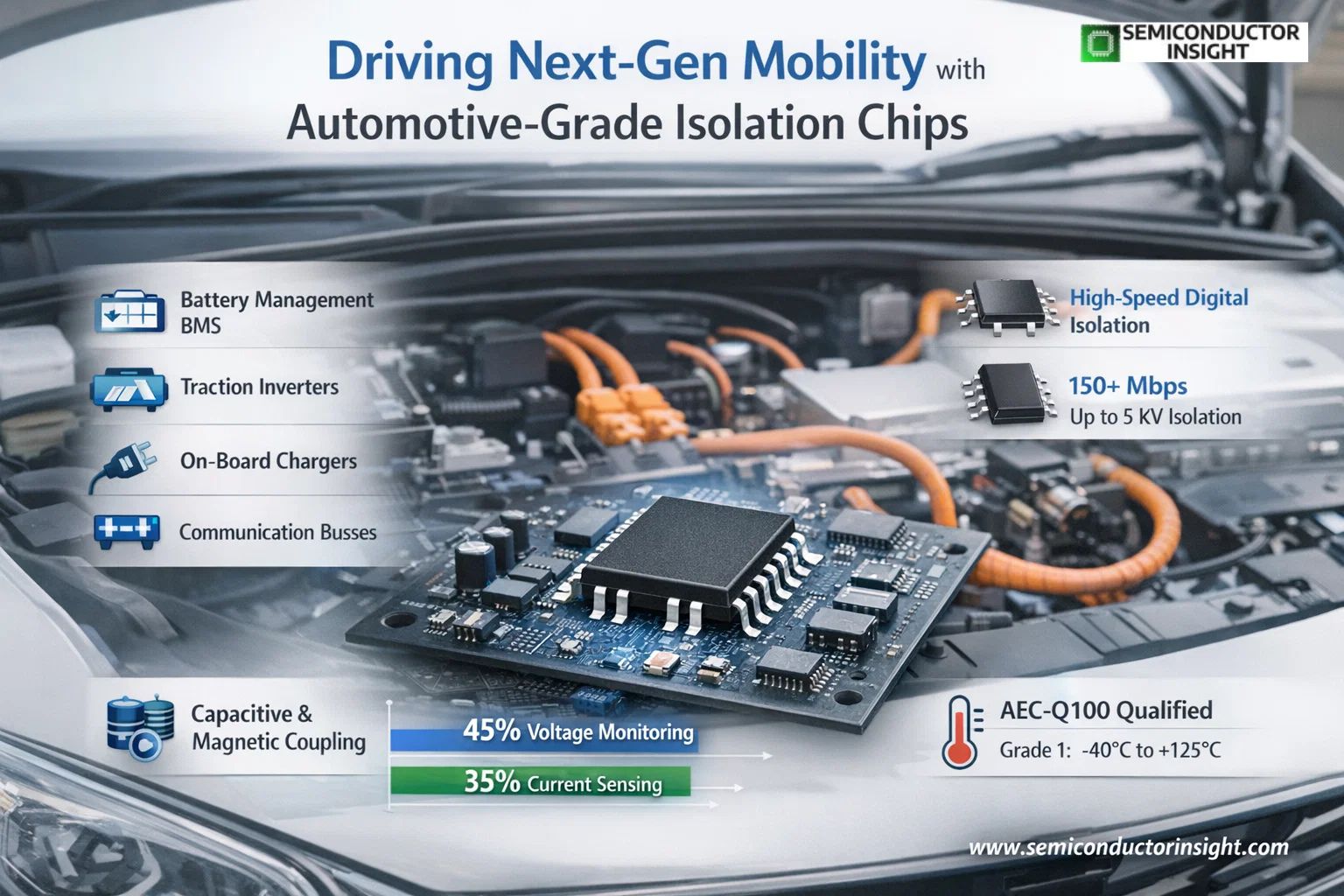
- Battery Management Systems (BMS): Monitoring cell voltages and current in high-voltage battery packs.
- Traction Inverters: Safely controlling high-power FETs that drive the electric motor from a low-voltage controller.
- On-board Chargers (OBC): Managing power conversion from the charging station to the battery.
- Communication Busses: Protecting CAN, SPI, or RS-485 interfaces from electrical noise and ground potential differences.
Technology Evolution: From Optocouplers to High-Speed Digital Isolation
Traditional optocouplers are rapidly being replaced by digital isolators due to superior performance. Modern isolation chips support data rates exceeding 150 Mbps, while maintaining electrical isolation up to 5 kV and operating with minimal power consumption in the milliwatt range.
Capacitive coupling dominates the market due to its high-speed transmission and low latency, while magnetic coupling is gaining traction in high electromagnetic interference (EMI) environments such as powertrain systems.
Additionally, multi-channel isolators (4–6 channels) are becoming standard as automotive architectures grow more complex, enabling multiple signal paths within compact ECUs.
Access the Latest Insights from Our Updated Released Study: https://semiconductorinsight.com/report/automotive-grade-digital-isolation-chip-market/
Real-World Application: Where Isolation Chips Make the Difference
In practical automotive systems, digital isolation chips are indispensable. Battery voltage monitoring alone accounts for nearly 45% of usage, followed by current measurement at 35%, highlighting their dominance in EV safety systems.
For example, in electric vehicles, isolation chips protect high-voltage battery packs (typically 400V–800V systems) from low-voltage control electronics, preventing catastrophic failures. In ADAS, they ensure noise-free communication between sensors, processors, and control units critical for real-time decision-making.
Recent industry developments show semiconductor companies collaborating directly with automotive OEMs to design custom isolation solutions tailored for autonomous driving and zonal architectures.
Key Features and Standards
- AEC-Q100 Qualification: This is the main industry standard for integrated circuits (ICs) used in car systems. It sets quality and reliability stress testing.
- Temperature Grades:
- Grade 1: Common for EVs, works from -40°C to +125°C.
- Grade 0: Required for high-heat situations like internal combustion engines (ICE), supporting -40°C to +150°C.
- Isolation Barriers: They use technologies like capacitive coupling (like Texas Instruments) or magnetic coupling (like Analogue Devices iCoupler) to stop ground loops and defend against high-voltage transients.
- Safety Criticality: These chips are very important for functional safety standards like ISO 26262 because if an isolator fails, the whole system can fail.
How Top Chipmakers Are Redefining Industry Competition?
- The market displays moderate consolidation, featuring 25–30 major global players that compete primarily through technological innovation and strategic integration.
- Dominant firms like Analog Devices, Texas Instruments, Broadcom, and Silicon Labs command over 60% of the market share, capitalizing on their deep expertise in analog and mixed-signal technologies.
- Recent advancements emphasize low-power, high-bandwidth isolators; integration of diagnostics and safety features compliant with ISO 26262 standards; and a strong push toward miniaturization alongside enhanced thermal efficiency.
- As vehicles evolve into software-defined platforms, the need for reliable, high-speed, and secure communication between electronic domains will intensify.
- Emerging architectures such as centralized computing and zonal electronics require high-channel, high-speed isolation solutions capable of handling massive data flows.
Moreover, cybersecurity is becoming a new frontier. Future isolation chips are expected to integrate secure data transmission features, ensuring protection not just from electrical faults but also from cyber threats.

Comments (0)