

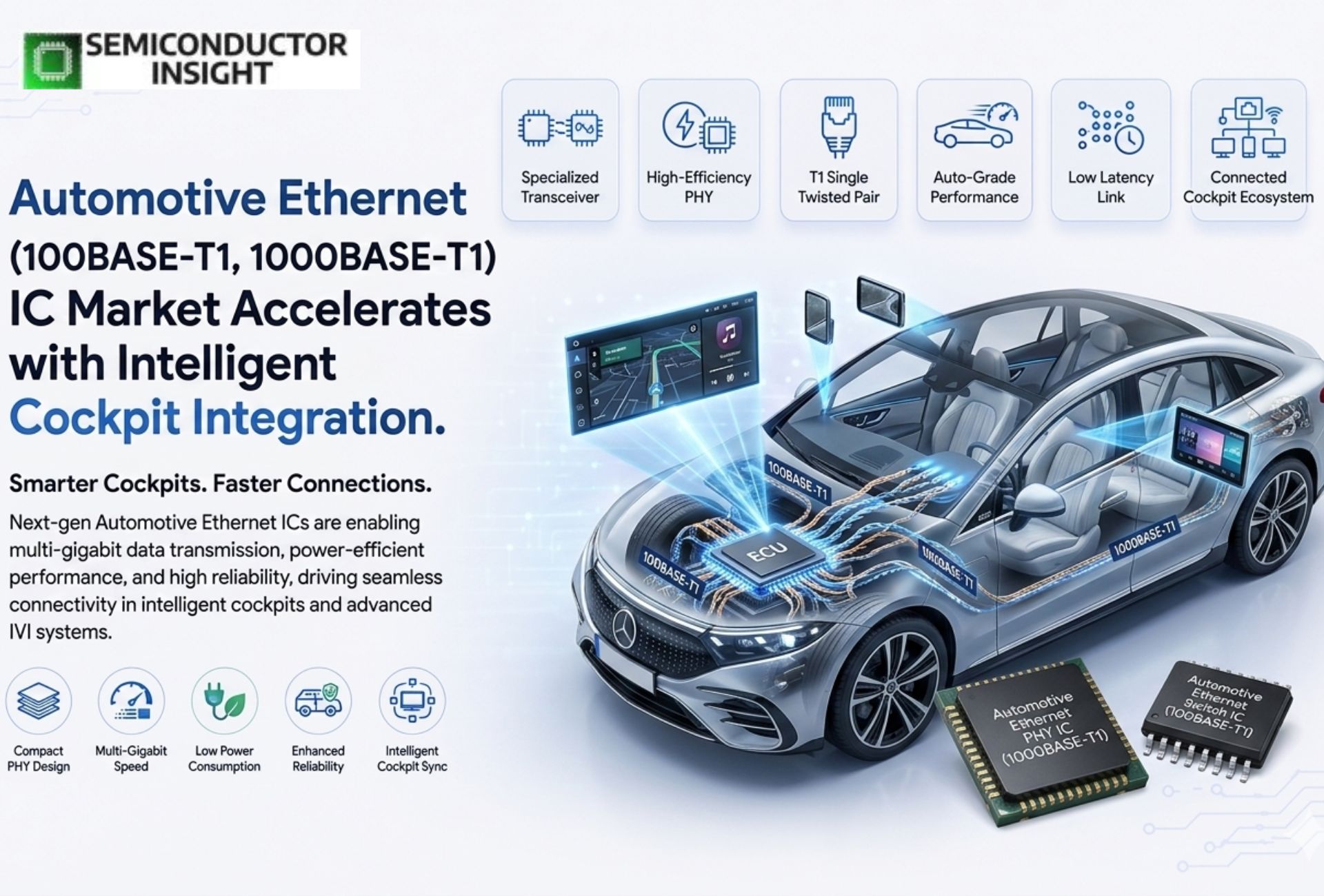
Automotive Ethernet (100BASE-T1, 1000BASE-T1) IC Market Accelerates with Intelligent Cockpit Integration
Modern vehicles are no longer built around isolated electronic systems. Today’s cars process enormous streams of data from cameras, radar modules, infotainment screens, lidar sensors, battery management systems, and over-the-air software platforms. As this data traffic increases, automakers are moving away from traditional communication protocols and embracing Automotive Ethernet technologies to handle real-time connectivity inside vehicles.
Automotive Ethernet (100BASE-T1, 1000BASE-T1) IC Market is becoming a strategic part of next-generation mobility platforms because these chips enable faster, lighter, and more scalable in-vehicle networking. Unlike older CAN and FlexRay systems that struggle with high-bandwidth applications, Automotive Ethernet supports gigabit-level communication required for autonomous driving and AI-powered cockpit systems.
A single autonomous test vehicle can generate nearly 4 terabytes of data per day during development operations, according to engineering studies published by automotive technology organizations. Managing this volume of information requires highly efficient communication links capable of handling sensor fusion and centralized computing without latency issues.
Vehicles Are Becoming Mobile Data Ecosystems
- Cars are evolving into software-defined machines where data movement matters as much as mechanical performance. Premium electric vehicles now integrate more than 100 electronic control units, multiple HD displays, and advanced driver assistance systems operating simultaneously.
- This shift is creating demand for 100BASE-T1 and 1000BASE-T1 Ethernet ICs because they support high-speed communication over a single twisted pair cable, reducing vehicle weight and wiring complexity. Weight reduction has become especially important in EV platforms where every kilogram directly impacts battery efficiency and driving range.
- The transition is also visible in smart cockpit systems. Modern infotainment displays now support 4K video streaming, AI voice assistants, real-time navigation rendering, and cloud-based vehicle diagnostics simultaneously. These workloads require significantly higher bandwidth than legacy automotive networks can provide.
For a more thorough report, please contact us using our most recent report: https://semiconductorinsight.com/report/automotive-ethernet-100base-t1-1000base-t1-ic-market/
Gigabit Connectivity Is Reshaping ADAS Engineering
ADAS platforms are among the biggest growth areas for Automotive Ethernet IC deployment. Advanced safety systems depend on rapid communication between multiple cameras, radar sensors, ultrasonic systems, and AI processors.
A Level 2+ vehicle may include up to 12 cameras and several radar modules operating together to support adaptive cruise control, automated parking, lane centring, and driver monitoring systems. Each HD camera can transmit hundreds of megabits of data every second, making high-speed Ethernet communication essential.
1000BASE-T1 technology is particularly gaining traction because it allows gigabit-speed transmission over automotive-grade single-pair cables while meeting electromagnetic compatibility requirements inside vehicles. This enables automakers to support sensor-rich environments without dramatically increasing cable bulk.
Recent EV launches from Chinese manufacturers and European premium brands have highlighted how centralized computing architectures are replacing distributed ECU-heavy designs. Instead of separate processors for each function, centralized vehicle computers now aggregate data from across the car, increasing dependence on ultra-fast networking ICs.
Semiconductor Supply Chains Are Redefining Automotive Priorities
- The automotive semiconductor shortage between 2021 and 2023 exposed how dependent the mobility industry had become on advanced chip manufacturing. Since then, governments and automotive companies have accelerated investments in semiconductor resilience.
- The European Chips Act and the U.S. CHIPS and Science Act collectively involve tens of billions of dollars aimed at strengthening semiconductor production ecosystems. Automotive communication ICs, including Ethernet PHY chips and network controllers, are expected to benefit from these initiatives as vehicle digitalization expands.
- At the same time, automotive-grade chip validation remains extremely demanding. Ethernet ICs used inside vehicles must withstand harsh temperatures ranging from -40°C to 125°C while maintaining low latency and high reliability over long operational lifecycles.
- Suppliers are also focusing on cybersecurity-ready Ethernet architectures as connected vehicles become more exposed to software vulnerabilities. Secure communication protocols and real-time intrusion detection capabilities are increasingly being integrated into networking chipsets.
M&A, Standards & Regulatory Timeline
- May 2026: Microchip LAN878x / LAN888x launched
New SPE PHY families that enable TSN, ASIL-B, and MACsec (IEEE 802.1AE-2018). Scalability of the SDV platform is made possible by pin-compatible dual-speed 100/1000BASE-T1 variations.
- August 2025: Infineon completes Marvell Automotive Ethernet acquisition
A $2.5 billion all-cash deal closes. Infineon’s Ethernet Solutions business line incorporates the Marvell Brightlane range. Revenue of $225-250 million is anticipated in 2025, with a $4 billion design-win pipeline through 2030.
- April 2025: Marvell-Infineon deal announced; NXP gateway multi-speed PHY line
Infineon declared a final agreement to buy Brightlane. For zonal compute, NXP introduced multi-speed gateway integrated circuits (ICs) that handle 100BASE-T1, 1000BASE-T1, and multi-gig in a single SoC.
- 2025 IEEE: IEEE 802.1DG-2025 TSN automotive profile published
TSN profiles for bounded-latency in-car bridging Ethernet networks are specifically defined by IEEE STD 802.1DG. PHY IC design guide that directly addresses synchronisation, latency, and bandwidth requirements.
AI Driven Mobility Platforms Are Creating New Revenue Streams
AI-focused mobility solutions are anticipated to drive the next wave of automotive Ethernet expansion. Autonomous navigation models, cloud apps, driver behaviour patterns, and real-time traffic data will all be continuously processed by future cars.
- Industry engineering publications estimate that autonomous vehicle computing platforms may eventually require network capacities exceeding 10 Gbps in premium platforms. While 100BASE-T1 and 1000BASE-T1 currently dominate deployment, they are also laying the groundwork for multi-gig automotive Ethernet evolution.
- Automotive Ethernet IC vendors are therefore positioning themselves beyond basic connectivity providers. They are becoming critical enablers of intelligent mobility ecosystems where software performance, AI inference speed, and cloud integration depend heavily on reliable high-bandwidth communication networks.
As vehicles increasingly resemble connected computing platforms on wheels, Automotive Ethernet technologies are expected to remain at the centre of next-generation semiconductor innovation.

Comments (0)