
Automotive 6 Axis MEMS IMU Market Growth and Semiconductor Sensor Innovation
Automotive 6 Axis MEMS IMU Market represents one of the most critical segments within automotive semiconductor innovation. These highly compact sensor modules combine a 3 axis accelerometer and 3 axis gyroscope on a single silicon chip to detect motion, orientation, and angular velocity in real time.
In modern vehicles, motion intelligence is no longer optional. Vehicles require continuous sensing to maintain stability, improve safety, and enable advanced driving functions. Automotive MEMS IMUs provide real-time vehicle positioning data even when GPS signals fail, making them essential for navigation and safety systems.
Silicon Level Engineering Behind MEMS Motion Sensors
At the semiconductor level, automotive MEMS IMUs are manufactured using micro electromechanical system fabrication processes that integrate mechanical structures with electronic circuits on silicon wafers.
These sensors operate through microscopic vibrating structures that detect movement changes and convert them into electrical signals. Their compact architecture enables precise motion detection while maintaining low power consumption and high reliability under extreme automotive conditions.
MEMS devices dominate automotive motion sensing largely because they occupy less than 5 mm³ of space and cost significantly lower than traditional inertial sensing technologies.
Continuous improvements in wafer fabrication, packaging technology, and sensor calibration are enhancing accuracy and reducing noise interference, strengthening semiconductor adoption in automotive electronics.
Vehicle Safety Electronics and Sensor Driven Control Systems
Automotive MEMS IMUs play a central role in vehicle safety architecture. They enable electronic stability control, rollover detection, chassis balancing, and collision prevention systems.
More than 60% of new vehicles now integrate advanced driver assistance features, creating strong demand for high-precision inertial sensors.
These sensors continuously monitor vehicle movement and provide real-time feedback to braking and steering systems. Their ability to detect sudden directional changes significantly improves passenger safety and vehicle handling performance.
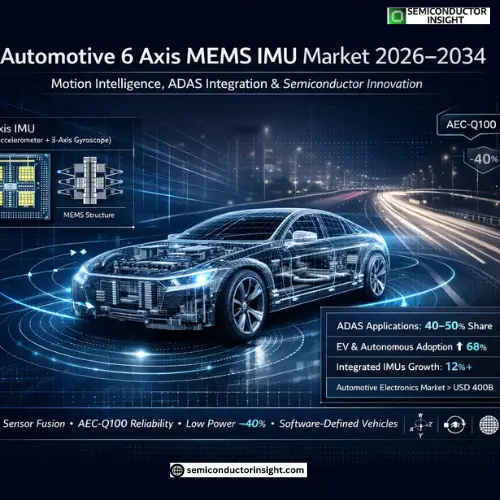
ADAS and autonomous driving systems currently account for nearly 40-50% of total MEMS IMU applications, demonstrating their strong importance in next-generation vehicle design.
Sensor Fusion and Automotive Semiconductor Architecture
A major transformation in automotive electronics is the shift toward sensor fusion integration. Modern vehicles combine MEMS IMUs with radar sensors, LiDAR modules, and positioning chips to create highly accurate motion awareness.
Integrated semiconductor platforms now perform real-time processing of acceleration and rotation data, improving navigation accuracy and vehicle response speed.
In-sensor fusion adoption already accounts for nearly 38% of automotive IMU programs, showing rapid integration of multi-sensor semiconductor architectures.
This approach improves system redundancy and supports vehicle automation, particularly in complex driving environments.
Automotive Grade Reliability and Packaging Technology
Automotive environments require extreme durability. MEMS IMU chips must withstand vibration, temperature fluctuations, and harsh operating conditions.
To ensure reliability, semiconductor manufacturers design sensors according to AEC Q100 automotive standards, ensuring long-term stability and fault tolerance.
Advanced packaging methods such as hermetic sealing, temperature compensation circuits, and noise filtering architectures enhance sensor performance and operational lifespan.
These innovations are particularly important for electric vehicles and high-performance automotive platforms.
Electrification and Vehicle Digitalization Accelerating Sensor Demand
The shift toward electric vehicles and connected mobility is significantly increasing semiconductor content per vehicle. Electrified platforms require precise motion sensing for battery stability, traction control, and energy optimization.
Automotive IMU adoption in electric and autonomous vehicles has increased by more than 68%, reflecting strong demand for motion sensing technology.
Premium vehicle segments show particularly strong integration levels, with technology penetration exceeding 78% in advanced vehicle models.
The rise of software defined vehicles and digital chassis systems continues to drive demand for high-precision MEMS sensors.
Latest Semiconductor Innovations and Industry Developments
The automotive semiconductor ecosystem continues to introduce new MEMS sensor technologies with improved efficiency and performance.
Recent developments include the launch of automotive grade 6 axis IMU sensors designed specifically for advanced driver assistance and navigation applications, improving vehicle safety and performance capabilities.
New generation IMU designs also deliver up to 40% lower power consumption, addressing energy efficiency requirements in modern electronic systems.
Additionally, semiconductor companies are developing sensors with enhanced noise performance and ruggedness for automotive applications, further strengthening system accuracy and reliability.
These innovations highlight continuous semiconductor advancement shaping vehicle motion sensing.
You Can Freely Surf Our Latest Updated Report Here:
https://semiconductorinsight.com/report/automotive-6-axis-mems-imu-market/
Technology Maturity and Industry Transformation Landscape
Rather than simply focusing on long-term predictions, the automotive MEMS IMU market is currently entering a phase of technology maturity and ecosystem transformation.
Integrated six-axis IMUs are replacing discrete sensors at a growth rate above 12%, as automakers consolidate multiple sensing functions into single semiconductor platforms.
The automotive electronics ecosystem itself is expanding rapidly, with global automotive electronics expected to exceed USD 400 billion value, reinforcing the importance of semiconductor sensors in vehicle architecture.
At the same time, supply chain concentration in MEMS wafer production and rising safety regulations are reshaping manufacturing strategies and sensor sourcing decisions.
This transition reflects a shift from component innovation toward system level semiconductor integration.

Comments (0)