
Market Insights
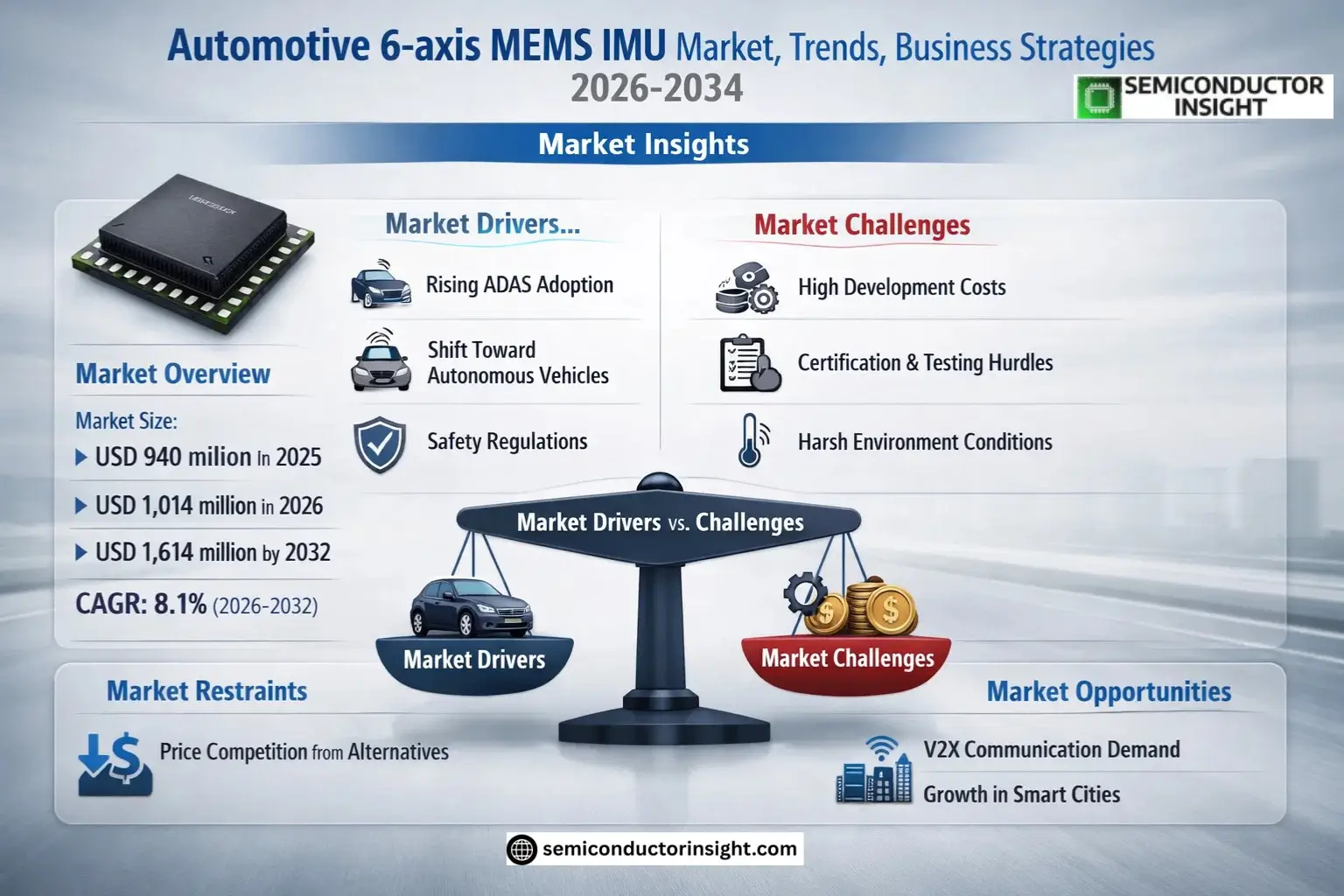
Global Automotive 6-axis MEMS IMU Market size was valued at USD 940 million in 2025. The market is projected to grow from USD 1,014 million in 2026 to USD 1,614 million by 2032, exhibiting a CAGR of 8.1% during the forecast period.
Automotive 6-axis MEMS IMU (Inertial Measurement Unit) is a critical sensor module integrating a 3-axis accelerometer and a 3-axis gyroscope on a single chip, designed to meet stringent automotive-grade reliability standards (AEC-Q100). These units provide real-time motion data for vehicle stability control, navigation, and advanced driver-assistance systems (ADAS), particularly in scenarios where GPS signals are unavailable. Their compact design and high precision make them indispensable for modern automotive safety and autonomous driving applications.
MARKET DRIVERS
Increasing Demand for Advanced Driver Assistance Systems (ADAS)
Automotive 6-axis MEMS IMU Market is experiencing strong growth due to rising adoption of ADAS technologies. These inertial measurement units provide critical motion detection and orientation data for features like electronic stability control and autonomous parking. By 2025, over 60% of new vehicles are expected to incorporate some form of ADAS functionality, creating significant demand for high-performance MEMS IMUs.
Transition Toward Autonomous Vehicles
Automotive manufacturers are increasingly integrating 6-axis MEMS IMUs as foundational sensors for autonomous driving systems. The combined accelerometer and gyroscope functionality provides reliable vehicle positioning data when GPS signals are unavailable. Major automakers are projecting Level 3 autonomous capabilities in production vehicles within the next 3 years, requiring robust motion sensing solutions.
Regulatory mandates for vehicle safety systems across North America, Europe, and Asia Pacific are further accelerating adoption of these precision motion sensors in automotive applications.
MARKET CHALLENGES
High Development and Certification Costs
Automotive-grade 6-axis MEMS IMUs require extensive qualification testing and meet stringent AEC-Q100 standards, resulting in significant R&D investments. The certification process can add 18-24 months to product development cycles, delaying time-to-market.
Other Challenges
Precision Requirements in Harsh Environments
Maintaining measurement accuracy across extreme temperature ranges (-40°C to +125°C) and high-vibration conditions remains a technical hurdle for MEMS IMU manufacturers.
MARKET RESTRAINTS
Price Pressure from Competing Technologies
Automotive 6-axis MEMS IMU Market faces competition from lower-cost sensor fusion solutions combining discrete components. Budget-conscious OEMs in developing markets often opt for these alternatives, constraining premium MEMS IMU adoption in entry-level vehicle segments.
MARKET OPPORTUNITIES
Emergence of V2X Communication Systems
Vehicle-to-everything (V2X) infrastructure development creates new requirements for high-accuracy positioning data, which 6-axis MEMS IMUs can reliably provide. Smart city initiatives worldwide are expected to drive USD 450 million in MEMS IMU demand specifically for V2X applications by 2027.
Automotive 6-axis MEMS IMU Market TrendsKey Market Drivers and Technological Advancements
Automotive 6-axis MEMS IMU Market is witnessing steady growth driven by increasing demand for advanced driver-assistance systems (ADAS) and autonomous driving technologies. High-level autonomous vehicles require precise inertial measurement for reliable navigation, particularly in GNSS-denied environments. Manufacturers are focusing on developing MEMS IMUs with improved accuracy, lower noise, and enhanced reliability to meet stringent automotive-grade AEC-Q100 standards.
Other Trends
Application-Specific Demand Growth
ADAS/AD systems currently account for 40-50% of Automotive 6-axis MEMS IMU applications, followed by body control and chassis systems at 25-35%. The expanding electrification of vehicles is creating additional demand for precise motion sensing in battery management and dynamic control systems. Cockpit applications for advanced infotainment and driver monitoring are emerging as a significant growth segment.
Competitive Landscape Developments
The market is dominated by established players including Murata, STMicroelectronics, TDK, and Bosch, which collectively hold significant market share. Chinese manufacturers like Guangzhou Asensing Technology are rapidly advancing their capabilities, increasing competition in the Asia-Pacific region where automotive production is concentrated.
Regional Market Trends
North America and Europe continue to lead in adoption due to stringent automotive safety regulations, while Asia Pacific shows the fastest growth rate. China’s automotive sector is driving demand for localized MEMS IMU solutions, with domestic suppliers expanding production capabilities to meet the needs of both domestic automakers and global OEMs operating in the region.
Technological Innovation Trends
Manufacturers are developing next-generation 6-axis MEMS IMUs with integrated sensor fusion capabilities, reducing the need for external processing. There is also a trend toward chip-scale packaging solutions that minimize size while maintaining performance in harsh automotive environments. These advancements are crucial for supporting higher levels of vehicle autonomy.
COMPETITIVE LANDSCAPE
Key Industry Players
Automotive 6-axis MEMS IMU Market Dominated by Tier-1 Semiconductor Giants
Global Automotive 6-axis MEMS IMU Market is characterized by strong dominance from established semiconductor manufacturers, with Murata, STMicroelectronics, and Bosch collectively holding over 45% market share. These leaders benefit from vertical integration, AEC-Q100 qualified MEMS fabs, and longstanding relationships with automotive OEMs. STMicroelectronics leads in innovation with their latest ASIL-D compliant IMUs, while Bosch leverages its automotive systems expertise to offer tightly integrated solutions for ESC and ADAS applications.
Several specialized players are carving niches through technological differentiation. MEMSIC Semiconductor focuses on high-temperature military-grade IMUs adapted for automotive, while Chinese entrants like Guangzhou Asensing Technology compete aggressively on price-performance for domestic EV makers. Emerging players are gaining traction with novel packaging technologies (e.g., TDK’s chip-scale solutions) and software-centric approaches that enhance standard MEMS performance through advanced sensor fusion algorithms.
List of Key Automotive 6-axis MEMS IMU Companies Profiled
- Murata Manufacturing
- STMicroelectronics
- TDK Corporation
- Robert Bosch GmbH
- Panasonic Industry
- MEMSIC Semiconductor
- Guangzhou Asensing Technology
- Shanghai QST
- Analog Devices
- InvenSense (TDK)
- Sensata Technologies
- NXP Semiconductors
- TE Connectivity
- Alps Alpine
- Hunan Chendeyang Technology
Segment Analysis:
| Segment Category | Sub-Segments | Key Insights |
| By Type |
|
6-DoF dominates due to its optimal balance between performance and cost in automotive applications.
|
| By Application |
|
ADAS/AD Systems represent the highest growth potential with expanding autonomous driving requirements.
|
| By End User |
|
Tier 1 Suppliers drive innovation through integrated system solutions.
|
| By Vehicle Type |
|
Electric Vehicles show accelerated adoption due to advanced control needs.
|
| By Packaging |
|
LGA Package maintains leadership for automotive reliability.
|
Regional Analysis: Global Automotive 6-axis MEMS IMU Market
China’s position as the world’s largest automotive market translates into significant 6-axis MEMS IMU adoption, with domestic suppliers developing specialized variants for local vehicle architectures. Joint ventures between international MEMS manufacturers and Chinese tech firms are driving innovation in miniaturized designs.
Japanese automakers prioritize high-reliability 6-axis MEMS IMUs with vibration compensation, demanding exceptional performance metrics from suppliers. The country’s MEMS ecosystem excels in producing automotive-grade sensors that meet stringent quality requirements for luxury and performance vehicles.
South Korean automotive groups are at the forefront of integrating 6-axis MEMS IMUs with advanced driver assistance systems, leveraging the country’s strong semiconductor and display industries. This enables tightly coupled sensor fusion implementations in next-gen vehicle platforms.
India’s emerging Automotive 6-axis MEMS IMU Market shows strong growth potential as domestic safety regulations evolve. Local manufacturers are developing cost-optimized solutions adapted to the region’s unique road conditions and temperature variations.
North America
The North American Automotive 6-axis MEMS IMU Market benefits from rigorous vehicle safety standards and early autonomous driving adoption. U.S. manufacturers focus on high-accuracy sensors for premium vehicle segments, with particular emphasis on redundancy systems for autonomous applications. The region’s strong defense-aerospace MEMS heritage contributes to automotive sensor reliability advancements. Canadian innovation centers are developing cold-weather optimized IMU solutions addressing northern climate challenges.
Europe
Europe’s Automotive 6-axis MEMS IMU adoption is driven by EU safety mandates and premium vehicle requirements. German automakers lead in integrating MEMS-based inertial sensors with braking and stability control systems. The region sees growing demand for high-temperature resistant variants to meet performance car requirements. Collaborative R&D initiatives between automotive suppliers and MEMS manufacturers are accelerating qualification processes for next-generation designs.
Middle East & Africa
The MEA Automotive 6-axis MEMS IMU Market is developing around luxury vehicle imports and localized off-road vehicle production. Suppliers are adapting sensor designs to withstand extreme heat and dust conditions prevalent in the region. Gulf countries show growing interest in advanced MEMS solutions as part of smart city transportation initiatives.
South America
South America’s Automotive 6-axis MEMS IMU adoption is concentrated in Brazil’s flex-fuel vehicle market, requiring specialized sensor calibrations. Regional manufacturers focus on cost-effective solutions that maintain performance across diverse fuel mixtures. Growing safety awareness and entry-level vehicle modernization are creating new opportunities for MEMS-based inertial measurement adoption.
Report Scope
This market research report provides a comprehensive analysis of the Automotive 6-axis MEMS IMU Market , covering the forecast period 2025–2032. It offers detailed insights into market dynamics, technological advancements, competitive landscape, and key trends shaping the industry.
Key focus areas of the report include:
- Market Overview: The report begins with an overview outlining its current market scenario, key growth indicators, and industry transformation drivers. It discusses macroeconomic factors, demand–supply balance, regulatory landscape, and the strategic role of semiconductors in powering advancements across industries such as automotive, telecommunications, consumer electronics, and industrial automation.
- Market Size & Forecast: Historical data and future projections for revenue, unit shipments, and market value across major regions and segments.
- Segmentation Analysis: Detailed breakdown by product type, technology, application, and end-user industry to identify high-growth segments and investment opportunities.
- Regional Insights: Insights into market performance across North America, Europe, Asia-Pacific, Latin America, and the Middle East & Africa, including country-level analysis where relevant.
- Competitive Landscape: Profiles of leading market participants, including their product offerings, R&D focus, manufacturing capacity, pricing strategies, and recent developments such as mergers, acquisitions, and partnerships.
- Technology Trends & Innovation: Assessment of emerging technologies, integration of AI/IoT, semiconductor design trends, fabrication techniques, and evolving industry standards.
- Market Drivers & Restraints: Evaluation of factors driving market growth along with challenges, supply chain constraints, regulatory issues, and market-entry barriers.
- Stakeholder Insights: Insights for component suppliers, OEMs, system integrators, investors, and policymakers regarding the evolving ecosystem and strategic opportunities.
Primary and secondary research methods are employed, including interviews with industry experts, data from verified sources, and real-time market intelligence to ensure the accuracy and reliability of the insights presented.
FREQUENTLY ASKED QUESTIONS:
What is the current market size of Automotive 6-axis MEMS IMU Market?
-> Automotive 6-axis MEMS IMU Market size was valued at USD 940 million in 2025. The market is projected to grow from USD 1,014 million in 2026 to USD 1,614 million by 2032, exhibiting a CAGR of 8.1% during the forecast period.
Which key companies operate in Automotive 6-axis MEMS IMU Market?
-> Key players include Murata, STMicroelectronics, TDK, Bosch, Panasonic Industry, MEMSIC Semiconductor, Guangzhou Asensing Technology, and Shanghai QST.
What are the key growth drivers?
-> Key growth drivers include high-precision vehicle state perception requirements for autonomous driving, active safety regulations, and demand from new energy vehicles for enhanced chassis dynamic control.
Which application segment dominates the market?
-> ADAS/AD systems lead with 40-50% market share, followed by body control & chassis systems (25-35%) and cockpit & positioning systems (15-25%).
What is the production capacity and average price?
-> Global production capacity averages 60k units per line with 245.6k units produced in 2025. The average price per unit is approximately USD 41.89.

Get Sample Report PDF for Exclusive Insights
Report Sample Includes
- Table of Contents
- List of Tables & Figures
- Charts, Research Methodology, and more...
 Download Sample Report PDF






