
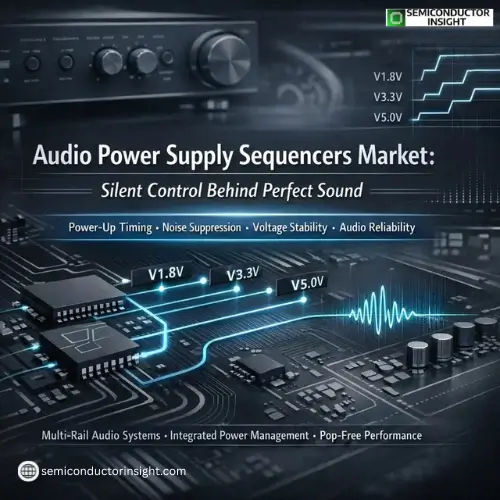
Audio Power Supply Sequencers Market Analysis: Enabling Silent, Stable Audio Systems
In high-performance audio systems, what happens before the sound begins matters just as much as the sound itself. Power-up timing, voltage stability, and noise suppression determine whether an audio experience feels refined or flawed. This is where audio power supply sequencers quietly take control.
Often overlooked outside engineering circles, these components are becoming indispensable as audio electronics grow more complex, compact, and performance-driven.
Take a Quick Glance at Our In-Depth Analysis Report:
https://semiconductorinsight.com/report/audio-power-supply-sequencers-market/
Understanding the Role: Why Sequencing Comes First
Audio power supply sequencers are semiconductor devices designed to control the order, timing, and stability of voltage rails in audio circuits. Instead of allowing power to flow freely and simultaneously, sequencers ensure that sensitive components such as DACs, amplifiers, and signal processors receive power in a carefully defined sequence.
This controlled start up and shutdown process prevents common audio issues such as popping noises, transient distortion, latch-up failures, and long-term component stress. In premium audio equipment, silence during power transitions is no longer a luxury it is a baseline expectation.
As audio designs integrate more rails for analog, digital, and mixed-signal blocks, sequencing has shifted from manual circuit logic to dedicated semiconductor solutions.
Where Demand Is Taking Shape?
The audio power supply sequencers market is gaining traction across multiple application environments, driven by the convergence of performance expectations and tighter system integration.
In consumer electronics, compact audio systems such as wireless speakers, sound bars, and true wireless stereo hubs rely on sequencers to manage multi-rail architectures within limited board space. Designers are under pressure to reduce component count while improving reliability, making integrated sequencing Integrated Circuits (ICs) increasingly attractive.
In automotive audio, the shift toward premium in-car entertainment has introduced complex amplifier chains and digital signal processing units. Sequencers help ensure smooth system start up even under fluctuating vehicle power conditions, supporting longer component life and consistent sound quality.
In professional and studio equipment, power sequencing is essential for protecting high-value audio components used in mixers, interfaces, and monitoring systems where downtime or audible faults are unacceptable.
The Semiconductor Design Shift behind the Market
What makes this market especially interesting is not just demand growth, but how design priorities are evolving.
Modern audio power supply sequencers are no longer simple timing controllers. Semiconductor manufacturers are embedding features such as programmable delay paths, fault detection, under voltage lockout, and enable pin coordination within compact packages. This evolution reflects a broader trend toward system-level power intelligence, where power management actively supports signal integrity.
As mixed-signal ICs become denser, the sequencing function increasingly serves as a protective layer between sensitive analog paths and noisy digital domains. This makes sequencers a strategic design element rather than a peripheral add-on.
Design Expectations Are Rising
Audio equipment manufacturers now expect sequencers to do more than manage timing. Market conversations increasingly revolve around reliability, layout efficiency, and ease of integration.
Key expectations shaping product development include:
- Compatibility with low-noise audio rails and high-current amplifier stages
- Programmability that allows customization without redesigning the board
- Small footprint packages suitable for space-constrained designs
- Robust fault handling to prevent cascading failures
These expectations are pushing semiconductor vendors to refine architectures that balance analog precision with digital configurability.
Competitive Differentiation through Integration
One of the defining characteristics of the audio power supply sequencers market is integration-driven competition. Instead of standalone solutions, suppliers are positioning sequencers as part of broader power management portfolios that include regulators, voltage supervisors, and protection ICs.
This integration strategy benefits OEMs by simplifying sourcing, reducing validation time, and improving interoperability across power domains. It also raises entry barriers, as new players must demonstrate not only functional accuracy but long-term reliability and audio-grade performance consistency.
Regional Momentum and Manufacturing Influence
Demand patterns in this market closely follow semiconductor manufacturing and audio electronics production hubs. Asia-Pacific continues to be a major contributor due to its concentration of consumer electronics manufacturing and rapid adoption of compact audio platforms.
North America and Europe maintain strong demand in professional audio, automotive systems, and premium consumer segments, where power sequencing is tightly linked to quality perception and regulatory compliance.
Across regions, the emphasis remains the same: minimize noise, protect components, and ensure predictable performance.
Why This Market Matters More Than It Appears?
Audio power supply sequencers may operate silently, but their impact is measurable. They extend product lifespan, improve end-user experience, and reduce costly design revisions. In an era where audio systems are judged not only by sound quality but also by reliability and refinement, sequencing has become a hidden differentiator.
As semiconductor architectures continue to converge and audio electronics grow smarter, the relevance of dedicated sequencing solutions will only deepen. The target market’s growth is less about volume and more about precision, trust, and performance consistency.
Important Lesson for Industry Participants
The audio power supply sequencers market reflects a broader semiconductor reality: small components increasingly carry system-level responsibility. For audio manufacturers, investing in robust sequencing is no longer optional it is fundamental to delivering modern sound experiences without compromise.

Comments (0)