
MARKET INSIGHTS
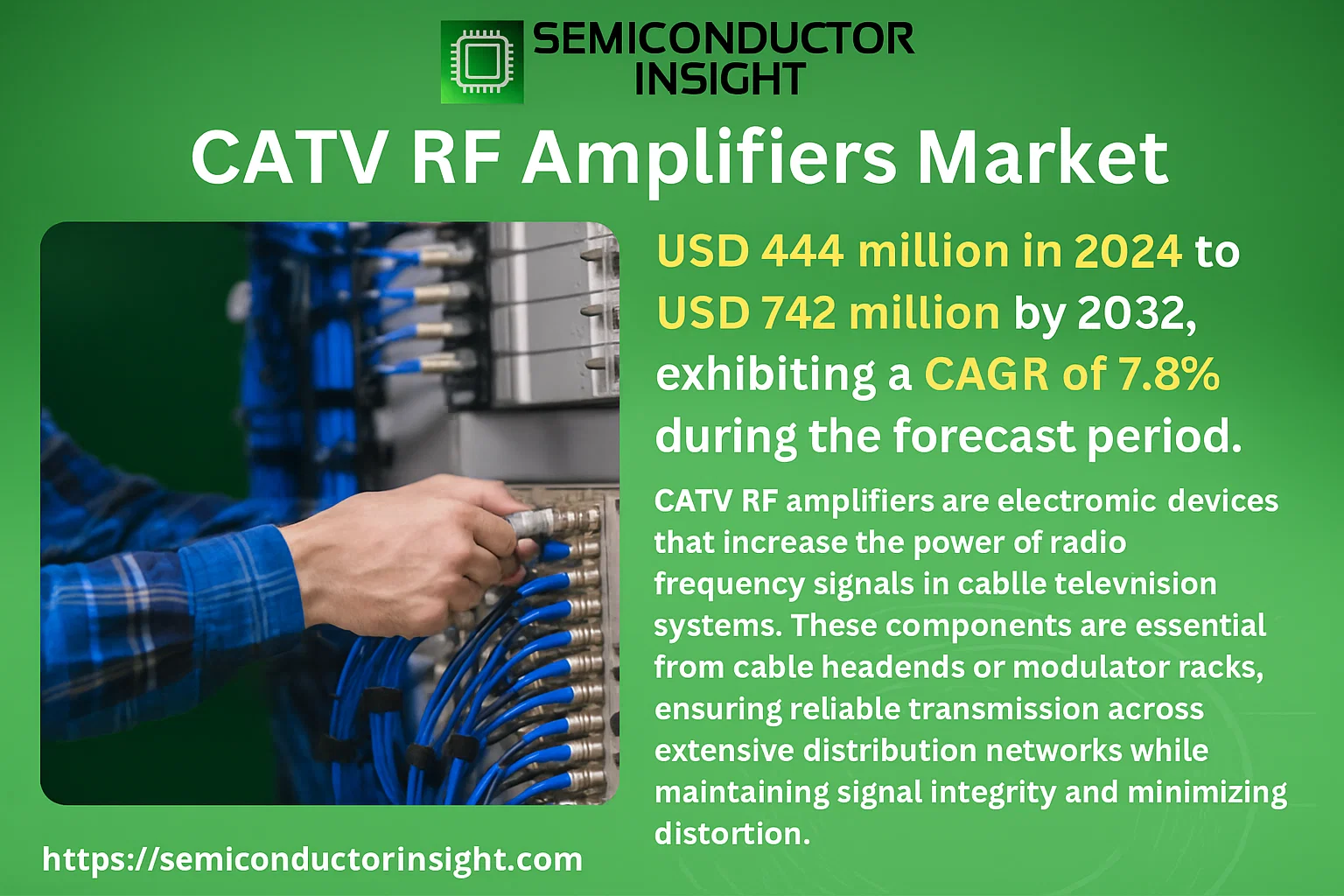
Global CATV RF Amplifiers Market size was valued at USD 444 million in 2024 to USD 742 million by 2032, exhibiting a CAGR of 7.8% during the forecast period.
CATV RF amplifiers are electronic devices that increase the power of radio frequency signals in cable television systems. These components are essential for boosting signal strength from cable headends or modulator racks, ensuring reliable transmission across extensive distribution networks while maintaining signal integrity and minimizing distortion.
The market is experiencing steady growth driven by increasing demand for high-speed broadband services and expanding cable television infrastructure globally. While North America and Europe remain dominant markets with approximately 25% share each, China represents a significant growth region with about 20% market share. Key players including Qorvo, Skyworks, and II VI Incorporated collectively hold around 35% of the global market. GaAs RF Amplifiers constitute the largest product segment with approximately 45% share, while residential applications lead end-use demand followed by commercial installations.
MARKET DRIVERS
Expansion of Broadband and High-Definition Services
Global push for higher internet speeds and the proliferation of high-definition video streaming services are primary drivers for the CATV RF Amplifier market. These amplifiers are critical for boosting signal strength over long coaxial cable runs, ensuring minimal signal degradation for broadband and video-on-demand services. The increasing consumption of data-intensive applications necessitates robust network infrastructure, directly fueling demand for high-performance RF amplifiers.
Network Upgrades and 5G Integration
Continuous upgrades of existing Cable TV networks to support higher frequencies and greater bandwidth are a significant market driver. Furthermore, the convergence of traditional CATV networks with 5G infrastructure for wireless backhaul applications creates new demand for RF amplifiers capable of handling broader frequency ranges. This technological evolution requires components that offer improved linearity and efficiency.
The rising demand for fiber-deep architectures and node segmentation also drives the market. As operators push fiber optic cables closer to subscribers, the role of the RF amplifier evolves, requiring devices that can work efficiently in hybrid fiber-coaxial (HFC) networks with advanced signal modulation schemes.
MARKET CHALLENGES
Intense Price Pressure and Competition
The market for CATV RF Amplifiers is highly competitive, with numerous manufacturers leading to significant price pressure. This challenges profitability and limits investments in research and development for smaller players. The commoditization of certain amplifier components further exacerbates this issue.
Other Challenges
Technical Complexity of Advanced Standards
The shift towards standards like DOCSIS 3.1 and 4.0, which use complex modulation techniques like OFDM, demands amplifiers with exceptional linearity and lower noise figures. Designing and manufacturing amplifiers that meet these stringent specifications without a substantial increase in cost presents a significant engineering challenge.
Signal Integrity in High-Frequency Ranges
As systems are required to operate at higher frequencies to deliver more bandwidth, maintaining signal integrity and minimizing distortion becomes increasingly difficult. This requires more sophisticated materials and designs, increasing complexity and cost.
MARKET RESTRAINTS
Substitution by Fiber-Optic Technology
A key restraint on the CATV RF Amplifier market is the long-term transition from traditional coaxial cable systems to pure fiber-to-the-home (FTTH) networks. In all-fiber networks, the need for RF amplifiers is eliminated, as signals are transmitted optically. This structural shift in network architecture poses a threat to the demand for coaxial line amplifiers in new deployments.
Market Maturity in Developed Regions
The CATV amplifier market in North America and Western Europe is largely mature, with growth primarily driven by network upgrades rather than new subscriber acquisitions. This limits the volume growth potential in these regions, as the installed base of amplifiers is already high and replacement cycles are extended.
MARKET OPPORTUNITIES
Growth in Emerging Markets
Significant opportunities exist in emerging economies across Asia-Pacific, Latin America, and Africa, where cable TV and broadband penetration rates are still growing. The expansion of HFC networks in these regions to meet rising demand for pay-TV and internet services creates a substantial market for new RF amplifier installations.
Development of Next-Generation Amplifiers
The ongoing evolution towards DOCSIS 4.0 and full-duplex technologies presents a major opportunity for innovation. There is a growing demand for amplifiers that offer extended frequency ranges up to 1.8 GHz, improved power efficiency, and enhanced reliability. Companies that can develop and supply these advanced components will capture a significant market share.
Integration with Smart Home and IoT
The role of the coaxial cable network is expanding beyond video to become a backbone for smart home devices and IoT applications. This creates opportunities for RF amplifiers that can support reliable, low-latency bidirectional data communication for a wide array of connected devices within the home environment.
CATV RF Amplifiers Market Trends
Sustained Market Growth Driven by Bandwidth Demand
Global CATV RF Amplifiers Market is on a clear growth trajectory, valued at USD 444 million in 2024 and projected to reach USD 742 million by 2032, reflecting a compound annual growth rate (CAGR) of 7.8%. This robust expansion is fundamentally driven by the continuous increase in global bandwidth consumption. The proliferation of high-definition video streaming, video-on-demand services, and the rising deployment of fiber-rich hybrid fiber-coaxial (HFC) networks necessitate superior signal integrity over longer distances, directly boosting the demand for high-performance RF amplifiers within cable television infrastructure.
Other Trends
Technology and Material Advancements
A significant trend shaping the market is the technological evolution and material composition of the amplifiers themselves. Gallium Arsenide (GaAs) based RF amplifiers currently dominate the market, holding a share of approximately 45%. However, Gallium Nitride (GaN) amplifiers are gaining traction due to their superior efficiency, higher power density, and better thermal performance, which are critical for next-generation broadband systems. This shift is compelling key manufacturers to invest in R&D to enhance product offerings and maintain competitive advantage.
Geographical Market Concentration
The market exhibits strong regional concentrations, with Europe and North America each accounting for about 25% of the global market share. This is attributed to well-established cable TV infrastructures and early adoption of advanced broadband technologies. China follows as a significant market with a 20% share, driven by massive ongoing digitalization and network upgrades. The competitive landscape is consolidated, with the top five manufacturers, including Qorvo and Skyworks, collectively holding around 35% of the market, emphasizing the importance of technological innovation and strategic partnerships for market players.
Application Segment Dynamics
In terms of application, the residential segment is the largest end-user of CATV RF amplifiers, followed by the commercial sector. The residential dominance is linked to the universal demand for high-quality television and internet services in households. The consistent need for network maintenance, upgrades to support higher data speeds, and the expansion of cable services in emerging economies are key factors sustaining demand across both segments, ensuring steady market growth throughout the forecast period.
COMPETITIVE LANDSCAPE
Key Industry Players
Market Dominated by Leading Suppliers with Strong R&D Focus
Global CATV RF Amplifiers Market is characterized by the presence of several established players, with the top five manufacturers collectively holding a significant share of approximately 35% of the market. Market leadership is held by companies like Qorvo and Skyworks, which benefit from extensive product portfolios, global distribution networks, and substantial investments in research and development, particularly in advanced semiconductor technologies like GaAs and GaN. II VI Incorporated (now Coherent Corp.) and Analog Devices are also pivotal players, known for their high-performance components. The market structure is moderately consolidated, with competition primarily revolving around product reliability, bandwidth capabilities, power efficiency, and cost-effectiveness to serve both residential and commercial application segments. North America and Europe are the largest regional markets, each accounting for about 25% of the global share, driven by advanced cable infrastructure upgrades.
Beyond the top-tier suppliers, a diverse group of niche and specialized manufacturers contribute to the competitive dynamics. Companies such as Macon, ShenZhen ChuangMo Electronics, and Blonder Tongue have established strong positions by focusing on specific geographic markets or application niches, offering cost-competitive solutions. Specialized firms like Mini-Circuits and Amplifier Solutions Corporation cater to custom and high-frequency requirements. Emerging players, particularly from Asia-Pacific regions like Seebest and Candid Optronix, are increasing their presence by leveraging manufacturing efficiencies. The competitive landscape is further shaped by technological innovation in amplifier design and the ongoing transition in cable networks, which demands components supporting higher frequencies and greater signal integrity.
List of Key CATV RF Amplifiers Companies Profiled
- Qorvo
- Skyworks
- II VI Incorporated (Coherent Corp.)
- Analog Devices
- Macon
- ShenZhen ChuangMo Electronics
- Seebest
- SOFTEL
- NXP Semiconductors
- Blonder Tongue
- Texas Instruments
- Amplifier Solutions Corporation
- ASB Inc.
- Mini-Circuits
- RF-Lambda
Segment Analysis:
| Segment Category | Sub-Segments | Key Insights |
| By Type |
|
GaAs RF Amplifiers lead the market due to their superior performance in high-frequency applications, excellent linearity, and proven reliability in existing cable television infrastructure. Their widespread adoption is driven by the need for stable signal amplification across long-distance transmissions. The emergence of GaN RF Amplifiers presents a significant growth opportunity, offering higher power density and efficiency, which are critical for next-generation broadband and fiber-coaxial hybrid networks. The “Others” category includes legacy silicon-based technologies, which continue to serve niche applications but are gradually being superseded by more advanced semiconductor materials. |
| By Application |
|
Residential applications constitute the primary driver for the CATV RF Amplifiers Market, fueled by the massive global subscriber base for cable television and broadband services. The demand is sustained by the need for reliable signal integrity in multi-dwelling units and single-family homes to support high-definition video, video-on-demand, and high-speed internet. The Commercial segment, encompassing hotels, offices, and hospitals, requires robust amplification solutions for complex distribution systems. This segment’s growth is linked to the expansion of digital signage, enterprise-level communication networks, and the demand for premium video services in hospitality and corporate environments. |
| By End User |
|
Multi-System Operators (MSOs) represent the dominant end-user segment, as they are the primary entities that build, maintain, and upgrade cable network infrastructure. Their continuous investment in network expansion and modernization to support higher bandwidth services drives consistent demand for high-performance RF amplifiers. Internet Service Providers (ISPs) are increasingly significant, leveraging cable infrastructure for broadband delivery. System Integrators & Installers form a critical channel, providing specialized installation and upgrade services for both residential and commercial clients, influencing product selection based on reliability and ease of integration. |
| By Technology Generation |
|
Traditional Analog/Digital Hybrid networks currently represent the largest installed base, requiring amplifiers for signal conditioning and distribution across coaxial cable plants. The transition towards Full-Digital / Fiber Deep architectures is a key trend, where RF amplifiers are used in node deployment to push fiber deeper into the network, reducing noise and increasing bandwidth capacity. The most significant growth potential lies in Next-Generation Access Networks, such as Distributed Access Architectures (DAA) and 10G platforms, which demand amplifiers with higher linearity and greater power efficiency to support symmetrical multi-gigabit services. |
| By Distribution Channel |
|
Direct Sales (OEMs) to large cable operators and network equipment manufacturers is the leading channel, characterized by long-term contracts and customized solutions tailored for large-scale deployments. This channel benefits from deep technical integration and direct customer support. Distributors & Resellers serve a broader base of smaller regional operators and system integrators, providing inventory management and localized logistics. The emergence of Online Retail channels is gaining traction for serving the small-office and pro-installer markets, offering quicker access to standard components and facilitating smaller quantity purchases with greater convenience. |
Regional Analysis: CATV RF Amplifiers Market
The extensive, legacy coaxial cable networks require ongoing lifecycle management and strategic upgrades. This constant cycle of replacing aging amplifiers with newer, more efficient models to support increased bandwidth demands represents a foundational driver for the market, ensuring a stable and recurring demand base from established operators.
North American operators are often first to implement new standards like Full Duplex DOCSIS, which places stringent performance requirements on the RF amplifier plant. This leadership in adopting next-generation technologies creates a premium market segment for amplifiers with enhanced linearity, lower noise, and greater reliability, driving value beyond basic replacement demand.
Intense competition among cable MSOs, telecom providers, and satellite services compels continuous investment in network quality. To minimize customer churn and support bundled service offerings, operators prioritize network performance, leading to proactive amplifier upgrades and a preference for high-quality components from established suppliers.
The strategic shift towards node splitting and fiber-deep architectures changes the role of RF amplifiers. While reducing the number of amplifiers in some parts of the network, it increases the need for specialized amplifiers at the optical node and tap interfaces, creating new product segments and opportunities for innovation within the regional market.
Europe
Europe represents a significant and technologically advanced market for CATV RF Amplifiers, characterized by a diverse landscape of national operators and varying levels of infrastructure development. Western European countries, with their dense urban populations and high broadband penetration, exhibit strong demand for amplifier upgrades to support escalating bandwidth requirements for video-on-demand and ultra-fast internet. The region’s stringent regulatory environment and emphasis on signal quality standards ensure a market for reliable, high-performance components. In Eastern Europe, ongoing digitalization efforts and network expansions in developing cable systems provide growth opportunities, though the market dynamics differ from the mature West. The overall trend is towards network consolidation and modernization, driving demand for amplifiers that offer better energy efficiency and remote monitoring capabilities aligned with smart network management initiatives.
Asia-Pacific
The Asia-Pacific region is the fastest-growing market for CATV RF Amplifiers, fueled by massive investments in digital infrastructure and rising disposable incomes. China and India are pivotal, with large-scale government-led digitalization projects and expanding cable TV and broadband subscriptions in suburban and rural areas creating substantial demand for basic and mid-tier amplifier products. Meanwhile, developed markets like Japan, South Korea, and Australia are focused on next-generation network upgrades, demanding amplifiers suitable for advanced hybrid fiber-coaxial (HFC) systems and fiber convergence. The region’s diversity results in a dual-track market: volume-driven demand for cost-effective amplifiers in emerging economies and sophisticated demand for high-performance units in mature markets, making it a complex but highly dynamic landscape for suppliers.
South America
The CATV RF Amplifier market in South America is in a developmental phase, with growth potential tied to economic stability and infrastructure investment. Brazil and Argentina are the key markets, where cable operators are gradually upgrading legacy networks to improve service quality and compete with direct-to-home satellite and streaming services. The primary demand is for amplifiers that offer a balance between cost-effectiveness and reliability, suitable for network expansions in secondary cities and towns. Challenges include economic volatility and uneven urban development, but the ongoing transition from analog to digital broadcasting and the need for basic signal boosting in extended cable networks continue to drive consistent, albeit modest, demand for RF amplifier solutions across the region.
Middle East & Africa
The Middle East & Africa region presents a nascent but promising market for CATV RF Amplifiers, with dynamics sharply divided along economic lines. Wealthy Gulf Cooperation Council (GCC) countries are investing in state-of-the-art fiber-rich cable networks, creating demand for advanced amplifiers for high-end residential and commercial developments. In contrast, much of Africa relies on broader community antenna television systems and is in the early stages of cable infrastructure rollout, leading to demand for durable, low-cost amplifiers for signal distribution. The market growth is closely linked to urbanization rates and telecommunications investment, with the region offering long-term growth potential as digital access expands, though it currently represents a smaller segment of the global market.
Report Scope
This market research report provides a comprehensive analysis of the CATV RF Amplifiers Market , covering the forecast period 2025–2032. It offers detailed insights into market dynamics, technological advancements, competitive landscape, and key trends shaping the industry.
Key focus areas of the report include:
- Market Overview: The report begins with an overview outlining its current market scenario, key growth indicators, and industry transformation drivers. It discusses macroeconomic factors, demand–supply balance, regulatory landscape, and the strategic role of semiconductors in powering advancements across industries such as automotive, telecommunications, consumer electronics, and industrial automation.
- Market Size & Forecast: Historical data and future projections for revenue, unit shipments, and market value across major regions and segments.
- Segmentation Analysis: Detailed breakdown by product type, technology, application, and end-user industry to identify high-growth segments and investment opportunities.
- Regional Insights: Insights into market performance across North America, Europe, Asia-Pacific, Latin America, and the Middle East & Africa, including country-level analysis where relevant.
- Competitive Landscape: Profiles of leading market participants, including their product offerings, R&D focus, manufacturing capacity, pricing strategies, and recent developments such as mergers, acquisitions, and partnerships.
- Technology Trends & Innovation: Assessment of emerging technologies, integration of AI/IoT, semiconductor design trends, fabrication techniques, and evolving industry standards.
- Market Drivers & Restraints: Evaluation of factors driving market growth along with challenges, supply chain constraints, regulatory issues, and market-entry barriers.
- Stakeholder Insights: Insights for component suppliers, OEMs, system integrators, investors, and policymakers regarding the evolving ecosystem and strategic opportunities.
Primary and secondary research methods are employed, including interviews with industry experts, data from verified sources, and real-time market intelligence to ensure the accuracy and reliability of the insights presented.
FREQUENTLY ASKED QUESTIONS:
What is the current market size of CATV RF Amplifiers Market?
-> CATV RF Amplifiers Market size was valued at USD 444 million in 2024 to USD 742 million by 2032, exhibiting a CAGR of 7.8% during the forecast period.
Which key companies operate in CATV RF Amplifiers Market?
-> Key players include Qorvo, Skyworks, II VI Incorporated, Macon, and ShenZhen ChuangMo Electronics, among others. Global top five manufacturers hold a share of about 35%.
What are the key growth drivers?
-> Key growth drivers include increasing demand for improved cable signal quality, expansion of broadband infrastructure, and technological advancements in RF amplifier design.
Which region dominates the market?
-> Europe and North America are the largest markets, each with a share of about 25%, followed by China with a share of about 20%.
What are the emerging trends?
-> Emerging trends include the adoption of GaN RF Amplifiers, increasing integration in residential applications, and the development of more efficient and compact amplifier solutions.

Get Sample Report PDF for Exclusive Insights
Report Sample Includes
- Table of Contents
- List of Tables & Figures
- Charts, Research Methodology, and more...
 Download Sample Report PDF



