

Armored Cars Market Evolution from Cash Transit to Tactical Protection Systems
Armored cars market is steadily transforming from a niche security solution into a critical mobility segment supporting financial systems, government operations, and high-net-worth protection. As urban risks evolve and security threats become more advanced, armored vehicles are no longer limited to cash transit they are now integrated into defence logistics, VIP mobility, and sensitive cargo transportation.
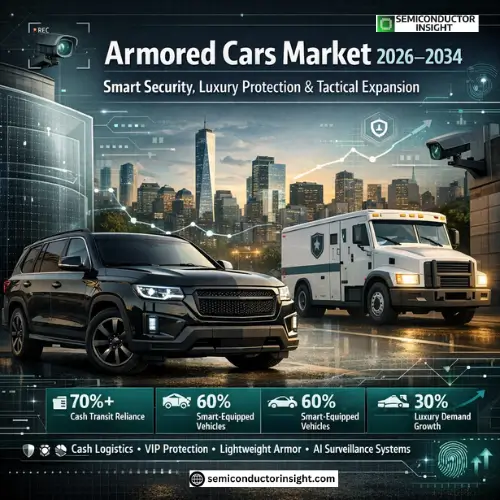
Globally, over 70% of cash-in-transit operations still rely on armored vehicles, underscoring their continued importance despite the growth of digital payments. At the same time, private demand is expanding rapidly, particularly in regions witnessing rising wealth concentration and urban security concerns.
The Shift from Traditional Protection to Intelligent Armoring
- Armored vehicles today are no longer just steel-reinforced transport units. Modern designs incorporate multi-layer ballistic protection, blast-resistant flooring, and advanced surveillance systems.
- Approx. 60% of newly manufactured armored vehicles now include integrated GPS tracking, remote immobilization features, and real-time communication systems.
- A notable example is the increasing deployment of armored SUVs equipped with 360° camera systems and AI-enabled threat detection. These features are redefining how security teams anticipate and respond to potential risks, especially in high-density urban environments.
Banking and Cash Logistics Still Dominate Core Demand
Despite digital banking growth, physical currency circulation remains significant in many economies. In countries where cash accounts for over 50% of transactions, armored vehicles continue to be indispensable.
More than 40,000 armored cash vans operate globally, with fleet sizes expanding in emerging markets. Banks and financial institutions are upgrading fleets to meet stricter security protocols, including biometric access systems and compartmentalized storage units.
A recent trend includes the adoption of dual-control locking systems, where access requires simultaneous authentication from two authorized personnel reducing internal theft risks and enhancing operational security.
Luxury Armored Vehicles Reshape High-Net-Worth Mobility
One of the fastest-growing segments within armored cars market is the luxury armored vehicle category. Demand for armored sedans and SUVs has surged by over 30% in the last few years, driven by business leaders, celebrities, and political figures.
Vehicles such as armored versions of premium SUVs now feature discreet ballistic protection that maintains the original vehicle aesthetics while offering protection against high-caliber ammunition. These vehicles often include reinforced glass capable of withstanding multiple impacts and run-flat tires that can sustain mobility even after severe damage.
An interesting development is the customization trend clients now request tailored armor levels, interior luxury upgrades, and integrated emergency systems, blending comfort with high-grade security.
Feel Free to Reach Our Most Recent Updates of the Related Report:
https://semiconductorinsight.com/report/gps-data-logger-market/
Defence and Tactical Integration Expanding Use Cases
- Beyond civilian applications, armored vehicles are increasingly being used in paramilitary and defence operations.
- Light armored vehicles (LAVs) are witnessing increased adoption due to their agility and versatility in urban conflict zones.
- In recent deployments, over 25% of newly procured tactical vehicles fall into the light armored category, reflecting a shift toward mobility-focused defence strategies. These vehicles are designed for rapid deployment, troop transport, and reconnaissance missions.
- Additionally, modular armor systems are gaining traction, allowing vehicles to be upgraded or downgraded based on mission requirements, thereby improving cost efficiency and operational flexibility.
Material Innovation Driving Performance Gains
The evolution of armored vehicles is closely tied to advancements in materials science. Traditional steel armor is increasingly being supplemented or replaced by composite materials such as aramid fibers and ultra-high-molecular-weight polyethylene (UHMWPE).
These materials can reduce vehicle weight by up to 40% while maintaining equivalent protection levels. This weight reduction directly improves fuel efficiency, maneuverability, and overall performance.
For instance, hybrid armor solutions combining ceramics and composites are now used in over 35% of newly manufactured armored vehicles, particularly in high-performance and defense-grade models.
Urban Security Trends Fuelling Demand Surge
Rapid urbanization and rising crime rates in major cities are pushing both public and private entities to invest in armored mobility. In cities with populations exceeding 10 million, demand for armored transport solutions has increased by nearly 20% in recent years.
Government agencies are also expanding armored fleets for law enforcement and emergency response units. Armored personnel carriers are being adapted for riot control, disaster response, and high-risk rescue operations.
A recent instance includes the deployment of armored evacuation vehicles during crisis situations, ensuring safe transport in volatile environments a clear indicator of their expanding utility beyond traditional roles.
Technology Convergence Redefining Security Standards
The integration of digital technologies is reshaping armored cars market. Features such as biometric authentication, AI-powered surveillance, and predictive maintenance systems are becoming standard in next-generation vehicles.
Nearly 50% of premium armored vehicles now include advanced telematics systems that monitor vehicle health, route efficiency, and potential security threats in real time.
This convergence of physical armor and digital intelligence is setting new benchmarks for security, making armored vehicles not just protective assets but smart mobility solutions.

Comments (0)