

ARIES Launches in the U.S., Bringing Power Semiconductors, AI, Photonics and RF Research Under One Innovation Ecosystem
The semiconductor industry is entering an era where power efficiency, wide-bandgap materials, AI-enabled electronics, photonics, cybersecurity and high-frequency technologies increasingly need to advance together.
Against this backdrop, the University of Arkansas has launched the Arkansas Research Institute for Electronics Systems (ARIES), a new research organization focused on developing, producing and deploying next-generation electronics and semiconductor technologies designed for demanding operating environments.
Four Technology Pillars Define the ARIES Roadmap
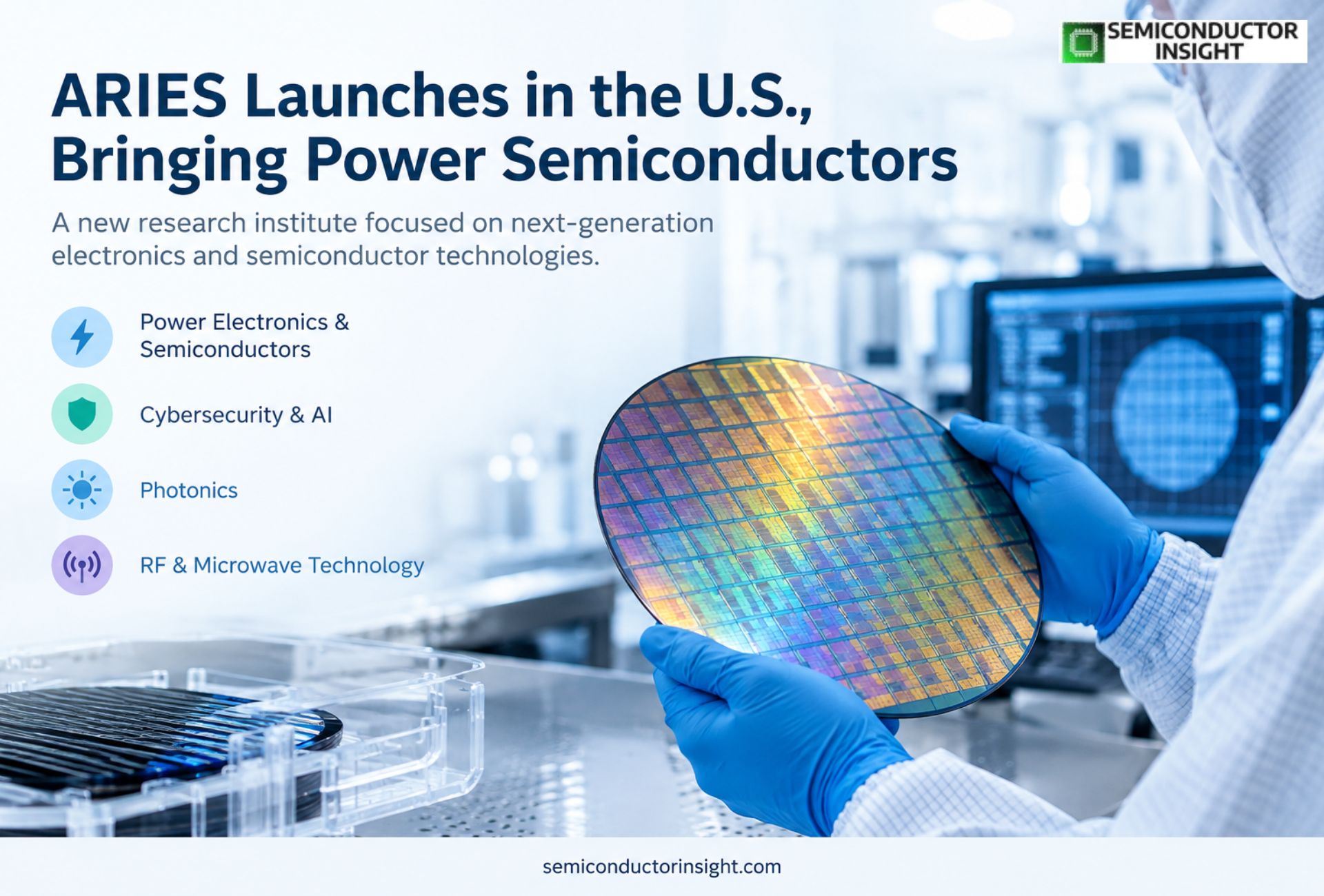
Rather than concentrating on a single semiconductor technology, ARIES brings multiple electronics disciplines into one research structure:
▪ Power Electronics & Semiconductors – advancing devices and systems for demanding power applications.
▪ Cybersecurity & AI – connecting electronic hardware development with secure and intelligent computing architectures.
▪ Photonics – supporting research into optical technologies and photonic systems.
▪ RF & Microwave Technology – addressing high-frequency electronics and communications-related applications.
According to the University of Arkansas, the institute combines researchers with established federal and industry collaboration experience with facilities spanning materials research, fabrication, packaging and high-power testing.
From Semiconductor Materials to System-Level Testing
A major feature of ARIES is its access to an interconnected research infrastructure rather than isolated laboratories.
Its ecosystem includes MUSiC, the National Multi-User Silicon Carbide Research and Fabrication Laboratory. The facility is described by the University of Arkansas as the nation’s only openly accessible, low-volume SiC integrated-circuit fabrication facility, enabling researchers to prototype and demonstrate silicon-carbide technologies.
The institute also incorporates:
HiDEC – High-Density Electronics Center
Focused on electronics processing and packaging capabilities, providing R&D infrastructure and workforce training for advanced electronics.
NCREPT – National Center for Reliable Electric Power Transmission
A 6 MVA university-based high-power testing facility supporting research into solid-state solutions for electrified transportation and the electric grid.
This combination gives ARIES a vertically connected pathway extending from materials and semiconductor devices → fabrication → packaging → electronic systems → high-power testing.
Why Silicon Carbide Is Central to the Opportunity
The emphasis on SiC is particularly relevant as power electronics expands across electric transportation, renewable-energy systems, grid infrastructure and other high-performance applications.
The University of Arkansas has positioned MUSiC as an open resource for prototyping and proof-of-concept demonstrations in silicon carbide, helping bridge the gap between university research and eventual commercial or government applications.
For semiconductor companies and technology developers, this type of infrastructure can be important because advanced-device innovation requires more than laboratory-level material research. Access to fabrication, packaging and testing capabilities can help move concepts toward device validation and technology transition.
A Broader Industry Signal for Semiconductor R&D
From a client perspective, the ARIES launch is notable because it reflects a broader evolution in semiconductor innovation: research ecosystems are increasingly being structured around the complete technology-development chain rather than individual disciplines.
For semiconductor manufacturers, equipment suppliers, materials companies and technology developers, developments such as ARIES can create potential opportunities around:
- Wide-bandgap semiconductor development
- SiC device prototyping and fabrication
- Advanced electronic packaging
- Power conversion and electrification
- AI and hardware security
- Photonics and optical electronics
- RF and microwave systems
- University–industry technology transfer
- Specialized semiconductor workforce development
The University of Arkansas has also emphasized workforce development as a central part of the institute, with ARIES intended to prepare students for careers spanning materials science, power electronics and semiconductor technologies.
What This Could Mean for the Global Semiconductor Landscape?
The launch arrives at a time when semiconductor innovation is extending beyond conventional computing chips into energy infrastructure, transportation, defense-related electronics, communications, photonics and intelligent systems.
ARIES brings these technology areas together within a single research ecosystem in Arkansas, while it’s MUSiC, HiDEC and NCREPT facilities provide capabilities across fabrication, packaging and high-power testing.
For the global semiconductor value chain, the development highlights a key trend: the next generation of semiconductor competitiveness will increasingly depend not only on advanced devices, but also on the infrastructure, talent and collaborative ecosystems capable of taking those devices from research to real-world deployment.
For More Detailed Insights, You Can Surf Our Latest Report Here: https://semiconductorinsight.com/report/global-power-semiconductors-market/

Comments (0)