
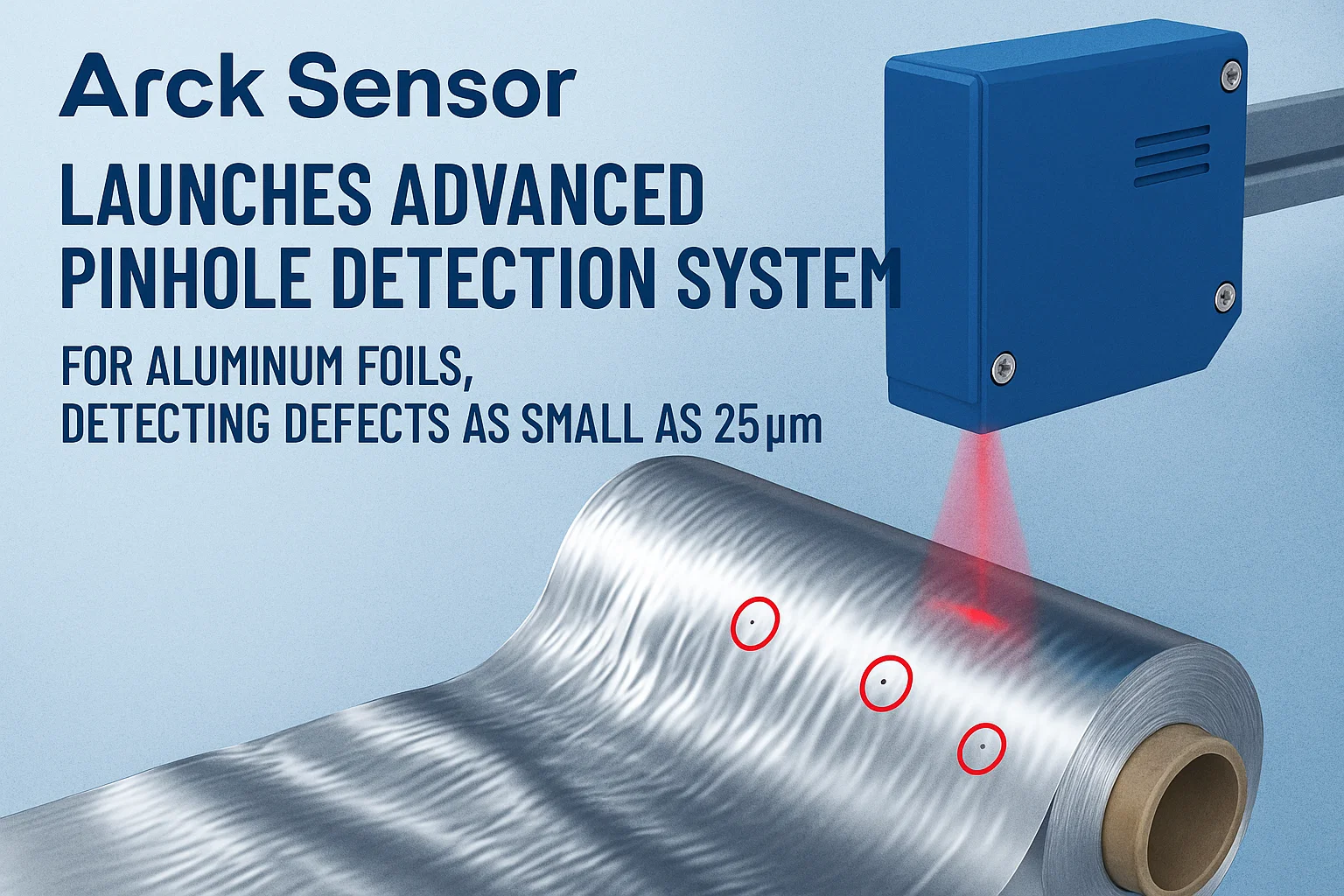
Arck Sensor Launches Advanced Pinhole Detection System for Aluminum Foils, Detecting Defects as Small as 25µm
The foil sensors market has entered a period of rapid technological evolution, driven by the increasing demand for high-precision sensing solutions across industries such as medical devices, battery manufacturing, automotive electronics, aerospace, and industrial automation. In 2024, the global foil sensors market was valued at US$ 234 million, and it is projected to grow at a CAGR of 6.2% during the forecast period, reaching US$ 378 million by 2032. This growth reflects the convergence of several factors: miniaturization of electronics, demand for flexible and lightweight sensors, stricter quality control in advanced manufacturing, and the rise of next-generation energy and mobility technologies.
Foil sensors, known for their thin, flexible design and high sensitivity, are being widely adopted in areas where traditional rigid sensors fail to meet performance or design requirements. These sensors typically consist of a thin metallic foil etched into precise patterns, enabling them to measure variables such as temperature, pressure, strain, and force with exceptional accuracy. As industries move toward smarter, data-driven systems, foil sensors are playing a critical role in bridging the gap between physical processes and digital control systems.
Access Your Free Sample Report- Foil Sensors Market
- Market Overview: Foil Sensors Industry at a Glance
Foil sensors have historically been associated with applications like strain gauges and resistance temperature detectors (RTDs). However, recent years have seen a surge in next-generation flexible sensors, where thin foils act as substrates for advanced sensing materials and integrated circuits. The growing popularity of wearable devices, electric vehicles (EVs), renewable energy systems, and medical diagnostic equipment has opened new growth avenues for foil sensor technologies.
Key Market Figures
- 2024 Market Size: US$ 234 million
- 2032 Projected Market Size: US$ 378 million
- CAGR (2025-2032): 6.2%
Major Application Areas
- Medical Devices: Temperature monitoring, patient wearables, diagnostic tools
- Battery Manufacturing: Quality inspection of electrode foils, defect detection
- Automotive Electronics: Advanced driver-assistance systems (ADAS), electric drivetrain monitoring
- Industrial Automation: Robotic sensing, precision manufacturing controls
- Aerospace: Lightweight, flexible sensors for structural health monitoring
- Recent Technological Developments in Foil Sensors
Recent advancements in foil sensors highlight the industry’s commitment to precision, flexibility, and integration. Below are some of the most significant innovations making headlines in 2024 and 2025.
2.1 Etched Balco/Nickel Foil Sensors for Advanced RTDs
Traditional RTDs use wire-wound elements or thin-film technology, but a new wave of etched Balco and nickel foil sensors is revolutionizing temperature sensing. These sensors are created by etching precise circuits into ultra-thin foil materials, such as Balco (a nickel-iron alloy) or pure nickel.
Benefits:
- Ultra-thin design: Enables integration into compact medical devices and wearables.
- High accuracy: Provides reliable temperature readings across a wide range.
- Durability: Resistant to mechanical stress and corrosion.
- Multi-point sensing: Can measure temperature across a surface rather than at a single point.
These sensors are now being adopted in medical diagnostic equipment such as MRI machines, ventilators, and portable monitors. According to Today’s Medical Developments, etched foil RTDs are gaining traction because they combine the performance of wire-wound RTDs with the compactness of thin-film designs, making them ideal for next-generation healthcare applications.
2.2 Non-Contact Sensing for Lithium Battery Foil Inspection
The rapid rise of electric vehicles and renewable energy storage has created a surge in demand for high-quality lithium-ion batteries. In battery manufacturing, the precise handling of electrode foils is crucial. Even microscopic defects can compromise battery performance or safety.
SinceVision, a leader in machine vision technology, has developed non-contact optical sensors for inspecting battery electrode foils. These sensors use laser-based measurement systems to:
- Measure foil thickness with sub-micron precision (±0.3 µm).
- Detect leftover foil scraps or uneven coating.
- Monitor scribing and cutting quality during production.
By enabling manufacturers to identify defects early, these sensors reduce waste and improve overall product reliability. This innovation is vital as battery makers race to meet the growing demand for EVs while maintaining strict quality standards.
2.3 High-Precision Pinhole Detection in Aluminum Foils
Defects in aluminum foils, such as pinholes, pose a significant challenge in industries like battery manufacturing, packaging, and aerospace. Arck Sensor recently unveiled an upgraded Abell pinhole detector that can detect holes as small as 25 µm, even at high production speeds.
Key Features:
- Zonal defect mapping: Divides the foil into micro-zones (e.g., 5×5 mm) for localized analysis.
- Real-time alerts: Immediate notification when defect thresholds are exceeded.
- High throughput: Suitable for fast-paced industrial production lines.
This breakthrough improves quality assurance in sectors where foil integrity is mission-critical, such as EV battery separators and pharmaceutical packaging.
Download Sample Report PDF- Foil Sensors Market
2.4 Stick-On Flexible Foil Sensors by Accensors
German startup Accensors has introduced ready-to-use stick-on foil sensors, designed for easy integration into a wide range of products. These sensors are extremely thin (around 0.4 mm) and come in both strip and SMD configurations, supporting applications like:
- Temperature and pressure sensing.
- Moisture and humidity detection.
- Biochemical measurements (e.g., pH, ion concentration).
Their plug-and-play design simplifies deployment in complex systems, making them ideal for wearables, smart textiles, and embedded industrial monitoring.
2.5 LED-on-Foil Technology by ams OSRAM
While primarily focused on lighting, ams OSRAM’s ALIYOS LED-on-foil technology demonstrates the growing trend of integrating electronic functions into ultra-thin foil substrates. In automotive applications, this allows for:
- Decorative lighting elements.
- Embedded sensors alongside LED arrays.
- Reduced weight and improved design flexibility.
Though LEDs are not sensors, this innovation underscores the broader movement toward multi-functional foil electronics, where sensing, illumination, and data transmission coexist on a single flexible platform.
- Growth Drivers for the Foil Sensors Market
The robust growth of the foil sensors market is supported by several macro and microeconomic factors. Below are the most influential drivers:
3.1 Rising Demand for Flexible and Wearable Devices
The surge in wearable technology from smartwatches to medical monitoring patches has created strong demand for ultra-thin, lightweight sensors. Foil sensors are perfect for this application because they can conform to the human body, providing continuous monitoring without discomfort.
Healthcare applications are particularly promising. For example:
- Remote patient monitoring devices use foil temperature and pressure sensors.
- Smart bandages integrate foil sensors to monitor wound healing.
- Fitness wearables track biometric data with minimal bulk.
3.2 Electric Vehicle Boom and Battery Quality Standards
The EV revolution has intensified the need for high-precision sensors in battery production. As global automakers ramp up EV manufacturing, maintaining consistent quality in electrode foils is paramount. Even a tiny defect can lead to battery failure or fire hazards.
Foil sensors and optical inspection systems ensure:
- Accurate thickness control of battery foils.
- Real-time defect detection, minimizing waste.
- Compliance with stringent safety regulations.
3.3 Miniaturization and IoT Integration
The ongoing trend toward smaller, smarter devices is pushing sensor manufacturers to innovate. Foil sensors, with their compact form factor, are ideal for embedding in Internet of Things (IoT) devices. These sensors provide real-time data for smart homes, industrial automation, and connected vehicles.
3.4 Industry 4.0 and Precision Manufacturing
Modern factories rely on data-driven decision-making. Foil sensors play a crucial role in this ecosystem by providing real-time monitoring of machine performance, product quality, and environmental conditions. Their flexibility allows them to be installed in tight spaces or integrated into moving parts without interfering with operations.
- Regional Insights
The adoption of foil sensor technologies varies by region, reflecting differences in industrial focus and technological advancement.
North America
- Strong demand from medical devices and aerospace sectors.
- High concentration of R&D activity and advanced manufacturing.
- Major players like ams OSRAM and Accensors expanding partnerships.
Europe
- Leader in automotive innovations, especially EV battery production.
- Regulatory focus on quality control and environmental sustainability.
- Germany and France leading in foil sensor deployment.
Asia-Pacific
- Fastest-growing region, driven by large-scale electronics manufacturing in China, South Korea, and Japan.
- Massive investments in EV production and renewable energy.
- China emerging as a hub for low-cost, high-volume sensor production.
- Challenges Facing the Foil Sensors Industry
Despite strong growth prospects, the foil sensors market faces several challenges:
5.1 High Production Costs
The production of high-precision etched foil sensors requires advanced equipment and materials, leading to elevated costs. This can be a barrier for small and medium-sized manufacturers.
5.2 Technological Complexity
As sensors become more sophisticated, integrating them into complex systems poses design and compatibility challenges. Companies must invest heavily in R&D to stay competitive.
5.3 Supply Chain Disruptions
Global events, such as geopolitical tensions or natural disasters, can disrupt the supply of critical raw materials like nickel, aluminum, and specialty foils.
Click Here To Download Full Sample Report- Foil Sensors Market
- Future Outlook: The Next Decade of Foil Sensor Innovation
Looking ahead, the foil sensors market is expected to undergo transformative changes. Here are some key trends to watch:
- Integration with AI and Machine Learning:
Foil sensors will increasingly work in tandem with AI systems to enable predictive maintenance, automated quality control, and real-time process optimization. - Hybrid Foil Devices:
Combining sensing, energy harvesting, and wireless communication on a single foil substrate will revolutionize IoT device design. - Biocompatible Sensors for Healthcare:
The development of skin-friendly, biodegradable foil sensors will expand opportunities in medical monitoring and wearable health tech. - Sustainability Initiatives:
Manufacturers will focus on recyclable materials and greener production methods to align with global environmental goals.
The foil sensors market is on a strong growth trajectory, fueled by innovations in medical technology, electric vehicles, wearable devices, and industrial automation. Recent breakthroughs such as etched Balco/nickel RTDs, high-precision pinhole detection, and stick-on flexible sensors are reshaping the landscape, making these devices more versatile and accessible than ever before.
With a projected CAGR of 6.2%, reaching US$ 378 million by 2032, the industry offers lucrative opportunities for manufacturers, technology developers, and investors alike. Companies that prioritize R&D, integration with digital ecosystems, and sustainable practices will be best positioned to thrive in this dynamic market.

Comments (0)