MARKET INSIGHTS
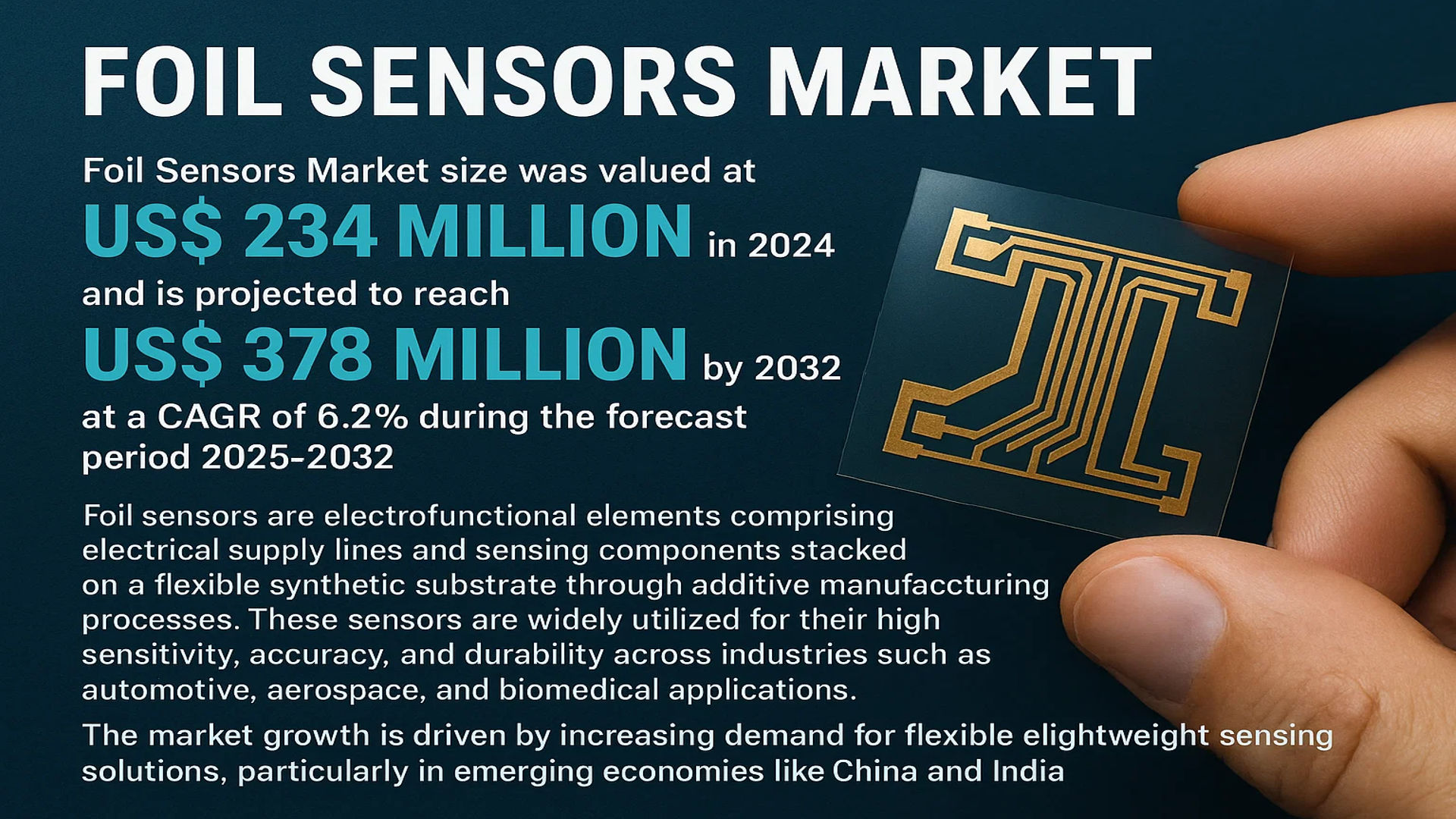
The global Foil Sensors Market size was valued at US$ 234 million in 2024 and is projected to reach US$ 378 million by 2032, at a CAGR of 6.2% during the forecast period 2025-2032.
Foil sensors are electrofunctional elements comprising electrical supply lines and sensing components stacked on a flexible synthetic substrate through additive manufacturing processes. These sensors are widely utilized for their high sensitivity, accuracy, and durability across industries such as automotive, aerospace, and biomedical applications.
The market growth is driven by increasing demand for flexible and lightweight sensing solutions, particularly in emerging economies like China and India. While the automotive sector remains a dominant end-user, advancements in medical and agricultural applications are further propelling adoption. Key players such as ABB, IEE Group, and Metallux AG are investing in R&D to expand their product portfolios, ensuring competitive market dynamics.
MARKET DRIVERS
Expanding Applications in Automotive and Aerospace Industries to Accelerate Market Growth
The global foil sensors market is witnessing robust growth due to increasing adoption in automotive and aerospace applications. These industries demand high-precision sensing technologies for applications like structural health monitoring, pressure sensing, and temperature measurement. With over 78 million vehicles produced globally in 2024, automotive manufacturers are increasingly integrating foil sensors for advanced driver assistance systems (ADAS) and battery thermal management in electric vehicles. Similarly, the aerospace sector, valued at $800 billion globally, utilizes foil sensors for real-time aircraft structural monitoring and fuel efficiency optimization.
Technological Advancements in Flexible Electronics to Propel Market Expansion
Breakthroughs in flexible electronics manufacturing are significantly enhancing foil sensor capabilities. Recent developments in additive manufacturing techniques allow for the production of ultra-thin, highly sensitive foil sensors that can conform to complex surfaces. The global flexible electronics market is projected to grow by 12% annually, with foil sensors playing a crucial role in this expansion. These advancements enable applications in wearable medical devices, where foil sensors monitor vital signs with unprecedented accuracy and comfort.
Growing Demand from Biomedical Sector to Drive Adoption
The biomedical industry represents one of the fastest-growing segments for foil sensor applications. With the global medical devices market exceeding $600 billion, foil sensors are increasingly used in diagnostic equipment, patient monitoring systems, and minimally invasive surgical tools. Their flexibility, biocompatibility, and precision make them ideal for applications like continuous glucose monitoring and smart wound dressings. The rising prevalence of chronic diseases and aging populations worldwide are further accelerating this demand, particularly in developed healthcare markets.
MARKET RESTRAINTS
High Manufacturing Costs and Complex Production Processes to Limit Market Penetration
While foil sensors offer numerous advantages, their production involves sophisticated manufacturing techniques and specialized materials that drive up costs. The precision required in depositing conductive materials on flexible substrates increases production complexity, resulting in sensor units that can cost 30-40% more than conventional alternatives. This cost premium makes widespread adoption challenging in price-sensitive industries and emerging markets, where cost considerations often outweigh performance benefits.
Technical Limitations in Harsh Environments to Constrain Applications
Foil sensors face performance limitations in extreme operating conditions. While they excel in controlled environments, challenges emerge when deployed in high-temperature, high-humidity, or chemically aggressive settings. Certain industrial applications require sensors that can withstand temperatures above 200°C or exposure to corrosive substances, parameters where traditional foil sensors may degrade or provide unreliable readings. These technical constraints currently limit their use in sectors like oil & gas and heavy industrial manufacturing.
Standardization Challenges to Impede Market Development
The lack of universal standards for foil sensor specifications creates challenges for manufacturers and end-users alike. Unlike more established sensing technologies, foil sensors currently lack industry-wide protocols for performance metrics, calibration procedures, and compatibility standards. This absence of standardization complicates system integration, increases development costs, and may slow adoption rates as potential users face uncertainties about reliability and interoperability.
MARKET OPPORTUNITIES
Emerging Smart Agriculture Applications to Open New Growth Avenues
Smart agriculture presents significant growth potential for foil sensor technologies. The need for precision farming solutions is driving demand for soil condition monitoring systems that utilize flexible, durable foil sensors. These sensors can measure multiple parameters including moisture content, nutrient levels, and temperature across vast agricultural fields. With the global smart agriculture market projected to reach $30 billion, foil sensors are well-positioned to capture this growing demand through innovative product offerings tailored to agricultural environments.
Expansion in Energy Storage Systems to Create Lucrative Opportunities
The rapid growth of battery energy storage systems, particularly for electric vehicles and renewable energy integration, offers substantial market opportunities. Foil sensors play a critical role in battery management systems by monitoring temperature distribution and detecting potential failures in large battery arrays. With global battery storage capacity expected to increase fivefold in the next decade, this segment represents a high-growth vertical for foil sensor manufacturers to target with specialized sensing solutions.
Development of Smart Infrastructure to Drive Future Demand
Smart city initiatives worldwide are creating opportunities for foil sensor integration in infrastructure monitoring. These sensors are ideal for embedding in bridges, buildings, and pipelines to provide real-time structural health data. Governments globally are investing heavily in infrastructure modernization, with smart city projects receiving increasing funding allocations. This trend positions foil sensors as a key enabling technology for next-generation infrastructure monitoring solutions.
MARKET CHALLENGES
Competition from Alternative Sensing Technologies to Intensify
Foil sensors face growing competition from emerging sensing technologies, particularly printed electronics and organic sensors. These alternatives offer similar benefits in terms of flexibility but may provide cost or performance advantages in certain applications. As these competing technologies mature and achieve production scalability, foil sensor manufacturers must continuously innovate to maintain their competitive edge, particularly in price-sensitive market segments.
Supply Chain Vulnerabilities to Impact Production Stability
The foil sensor industry faces supply chain challenges related to specialized materials procurement. Many foil sensors require rare or processed materials with limited supplier bases, creating potential vulnerabilities in production continuity. Recent global disruptions have highlighted these risks, with lead times for certain sensor components extending significantly. Manufacturers must develop robust supply chain strategies to mitigate these risks and ensure consistent product availability.
Integration Complexity with Existing Systems to Slow Adoption Rates
Despite their advantages, foil sensors often require specialized integration approaches when incorporated into existing monitoring systems. The need for customized interfaces and signal processing solutions can create implementation challenges, particularly in industries with established sensing infrastructures. This integration complexity may delay adoption as potential users evaluate the costs and benefits of transitioning from conventional sensing technologies to foil-based solutions.
FOIL SENSORS MARKET TRENDS
Increasing Adoption in Aerospace and Automotive Industries Drives Market Growth
The global Foil Sensors market is experiencing robust growth, with demand primarily driven by their increasing adoption in the aerospace and automotive industries. Foil sensors offer high sensitivity and accuracy, making them ideal for critical applications such as structural health monitoring in aircraft and pressure sensing in automotive systems. The aerospace sector, in particular, relies on foil sensors for real-time diagnostics to enhance safety and operational efficiency. In automotive applications, these sensors are used for tire pressure monitoring, engine management, and advanced driver assistance systems (ADAS). With the rising production of electric vehicles, which require precise monitoring components, the market is expected to grow at a steady CAGR of around 5-7% annually.
Other Trends
Expansion in Biomedical Applications
The biomedical industry is increasingly incorporating foil sensors due to their durability and stability in harsh environments. These sensors are used in wearable medical devices, patient monitoring systems, and diagnostic tools, where reliability is crucial. The rise of telemedicine and remote patient monitoring has further propelled demand, as foil sensors enable continuous health data collection with minimal interference. Recent innovations include ultra-thin, flexible foil sensors for non-invasive monitoring, with growth projections indicating a 12-15% increase in the medical segment over the next five years.
Technological Advancements and Miniaturization
Technological advancements have played a pivotal role in expanding the applications of foil sensors. Improved manufacturing techniques, such as additive printing and microfabrication, have led to more compact, lightweight, and energy-efficient sensor designs. Miniaturization is particularly critical for industries like consumer electronics, where small-footprint sensors are integrated into smart devices and IoT applications. Additionally, innovations in flexible and stretchable electronics are opening new opportunities in wearable technology and smart textiles. Research in nanotechnology is also contributing to enhanced sensor performance, improving response time and sensitivity while reducing power consumption.
While the market presents substantial growth opportunities, challenges such as high production costs and competition from alternative sensor technologies remain. However, with continued R&D investments and increasing demand from emerging economies, the global foil sensors market is poised for steady expansion.
COMPETITIVE LANDSCAPE
Key Industry Players
Leading Companies Focus on Innovation and Expansion in the Evolving Foil Sensors Market
The global foil sensors market features a moderately fragmented competitive landscape, with established multinational corporations competing alongside specialized manufacturers. Hukseflux has emerged as a dominant player, leveraging its expertise in thermal sensors and advanced measurement technologies. The company holds approximately 18% of the global market share in 2024, with strong penetration in aerospace and renewable energy applications.
ABB Ltd. and IEE Group have secured significant positions through their diversified industrial portfolios and global distribution networks. ABB’s recent integration of foil sensor technology into its automation solutions has particularly strengthened its market position. The company reported $2.1 billion in sensor-related revenues for 2023, with foil sensors accounting for an increasing portion.
Meanwhile, Accensors and Power Diagnostix Group are making strategic moves to expand their footprint. Both companies have recently invested in flexible electronics manufacturing capabilities, allowing them to tap into emerging applications like wearable medical devices. Accensors’ innovative thin-film solutions have shown particularly strong adoption in the European automotive sector.
The market has also seen notable participation from niche specialists like Metallux AG and RdF Corporation, who focus on custom foil sensor solutions for harsh environments. Their expertise in pressure and temperature measurement applications gives them competitive advantage in oil & gas and industrial processing sectors.
List of Key Foil Sensor Manufacturers Profiled
- Hukseflux Thermal Sensors (Netherlands)
- ABB Ltd. (Switzerland)
- IEE Group (Luxembourg)
- Accensors (Germany)
- Power Diagnostix Group (Germany)
- RdF Corporation (U.S.)
- Metallux AG (Switzerland)
- InnoME GmbH (Germany)
- Regal Components AB (Sweden)
Segment Analysis:
By Type
Plane Shape Foil Sensors Dominate Due to Cost-Effective Manufacturing and Widespread Adoption
The global foil sensors market is segmented based on type into:
- Plane Shape
- Subtypes: Single-layer, Multi-layer, and others
- Three-dimensional Shape
By Application
Electronic Industry Leads in Adoption Owing to High Demand for Flexible Sensing Solutions
The market is segmented based on application into:
- Electronic Industry
- Medical Industry
- Automobile Industry
- Agriculture
- Others
By End-Use Industry
Industrial Automation Sector Shows Strong Growth Potential for Integration of Smart Sensors
The market is segmented by end-use industry into:
- Consumer Electronics
- Industrial Automation
- Healthcare
- Automotive
- Aerospace & Defense
By Technology
Thin-Film Technology Prevails Due to Superior Integration Capabilities
The market is segmented by technology into:
- Thin-Film Technology
- Printing Technology
- Etching Technology
- Others
Regional Analysis: Foil Sensors Market
Asia-Pacific
The Asia-Pacific region dominates the global foil sensors market, accounting for over 40% of revenue share as of 2024. China leads regional growth with robust demand from electronics manufacturing (50% of regional consumption) and automotive sectors implementing smart sensor technologies. India’s expanding medical device industry demonstrates 18% annual growth in foil sensor adoption for wearables and diagnostic equipment. While Japan maintains technological leadership in high-precision industrial applications, Southeast Asian nations are emerging as key manufacturing hubs due to favorable FDI policies. The region benefits from concentrated supply chains, though intellectual property protection remains a concern for international suppliers.
North America
Characterized by advanced R&D and stringent quality standards, North America holds 28% market share with the U.S. driving 80% of regional demand. Aerospace applications (notably in next-gen aircraft pressure monitoring) and biomedical innovations like flexible epidermal sensors fuel premium-priced adoption. Strategic partnerships between academic institutions (MIT, Caltech) and manufacturers accelerate commercialization of nanotechnology-enhanced foil sensors. However, rising material costs and complex certification processes for medical-grade products pose barriers to entry for smaller players, consolidating market power among established manufacturers.
Europe
The European market emphasizes environmental sustainability with 65% of new foil sensor installations meeting EU RoHS directives. Germany’s automotive sector integrates foil-based strain gauges in EV battery monitoring systems, while French biomedical firms pioneer biodegradable sensor substrates. Strict data privacy regulations (GDPR) have slowed IoT sensor adoption in consumer applications but drive demand for secure industrial monitoring solutions. Eastern European nations are gaining traction as cost-effective manufacturing bases, though technological capabilities lag behind Western counterparts. Cross-border standardization initiatives aim to harmonize product specifications across the EU market.
South America
Brazil anchors regional growth with increasing automation in agriculture (25% CAGR in precision farming sensors) and oil/gas pipeline monitoring systems. While economic volatility affects capital expenditures, strategic sectors maintain investment in sensor technologies through public-private partnerships. Local manufacturing remains limited with 70% of foil sensors imported, primarily from North American and European suppliers. Currency fluctuations and complex customs procedures create pricing inconsistencies, though Mercosur trade agreements facilitate some regional supply chain integration.
Middle East & Africa
The UAE and Saudi Arabia drive adoption through smart city initiatives, with Dubai’s sensor infrastructure projects allocating $350 million for smart grid monitoring. South Africa’s mining sector utilizes ruggedized foil sensors for equipment condition monitoring, but geopolitical instability hinders broader industrial automation. North African nations show potential in medical applications, though limited local technical expertise necessitates foreign partnerships. While currently representing under 5% of global market share, the region exhibits the highest growth potential (projected 12% CAGR) through 2032 as digital transformation accelerates.
Report Scope
This market research report provides a comprehensive analysis of the global Foil Sensors market, covering the forecast period 2025–2032. It offers detailed insights into market dynamics, technological advancements, competitive landscape, and key trends shaping the industry.
Key focus areas of the report include:
- Market Size & Forecast: Historical data and future projections for revenue, unit shipments, and market value across major regions and segments.
- Segmentation Analysis: Detailed breakdown by product type, application, and end-user industry to identify high-growth segments and investment opportunities.
- Regional Outlook: Insights into market performance across North America, Europe, Asia-Pacific, Latin America, and the Middle East & Africa, including country-level analysis where relevant.
- Competitive Landscape: Profiles of leading market participants, including their product offerings, R&D focus, manufacturing capacity, pricing strategies, and recent developments such as mergers, acquisitions, and partnerships.
- Technology Trends & Innovation: Assessment of emerging technologies, integration of IoT, semiconductor design trends, and evolving industry standards.
- Market Drivers & Restraints: Evaluation of factors driving market growth along with challenges, supply chain constraints, regulatory issues, and market-entry barriers.
- Stakeholder Analysis: Insights for component suppliers, OEMs, system integrators, investors, and policymakers regarding the evolving ecosystem and strategic opportunities.
Primary and secondary research methods are employed, including interviews with industry experts, data from verified sources, and real-time market intelligence to ensure the accuracy and reliability of the insights presented.
FREQUENTLY ASKED QUESTIONS:
What is the current market size of Global Foil Sensors Market?
-> Foil Sensors Market size was valued at US$ 234 million in 2024 and is projected to reach US$ 378 million by 2032, at a CAGR of 6.2% during the forecast period 2025-2032.
Which key companies operate in Global Foil Sensors Market?
-> Key players include Accensors, IEE Group, Power Diagnostix Group, Hukseflux, ABB, RdF Corporation, Metallux AG, InnoME, and Regal Components, among others.
What are the key growth drivers?
-> Key growth drivers include increasing demand from automotive and medical industries, rising adoption of IoT-enabled sensors, and advancements in flexible electronics.
Which region dominates the market?
-> Asia-Pacific dominates the market with 42% share in 2024, driven by rapid industrialization and technological adoption in China and Japan.
What are the emerging trends?
-> Emerging trends include development of ultra-thin foil sensors, integration with AI for predictive maintenance, and expansion into wearable medical devices.

Get Sample Report PDF for Exclusive Insights
Report Sample Includes
- Table of Contents
- List of Tables & Figures
- Charts, Research Methodology, and more...
 Download Sample Report PDF